
Somewhere inside Westminster Abbey, past the royal tombs and the marble floors, sits a battered wooden chair. It does not look like much. The gold paint has long since worn away. The oak has darkened with centuries of age. And if you look closely, you can still make out the name of a schoolboy who scratched it into the wood in 1800.
That chair has been used to crown every British monarch for more than 700 years.
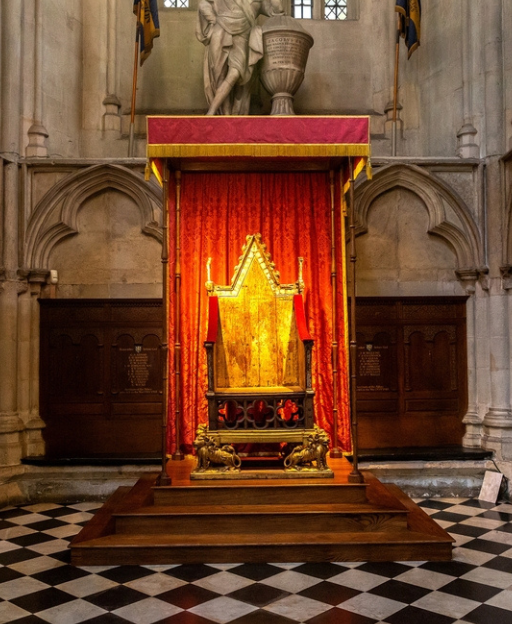
The Chair That Changed British History
The Coronation Chair was built around 1300, on the orders of King Edward I. A craftsman named Walter of Durham made it from oak and painted it gold, decorating it with gilded animals and intricate carvings.
But Edward did not commission it simply for decoration. He had just returned from Scotland carrying the country’s most sacred object: the Stone of Destiny, also known as the Stone of Scone. For centuries, this sandstone block had been used in the coronation of Scottish kings. By seizing it, Edward was sending a clear message about who now ruled whom.
The chair was built around the Stone, with a compartment beneath the seat. From that point forward, English and then British monarchs would be crowned while sitting above Scotland’s most cherished symbol of sovereignty.
It was a powerful piece of political theatre. It was also the beginning of one of the longest-running traditions in royal history.
Seven Centuries of Crownings
Since Edward II was crowned here in 1308, the chair has been used for virtually every British coronation. Henry V. Henry VIII. Elizabeth I. James I. George III. Queen Victoria. George VI. Elizabeth II.
Each time, the same ancient chair. Each time, the same ceremony stretching back to medieval England.
During the Second World War, German bombing raids threatened London’s most historic buildings. Westminster Abbey evacuated its most precious objects, and the Coronation Chair was among them. It was transported under careful escort to Gloucester Cathedral, where it stayed until the war ended.
It returned to Westminster and has remained there ever since. In May 2023, Charles III was crowned upon it — the latest monarch in an unbroken line stretching back more than 700 years.
The Stone of Scone was formally returned to Scotland in 1996. It now lives in Edinburgh Castle, but was brought back to London for the 2023 coronation, placed beneath the chair exactly as Edward I had intended. The extraordinary story of what happened to the Stone in 1950 is one of the most remarkable tales in London’s history.
The Graffiti No One Talks About
Here is the part of the Coronation Chair’s story that surprises most visitors.
For much of its long history, the chair sat in Westminster Abbey with very little protection around it. Schoolboys on educational visits would wander past it. Some reached out and touched the ancient wood. Others did rather more than that.
The chair is covered in graffiti.
Names, initials, and dates carved into the oak by visitors over the centuries. One inscription, still visible today, reads: “P. Abbott slept in this chair 5–6 July 1800.” Others date from the 1700s. Long-forgotten schoolboys, their names scratched into the holiest throne in Britain.
It is a wonderfully human detail. Amid all the ceremony and the weight of history, some boy with a penknife saw an opportunity and took it. The chair survived, the names remain, and somehow they add to the wonder of it rather than taking anything away.
The chair was placed behind glass in the 1970s to prevent further damage. The existing marks were left exactly as they are.
What the Chair Actually Looks Like
The Coronation Chair stands roughly two metres tall, including its canopy. It is made entirely of oak, now deeply worn and burnished by age. The original gilding has mostly disappeared, though traces remain in the carved details.
Four gilded lions support the base, a motif that echoes English royal heraldry from the medieval period. The seat itself is plain and low. There is no cushion when the chair is not in use. The proportions are medieval — not quite what modern eyes would expect from something so significant.
In the light of Westminster Abbey, the chair has a particular quality. It looks like what it is: something very old, very used, and very real. Not a museum piece preserved in controlled conditions, but an object that has been sat in, touched, and lived with for centuries.
What makes it so arresting is precisely that it has not been restored or polished into something pristine. The wear, the scratches, and the darkened wood are part of its story.
How to See the Coronation Chair
Westminster Abbey is open to visitors most days, though it closes on Sundays except for services. Entry is ticketed, and queues can be long in peak summer months. Booking ahead is strongly recommended.
The Coronation Chair is not always given a dedicated spotlight — it sits among the Abbey’s many extraordinary objects and monuments. Once you know what it is, though, it stops you. You are standing within arm’s reach of something that has been in continuous use for 700 years.
Few objects in any city on earth carry this weight of unbroken living history. The chair is not perfectly preserved. It is not spotless. That is precisely what makes it extraordinary.
If you are planning your trip to London, our full guide covers the best way to organise your time around the city’s major historical sites — including how to get the most from a visit to Westminster Abbey.
🇬🇧 25 Hidden Gems of London Most Tourists Never Find
From secret riverside walks to hidden Victorian tunnels, centuries-old pubs to rooftop gardens with skyline views — our free guide reveals the London most visitors never discover. Join 3,000+ London lovers who get it free.
Get Your Free London Hidden Gems Guide →Love more? Join 65,000 Ireland lovers → · Join 43,000 Scotland lovers → · Join 30,000 Italy lovers →
Free forever · Unsubscribe anytime

Subscribe Free