
London has no shortage of expensive attractions. You can pay thirty pounds for a theme park experience dressed up as history, queue for an hour to enter a room full of other tourists, and leave feeling vaguely cheated. But one of the most staggering painted ceilings in the world sits inside a free building in Greenwich, and most visitors walk straight past it.
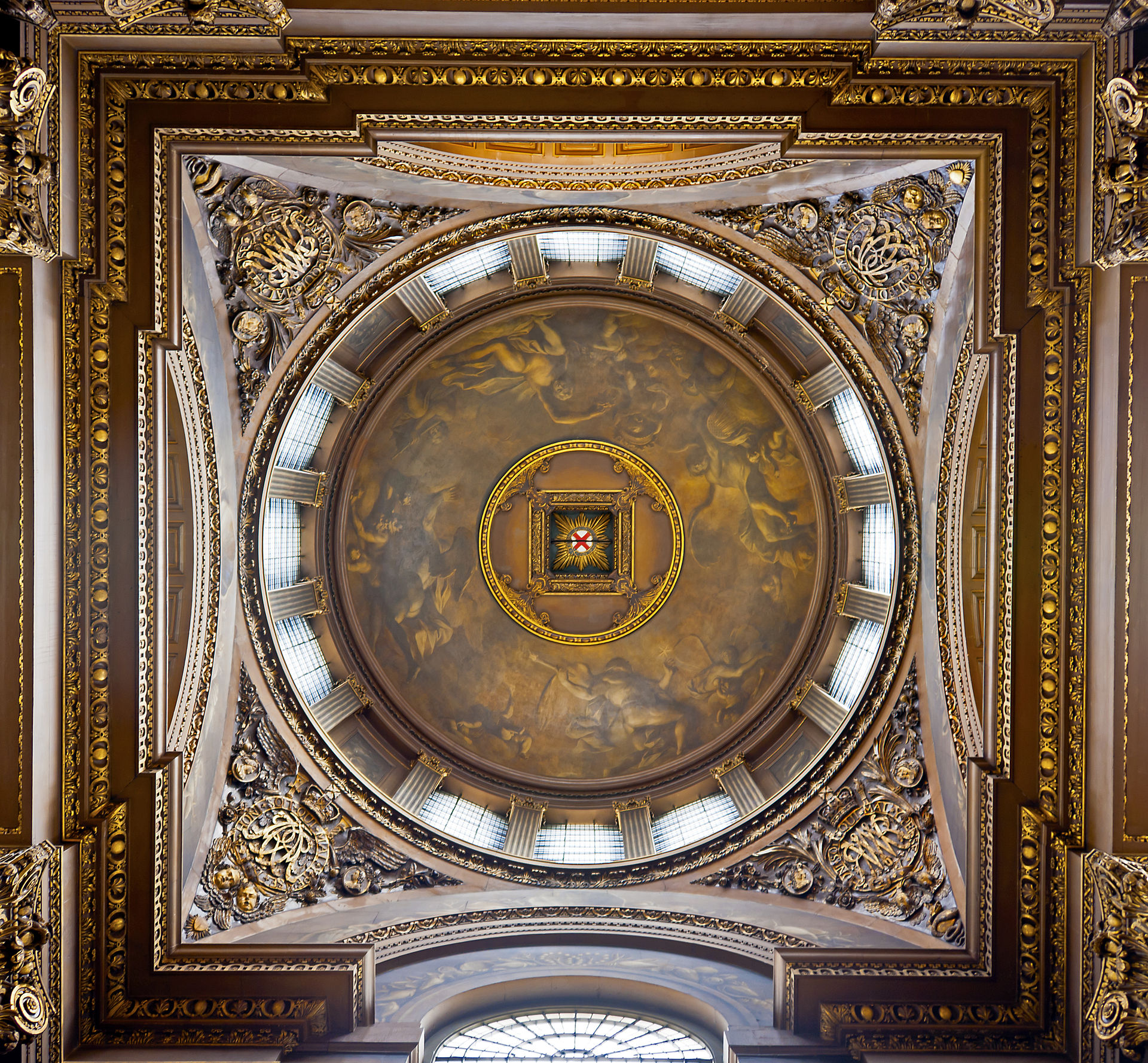
The Painted Hall at the Old Royal Naval College is not a museum exhibit or a reconstructed heritage attraction. It is a real room — magnificent, lived-in, and layered with three hundred years of history. And it costs nothing to walk through the door.
The Room That Stops You Cold
The Painted Hall is technically a dining hall. That description does it no favours whatsoever.
Walk through the doors and the room forces you to stop. The ceiling soars above you, coated in what is widely considered the greatest painted ceiling in Britain. Figures tumble across the vaulted sky in waves of gold, crimson, and deep Prussian blue. Allegorical gods and naval heroes stare down from swirling clouds. King William III and Queen Mary appear at the centrepiece, surrounded by personifications of virtue and triumph.
The room spans three connected sections — the Lower Hall, the Upper Hall, and the Vestibule — each with painted surfaces from floor to cornice. The walls carry more figures, more allegory, more detail than you can take in on a single visit. Every angle reveals something new. Most people stand in the centre and simply look up, turning slowly, trying to take it all in.
The Painted Hall is sometimes called Britain’s Sistine Chapel. It is not a careless comparison. Both are painted ceilings of overwhelming ambition inside buildings associated with institutional power. Both ask the viewer to look up and feel small in the best possible way.
One Man, Nineteen Years, and a Quiet Act of Cheek
The ceiling was painted by Sir James Thornhill between 1707 and 1726. Nineteen years. Thornhill spent nearly two decades lying on scaffolding, applying oil paint directly to a lime-plaster ceiling without modern lighting, without power tools, and without the basic safety equipment we would consider a legal minimum today.
He was paid by the square foot. The rate was not generous. As the project stretched on and the costs of maintaining himself and his assistants mounted, Thornhill found himself in difficult financial circumstances. Rather than simply ask for more money, he painted himself into the work.
He is there now, in the corner of the Lower Hall, dressed as a gentleman. He stands with one hand outstretched, pointing at the painted scene beside him. Art historians have long read the gesture as Thornhill pointing at his employers and quietly demanding additional payment. He did eventually receive a supplementary fee.
That act of wry persistence has survived three hundred years and outlasted every person who ever argued about it. Thornhill was later knighted — the first British-born painter to receive that honour. The self-portrait in the corner is his lasting joke, and it has been running since 1726.
What the Room Was Built For — and What It Witnessed
The Painted Hall was designed as a dining room for the pensioners of the Royal Hospital for Seamen. These were retired and disabled sailors of the Royal Navy, men who had given years of service and whose welfare the Crown had accepted as its responsibility.
They ate their meals beneath that ceiling every day. Porridge, salt fish, and bread, consumed in what is arguably the most lavishly decorated dining room in British history. The contrast between the austere naval life these men had lived and the grandeur surrounding them at mealtimes was not accidental. It was a statement of national gratitude, rendered in paint.
In 1806, the hall served a different and more solemn purpose. Admiral Horatio Nelson, killed at the Battle of Trafalgar the previous October, was brought here to lie in state. Thousands of Londoners queued outside the gates to pay their respects. They filed through the room beneath the painted sky, past the body of the man who had changed the course of the Napoleonic Wars.
The pensioners moved out in 1869. The Royal Naval College took over. Today the buildings house the University of Greenwich, and the Painted Hall opens to the public every day, free of charge.
The Restoration That Brought the Ceiling Back to Life
For generations, the ceiling had darkened. Layers of old varnish, candle soot, and accumulated grime had settled over Thornhill’s colours. Visitors still found it impressive — the scale alone guaranteed that — but they were seeing a muted version of what he had intended. The blues were murky. The golds had gone flat.
A major conservation project completed in 2019 changed that. Conservators worked painstakingly across three years, cleaning the painted surface a centimetre at a time using cotton swabs and specialist solvents. Each decision required careful research into what lay beneath the varnish and what the paint beneath could safely tolerate.
The result is remarkable. The ceiling visible today is the closest to Thornhill’s original intentions that anyone alive has seen. Colours that had not been visible for decades re-emerged from beneath the grime. The blues are now vivid. The gold leaf glows properly. Details that had faded into the general wash of the ceiling are crisp and legible again.
A new elevated viewing platform was installed as part of the restoration, allowing visitors to stand closer to the ceiling surface than was previously possible. Looking up from the platform, you can see individual brushstrokes. You can see exactly where Thornhill stood in 1714, in 1718, in 1726, laying colour onto plaster one section at a time.
How to Visit and What to Combine
The Painted Hall is at the Old Royal Naval College in Greenwich, on the south bank of the Thames. Entry to the Painted Hall is free, though a voluntary donation is welcomed. The hall is open daily, typically from 10am to 5pm. Check the official website before visiting, as it occasionally closes for private functions.
Getting there is simple. Take the Docklands Light Railway (DLR) to Cutty Sark for Maritime Greenwich. You will step out near the riverside, with the famous clipper ship directly visible. The gates to the Old Royal Naval College are a short walk along the waterfront.
Greenwich rewards a full day. The Greenwich Market — which has been trading since before the United States existed — is a short walk away. The National Maritime Museum, the Queen’s House, and Greenwich Park with the Royal Observatory are all within comfortable walking distance, and all free to enter.
If you are planning a visit built around London’s remarkable collection of free cultural spaces, our guide to London’s free museums covers everything available without a ticket. And for anyone building their first London itinerary, the London planning hub is the right place to start.
The Painted Hall fits naturally into a full Greenwich day, but it is also worth the journey on its own. Give yourself at least an hour. Take the new viewing platform. Look at the corner where Thornhill painted himself holding out his hand. Then look at the rest, and think about what it means that a retired sailor once ate his breakfast beneath it every morning.
There is something quietly extraordinary about that. One of the great painted spaces in Europe, used as a canteen, free to visit, and largely unknown outside the people who happen to find it.
Walk in. Look up. Take your time.
🇬🇧 25 Hidden Gems of London Most Tourists Never Find
From secret riverside walks to hidden Victorian tunnels, centuries-old pubs to rooftop gardens with skyline views — our free guide reveals the London most visitors never discover. Join 3,000+ London lovers who get it free.
Get Your Free London Hidden Gems Guide →Love more? Join 65,000 Ireland lovers → · Join 43,000 Scotland lovers → · Join 30,000 Italy lovers →
Free forever · Unsubscribe anytime
Subscribe Free