
Walk down almost any residential street in London and you are walking through history. Those rows of red brick houses with white window frames and iron railings are not just a backdrop. They are the physical record of one of the most dramatic periods in London’s story — the Victorian age, when the city doubled, then tripled in size, and had to house millions of new arrivals all at once.
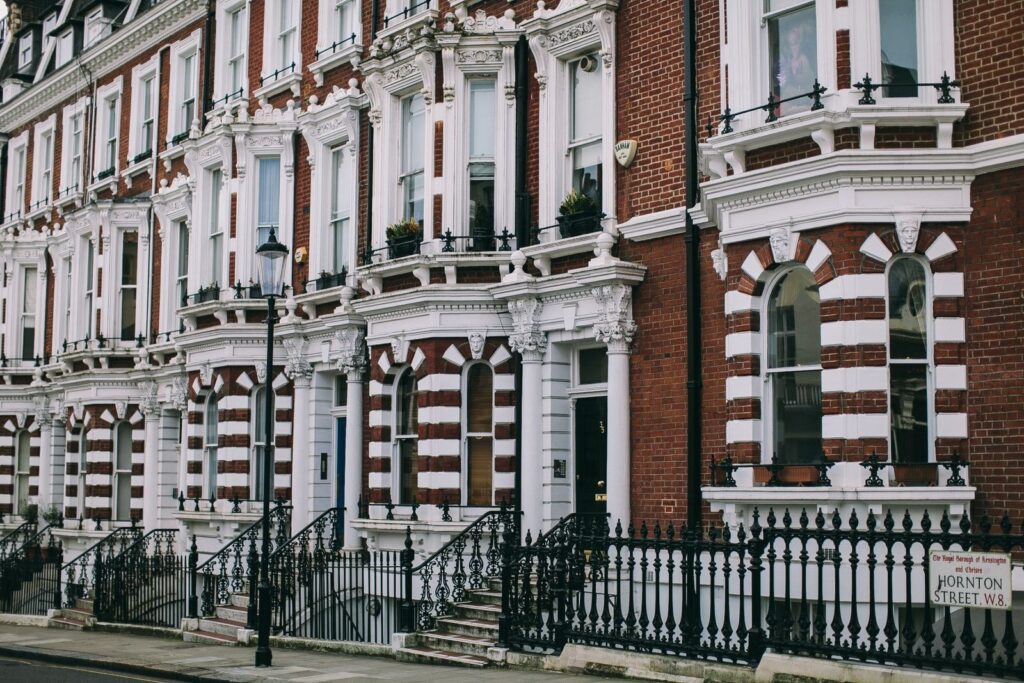
These terraced houses are everywhere. From Islington to Hackney, from Notting Hill to Battersea, they line street after street. Most visitors walk past them on the way to a museum or a pub. But if you slow down and look closely, these buildings have a remarkable amount to tell you.
London Before the Terraces
In 1837, when Queen Victoria came to the throne, London had around two million people. By the time she died in 1901, that number had grown to six and a half million. The city had to expand fast, and it did — outward in every direction.
Fields and market gardens on the edges of London were sold off, parcelled up, and handed to builders. Speculative developers — men who borrowed money to build streets of houses and hoped to sell or rent them before the debt came due — created whole new neighbourhoods almost overnight.
The result was the terraced house. It was efficient, affordable to build, and adaptable to almost any income level. A labourer could afford a two-up, two-down in Hackney. A solicitor could afford a five-storey townhouse in Kensington. Both were terraced houses, sharing walls with their neighbours, but worlds apart in their ambitions.
Who Actually Built These Streets?
The story of Victorian London’s housing boom is really a story about builders — and they were a fascinating lot.
At the top were the great speculative builders like Thomas Cubitt, who created much of Belgravia and Pimlico in the 1820s and 1830s, setting the template for what followed. Cubitt was unusual in that he employed all his own tradesmen year-round, rather than relying on seasonal labour. He kept costs down, quality up, and built an empire in the process.
Below the great builders came hundreds of smaller operators: local men who would contract to build one street, or half a street, before moving on to the next. Many of them went bankrupt. Building a street of houses meant tying up enormous capital for a year or more, and if the market turned, or a tenant could not be found, the whole enterprise could collapse.
The actual work was done by armies of craftsmen: bricklayers, plasterers, carpenters, glaziers, plumbers, and painters. Many of them moved into the houses they built, or into the same neighbourhoods. They were proud of their work, even when building at speed.
What the Details Tell You
Once you know what to look for, Victorian terraces become a kind of history lesson you can read on any street.
The coal holes. Look at the pavement in front of older terraces and you will often see small iron covers set into the stone. These are coal holes — the openings through which coal was delivered directly into the cellar, avoiding the need to carry sacks through the front door. The cast iron covers are often beautifully decorated, made by local foundries that competed for the contract.
The iron railings. Most Victorian terraces had elegant iron railings fronting the small garden or the area steps leading down to the basement. Many were removed during the Second World War for the metal drive — though historians have since questioned how much of the metal was actually used. Some railings survived, and some were reinstated in later decades. Where you see the original ironwork intact, it tells you the house has been looked after.
The basement kitchen. The wealthier the house, the more likely it was to have a basement level, reached by steps from the street below the main entrance. This was the servants’ domain: the kitchen, the scullery, the coal store. The mistress of the house might descend to give orders in the morning, but the real work happened down there, out of sight.
The fanlight. The semi-circular window above the front door — the fanlight — was not decorative. It let light into the entrance hall at a time when gas lighting was expensive and electricity had not yet arrived. Each fanlight is different: geometric patterns, sunburst designs, simple glazing bars. They are a small art form that almost nobody notices.
🏙️ Enjoying this? 3,000 London lovers get stories like this every week. Subscribe free →
The People Who Lived There
Victorian terraced streets were far more socially mixed than we might imagine.
A single street in inner London might contain a solicitor’s clerk, a piano teacher, a small shopkeeper, a skilled cabinetmaker, and a widow living off her savings — all within a few doors of each other. The houses were divided by size and quality, not by the street they were on.
Many of these residents were newcomers to London. The Victorian capital was fed by a constant stream of migrants from the countryside — from the agricultural counties of England as farming mechanised and fewer labourers were needed. It was also fed by migrants from Ireland, from Scotland, and from across Europe.
The East End, in particular, became a place where the newly arrived built communities. Huguenot weavers had been there since the late 1600s, French Protestants fleeing religious persecution who brought their silk-weaving skills to Spitalfields. Their chapel was later used by Irish Catholics, then by Jewish immigrants, and became a mosque — a single building that holds four centuries of migration history within its walls.
By the time Victoria came to the throne, the Jewish community of the East End was well established, concentrated around Petticoat Lane and Whitechapel. From the 1880s, new waves arrived from Russia and Poland, fleeing persecution. They brought their trades, their languages, their food, and their ambitions. The terraced streets absorbed them all.
American Connections to Victorian London
If your family has English roots, the chances are high that your ancestors lived in streets very much like these.
The great wave of British emigration to America took place between roughly 1820 and 1920 — precisely the Victorian and Edwardian era that built these streets. The emigrants came from the cities as much as the countryside. They came from terraced houses in Birmingham and London, Manchester and Leeds. They came because there was no land for them in England, because wages were low, because stories of cheap land in America sounded like a miracle.
When you walk down a Victorian terrace in Islington or Hackney, you are walking through the world that many of those emigrants left behind. The scale of the rooms, the layout of the kitchen, the small back garden — all of it would be recognisable to someone who crossed the Atlantic in the 1880s.
The census records make this very concrete. The Victorian censuses from 1841 to 1901 are fully digitised and searchable through Ancestry and FindMyPast. If you know a great-grandparent’s name and approximate birth year, you can frequently find the exact street and house number where they lived. You can see what their neighbours did for work, whether they had a lodger, whether a grandparent was living with them.
The Best Streets to Explore Today
London has preserved more of its Victorian housing stock than any other major city in Europe, partly through conservation areas, partly through the cost of demolishing solid Victorian brick, and partly through genuine affection.
Cloudesley Square, Islington — a quiet neighbourhood that gives you a sense of how these streets were designed as coherent communities, with a church at the centre and terraces radiating outward.
Princedale Road, Notting Hill — one of the best-preserved streets of mid-Victorian terraces in London, with original railings, decorative stucco, and enormous plane trees planted at the same time as the houses were built.
Victoria Park Road, Hackney — the grandest Victorian terraces on the edge of Victoria Park, built for the prosperous middle classes who wanted a park view. The houses are generous, with large sash windows and handsome ironwork.
Stockwell Park Road, Lambeth — a short street of unusually grand Victorian villas that survived the Second World War largely intact, offering a glimpse of what south London’s aspirational streets once looked like.
In every case, the best approach is to walk slowly and look carefully. These houses were built to be looked at as well as lived in. The Victorians believed that good architecture could improve the character of the people who lived within it, and they put that belief into every fanlight and every piece of ironwork they could afford.
Frequently Asked Questions
Why do so many London streets look the same?
Because they were built by speculative developers working to standard plans and building regulations. The uniformity was deliberate — it made construction cheaper and created a sense of order that the Victorians valued. What looks the same from a distance reveals individual details when you look closely.
Where can I see preserved Victorian interiors in London?
The Museum of the Home in Hoxton (formerly the Geffrye Museum) preserves period rooms from the 1600s to the present day, including two Victorian parlours. It is one of the best places in London to understand how these houses actually felt from the inside.
Can I trace my English ancestry to a specific Victorian London street?
Often, yes. The Victorian censuses from 1841 to 1901 are fully digitised and searchable through Ancestry and FindMyPast. If you know a great-grandparent’s name and approximate birth year, you can frequently find the exact street and house number where they lived.
🇬🇧 25 London Places Most Visitors Miss
From secret riverside walks to hidden Victorian tunnels, centuries-old pubs to rooftop gardens with skyline views — our free guide reveals the London most visitors never discover. Join 3,000+ London lovers who get it free.
Get Your Free 25-Places Guide →Already subscribed? Download your free London guide (PDF)
Free forever · Unsubscribe anytime
Subscribe Free