
If your surname is Smith, Taylor, Baker, or something more unusual like Aldgate or Threadneedle, there is a good chance its story starts somewhere in London. English surnames are among the oldest in the English-speaking world, and many trace directly to the streets, trades, and parishes of medieval London. For American families with English roots, understanding those names is often the first step to finding where your ancestors actually lived.
This guide walks through how English surnames developed, what your family name might tell you about your London ancestors, and exactly where to start searching.
How English Surnames Started
English surnames became widespread between roughly 1066 and 1400. Before the Norman Conquest, most people had just one name. The Normans brought a different system — family names passed down through generations — and slowly, this spread across England.
In cities like London, surnames developed faster than in the countryside. When thousands of people lived in close quarters, names became practical. If three men named John lived on the same street, they needed something to tell them apart. So they became John the Smith, John from Aldgate, and John son of William.
Over generations, “John the Smith” became John Smith. “John from Aldgate” became John Aldgate. And “John son of William” became John Williams. The city itself stamped its identity onto the people who lived there — and onto the family names they carried across the world.
The Four Types of English Surnames
Most English surnames fall into one of four categories. Understanding which type your name belongs to is the first step toward tracing where it came from.
Occupational Surnames
These come from what your ancestor did for a living. London was a city of trades, and those trades became last names. The medieval city had strict guild systems — if your family worked in a trade, they likely belonged to a guild that kept records for generations.
- Smith: blacksmith or metalworker. One of the most common surnames in both England and America.
- Taylor: a maker of clothes. Tailors were vital to London life — the Merchant Taylors’ Company, one of the oldest London guilds, still exists today.
- Baker: someone who baked bread, often for an entire neighbourhood from a shared oven.
- Cooper: a maker of barrels and casks. Crucial in a city that ran on ale and imported wine.
- Fletcher: an arrow-maker. A common London trade during the medieval period when archery was central to the military.
- Chandler: a candle-maker or seller. London’s streets and homes were lit entirely by their work.
- Thatcher: someone who thatched roofs. One of London’s most essential building trades before the Great Fire of 1666.
- Mason: a stoneworker. Many of London’s churches, halls, and bridges were built by men whose descendants carry this name today.
- Weaver: a maker of cloth. Particularly associated with Spitalfields in East London, where weaving became a major industry.
- Turner: someone who worked a lathe to make wooden or metal objects. A skilled trade in any city.
If your surname is any of these, your family almost certainly practised that trade in England — and if they came from a city, London is one of the most likely origins.
Locational Surnames
These come from places — the village, district, or landscape feature where your ancestor lived. Some locational surnames point directly to London neighbourhoods.
- Aldgate: from Aldgate, one of the ancient gates in London’s Roman wall, still a district in East London today.
- Moorgate: from Moorgate, another Roman-era gate near the old Moorfields marshes north of the city.
- Holborn: from the Holborn area, one of London’s most ancient districts, recorded since the 12th century.
- Stratford: from Stratford, an old settlement east of the city where a Roman road crossed the River Lea.
- Islington: from the village of Islington, now absorbed into inner north London but once a separate settlement.
- Bermondsey: from Bermondsey, a district south of the Thames with records stretching to the 11th century.
Other locational surnames come from the broader English landscape — fields, rivers, and hills — and these can point to villages outside London where your ancestors may have originated before moving to the city. Names like Hill, Wood, Brook, Field, and Heath all tell you something about the landscape your family came from.
🏙️ Enjoying this? 3,000 London lovers get stories like this every week. Subscribe free →
Patronymic Surnames
These come from a father’s first name. The most common English pattern adds “son” to the end.
- Johnson: son of John — one of the most popular Christian names in medieval England.
- Williams: son of William. The name William came with the Normans in 1066 and became enormously popular.
- Richardson: son of Richard, another Norman-origin name that spread widely after the Conquest.
- Harrison: son of Harry, a common medieval form of Henry.
- Thompson: son of Thomas.
- Wilson: son of Will, a shortened form of William. One of the most common surnames in both England and America.
- Davies / Davis: son of David, particularly common in Wales and the English border counties.
The patronymic surnames became so widespread because William, John, Thomas, and Richard were the four most popular male names in medieval England — largely thanks to the influence of the Church and the Norman kings.
Physical Description Surnames
These come from physical characteristics — hair colour, height, complexion, or personality traits.
- White, Black, Brown, Reed: all relate to hair or complexion.
- Long, Short, Little, Small: based on height.
- Strong, Hardy, Stout: physical strength or endurance.
- Swift, Sharp, Keen: speed, alertness, or intelligence.
- Young, Elder, Senior: age relative to another family member with the same first name.
Norman French Surnames and London
After 1066, William the Conqueror and his Norman lords brought a wave of French-origin names to England. Many of these concentrated in London, where the Normans built their greatest power. If your surname sounds more French than English, there is a good chance a Norman ancestor arrived after the Conquest and eventually settled in or near the city.
- Beaumont: from the French “beau mont,” meaning beautiful hill.
- Montague: from “mont aigu,” meaning pointed hill. The Montague family were prominent in medieval London’s political life.
- Clare: from the town of Clare in Normandy — one of the great Norman families in England.
- Percy: from Percy-en-Auge in Normandy. The Percy family held enormous power in northern England for centuries.
- Warren: from the town of Varenne in Normandy. The de Warenne family owned lands around London and the south-east.
- Mortimer: from Mortemer in Normandy. Roger de Mortimer was one of the most powerful men in 14th-century England.
Many Norman surnames dropped the “de” prefix over the centuries, leaving names like Clare, Percy, and Warren that look entirely English today but carry their French origins within them.
St Pancras Old Church: Where London Ancestry Begins
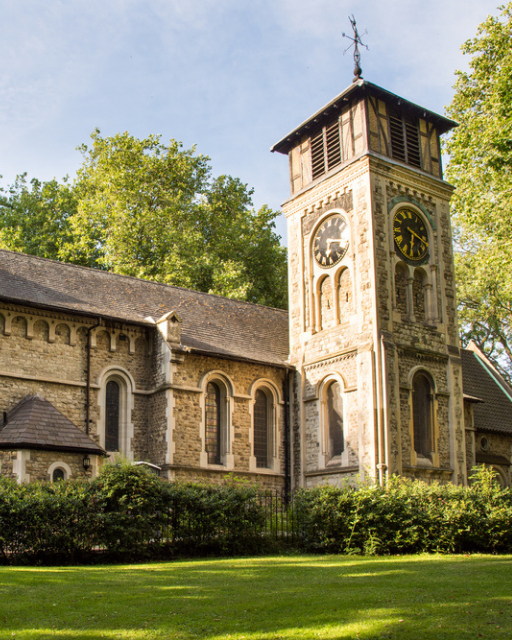
If you visit London to research your family history, St Pancras Old Church belongs on your itinerary. Standing in a quiet churchyard near King’s Cross, this is one of the oldest sites of Christian worship in England. The current building dates largely from the 13th and 14th centuries, but the site’s history stretches back to Roman times.
The churchyard contains the Hardy Tree — a distinctive ash tree with gravestones arranged around its roots — placed there in the 1860s when a young Thomas Hardy worked as an architect helping clear graves to make way for the Midland Railway. The tree has grown around the stones ever since.
More importantly for ancestry researchers, St Pancras has some of the oldest surviving parish records in London. Walking through this churchyard connects you to layers of English history that most tourists never encounter. It sits just north of central London, easily reached from King’s Cross station, and entrance is free.
Where to Search London Parish Records
Before civil registration began in 1837, the Church of England recorded births, marriages, and deaths for every parish in the country. London had hundreds of parishes, each keeping its own register. These records — many now digitised — can place a specific family on a specific street in a specific year.
The National Archives at Kew
The National Archives hold millions of documents relating to English families, including wills, court records, census returns, and military service papers. Many can be accessed online at nationalarchives.gov.uk, and the physical archives in Richmond are open to the public with free registration.
London Metropolitan Archives
Located in Clerkenwell, the London Metropolitan Archives holds records specific to London’s historic parishes, going back in some cases to the 16th century. Their online catalogue at cityoflondon.gov.uk is a good starting point for identifying which records survive for your family’s area.
FindMyPast and Ancestry
Both platforms hold digitised parish records for most of London’s historic parishes, along with census returns going back to 1841. A subscription gives access to tens of millions of records that can be searched from home before you plan any visit to London.
How to Start Your London Ancestry Search
Start by writing down everything you already know about your English-origin family members — names, birth years, and the places they were living when they arrived in America. Work backward from what you know rather than forward from a guess.
Search digitised parish records on FindMyPast or Ancestry before booking any travel. Confirm that records survive for your family’s time period and location. London’s Great Fire of 1666 destroyed records for many central parishes — if your family was in the City of London before that date, some records will be lost.
Use the National Archives’ free Discovery catalogue at discovery.nationalarchives.gov.uk to identify relevant document collections. Contact the London Metropolitan Archives in advance if you plan to visit, as some documents require advance ordering.
And remember: the connection between a surname and a place is often closer than it first appears. A Taylor in Pennsylvania may have had a great-great-grandparent who moved to America from a London street where that name began — on Threadneedle Street, or in a Cheapside workshop, or in the shadow of a medieval guild hall that still stands today.
🏛️ Trace Your English & British Ancestry — Free Step-by-Step Guide
Over 50 million Americans have British or English ancestry — is yours one of them? Our free guide walks you through every record, archive, and DNA database to trace your family back to the village they left behind.
Claim Your Free English Ancestry Guide →Already subscribed? Download your free London guide (PDF)
Love more? Join 64,000 Ireland lovers → · Join 43,000 Scotland lovers → · Join 30,000 Italy lovers →
Free forever · One email per week · Unsubscribe anytime