
Ask a Londoner what the city’s definitive meal is and you’ll get three different answers depending on who you ask, where they grew up, and what time of day it is. Fish and chips, a Sunday roast, and a full English breakfast have all made their case for decades. Each one has history behind it, a loyal following, and a strong argument for being the meal that best defines what eating in London actually means.
This is not a simple question. All three dishes are genuinely London — eaten everywhere from East End caffs to West End pubs to neighbourhood restaurants. But only one of them can claim the top spot. Here’s the case for each, along with where to find the best versions in the city.
Want more London food guides, hidden gems, and neighbourhood tips in your inbox? Subscribe to the Love London newsletter — it’s free.
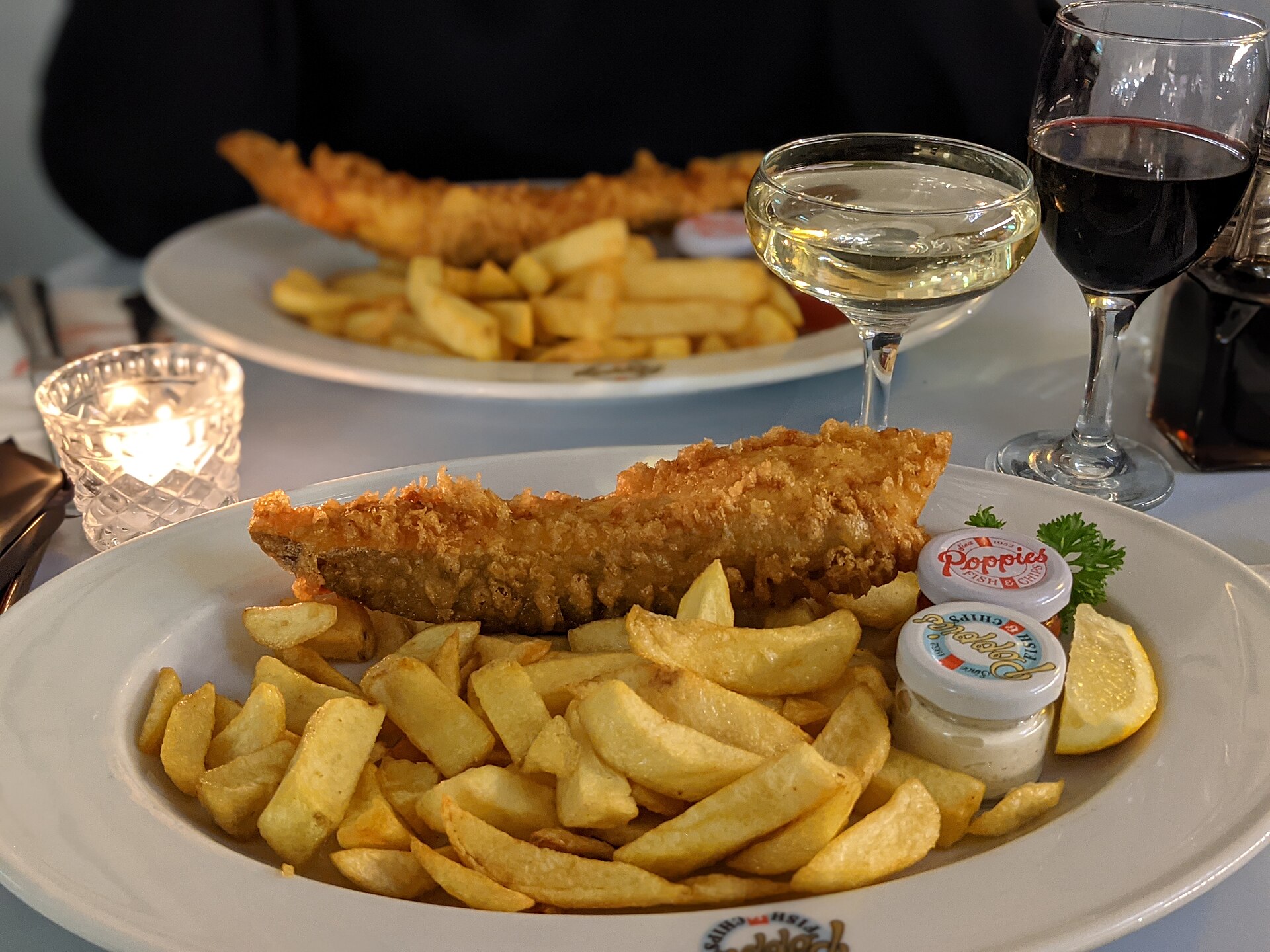
Fish and Chips: London’s Street Food Classic
Fish and chips has been a London staple since the 1860s. The dish is widely credited to Joseph Malin, who opened what is believed to be the first fish and chip shop in London’s East End around 1860. From that point on, it spread rapidly across working-class London as an affordable, filling meal that could be eaten on the go.
The dish is simple: battered cod or haddock, deep fried until golden, served with thick-cut chips and a choice of salt, vinegar, or mushy peas. In London, the traditional “chippy” is still very much alive, though the city also has upmarket versions that charge considerably more for the same idea.
What makes fish and chips feel London is accessibility. You can get a decent portion for under a tenner, eat it from the paper on a park bench, or sit down at a proper restaurant version. It requires no commitment, no booking, and no special occasion. It is the meal that London hands you when you need something fast and satisfying.
The fish matters enormously. Most chippies in London use cod, which has a mild, flaky texture that works well under batter. Haddock, more common in the north of England, has a slightly firmer bite and a stronger flavour. In London, cod is the default, and most locals would not have it any other way.
Best spots in London: Poppies in Spitalfields or Camden, Rock & Sole Plaice in Covent Garden (London’s oldest surviving chippy), and Toff’s in Muswell Hill are all worth visiting. The Golden Hind in Marylebone has been serving the same style since 1914.
The Sunday Roast: London’s Weekly Ritual
The Sunday roast is not just a meal — it is an event. Every Sunday, across every borough in London, pubs and restaurants fill with people settling in for a couple of hours with a plate piled with roasted meat, roast potatoes, Yorkshire pudding, seasonal vegetables, and gravy. It is the meal that most Londoners count as their favourite, even if they cannot be bothered to cook it themselves.
The tradition goes back to the Middle Ages, when families would put a joint of meat in the oven before heading to church, returning home to a cooked meal. By the 18th and 19th centuries, the Sunday roast had become embedded in British culture as the week’s main meal — the one occasion when the whole family gathered around the table.
In modern London, the pub roast is the dominant form. Choices typically include beef, lamb, chicken, pork, or a nut roast for vegetarians. The quality of the roast potatoes is non-negotiable — they should be crisp on the outside and fluffy inside. Yorkshire puddings, despite the name, appear on Sunday roast plates across England regardless of which meat is being served.
What sets the Sunday roast apart from the other two dishes is its social weight. Fish and chips is eaten alone or with one other person. A full English is a solo morning ritual. The roast is a group occasion — a meal that requires a table, time, and company. That social dimension gives it a different status in London life.
Best spots in London: The Harwood Arms in Fulham holds a Michelin star and does one of the best Sunday roasts in the city. The Eagle in Clerkenwell, The Princess of Shoreditch, and The Canton Arms in Stockwell are all reliable choices. For a classic neighbourhood pub roast, book ahead — good ones fill up by 11am.
Love London’s food scene and want to know where to eat, what to do, and where locals actually go? Join thousands of readers in the free Love London newsletter.
The Full English Breakfast: London’s Morning Institution
The full English — also called a fry-up — is the morning meal that London does better than anywhere else. Bacon, fried or scrambled eggs, sausages, baked beans, grilled tomatoes, mushrooms, black pudding, and toast. In some caffs, you will also get hash browns and a mug of builder’s tea strong enough to stand a spoon in.
The full English became popular in the Victorian era as a morning meal for the working class, designed to fuel a long day of physical work. The London “caff” — short for café, but bearing little resemblance to a French café — became its natural home. These are no-nonsense places with laminated menus, plastic sauce bottles, and staff who have been there since before you were born.
The quality of a full English depends almost entirely on the quality of its components. Cheap sausages ruin it. Overcooked eggs make it disappointing. A good caff takes its ingredients seriously even when the decor is minimal. The best full Englishes in London are not in fancy restaurants — they are in the kind of places that have been serving the same breakfast for 30 years.
For visitors, the full English serves a practical purpose: it is the meal that sets you up for a full day of sightseeing. Eat one before 9am and you will not need to think about lunch. That combination of value, sustenance, and simplicity is part of what makes it feel so distinctly London.
Best spots in London: E. Pellicci in Bethnal Green has been serving full Englishes since 1900 and is a Grade II listed building. The Regency Café in Westminster is another London institution with a counter service and a proper fry-up. For something a step up, Duck & Waffle in the City serves breakfast around the clock on the 40th floor of Heron Tower.
Which Dish Feels Most London?
All three dishes are genuinely London meals — each one has a real claim, real history, and real local passion behind it. But if forced to choose one, the full English breakfast probably edges it — and here is why.
Fish and chips is a national dish. You will find excellent versions in Bristol, Leeds, Edinburgh, and Cardiff. It is not unique to London, even if London helped create it. The Sunday roast is the same — it belongs to England broadly, not just to the capital.
The full English, by contrast, has its most recognisable form here. The London caff is a specific institution — the kind of place that predates chain coffee shops, survives gentrification in pockets all over the city, and keeps feeding the same mix of builders, office workers, night-shift nurses, and tourists. The full English is also the meal most connected to working London, to the city’s identity as a place built on graft, early mornings, and practical thinking.
That said, you would be doing yourself a disservice if you visited London and only tried one of the three. A weekend in the capital is enough time to eat a proper fry-up on Saturday morning, a Sunday roast in a pub the following day, and fish and chips whenever hunger strikes in between.
Where to Start If You Only Have One Meal
If you have one morning free, go to a proper caff before 9am and order the full English with tea. If you have a Sunday afternoon, book a table at a pub with a good roast and plan to spend a couple of hours there. And if you are wandering around after a long day and need something quick, find a chippy with a queue outside — the queue is usually a reliable sign.
All three meals are inexpensive compared to most London restaurant food. A full English rarely costs more than £12. A pub roast runs between £15 and £25 depending on the pub. Fish and chips can be had for under a tenner if you are not being precious about where you eat them.
London’s food scene gets a lot of attention for its international restaurants, its Michelin stars, its street food markets, and its ever-changing trends. But these three dishes have been here longer than any trend, and they will still be here when the next wave of restaurant openings has come and gone. They are London’s food in the same way that the Tube is London’s transport — imperfect, familiar, and essential.
Photo credit: Platdujour via Wikimedia Commons (CC BY-SA 4.0)
Get the best of London delivered to your inbox every week — restaurants, history, hidden spots, and what’s on. Sign up free to the Love London newsletter.