
Most cities inspire writers. London made Dickens.
The fog-wrapped streets, the debtors’ prisons, the criminal rookeries, the grand courts of law where cases dragged on for decades — Charles Dickens didn’t invent these places. He walked them, worked in them, and in some cases suffered through them. Every address in his novels had a real counterpart. Every dark corner came from memory.
Today, more of Dickens’ London survives than most visitors realise. A prison wall stands in Southwark. A 16th-century pub in Hampstead still pours pints. The very house where he wrote Oliver Twist opens its doors each morning to anyone who wants to walk through its rooms.
This is that London.
🏙️ Enjoying this? 3,000 London lovers get stories like this every week. Subscribe free →
The Marshalsea: The Prison That Shaped Everything
In February 1824, police arrested John Dickens — Charles’s father — for debt and took him to the Marshalsea Prison in Southwark. He owed £40 to a baker. Charles was twelve years old.
The family moved in with John Dickens, as families commonly did in debtors’ prisons. Charles did not. He took lodgings nearby and walked each day to Warren’s Blacking Factory near the Strand, where he pasted labels onto pots of boot blacking for six shillings a week.
He never forgot it.
The Marshalsea became Little Dorrit’s entire world in the novel of the same name. It shaped David Copperfield’s childhood, and its shadow falls across half a dozen other works. Dickens called it the “ruinous place,” and he described it with the accuracy of someone who had lived in its shadow.
Workers demolished the prison in the 1870s, but one long brick wall survived. You’ll find it today in Southwark, just off Borough High Street, down a passageway called Angel Place. A small plaque explains what stood here. The church of St George the Martyr stands close by — Little Dorrit’s church in the novel, where she was married and where she slept as a child when locked out after dark.
Stand at that wall and you stand in the place that made Dickens who he was.
Where to go: Angel Place, Borough, SE1 1QD. Open access at all times. The nearby George Inn on Borough High Street — a surviving galleried coaching inn and the last of its kind in London — features in Little Dorrit and would have been familiar to Dickens throughout his life.
The Spaniards Inn: Dickens at the Pub
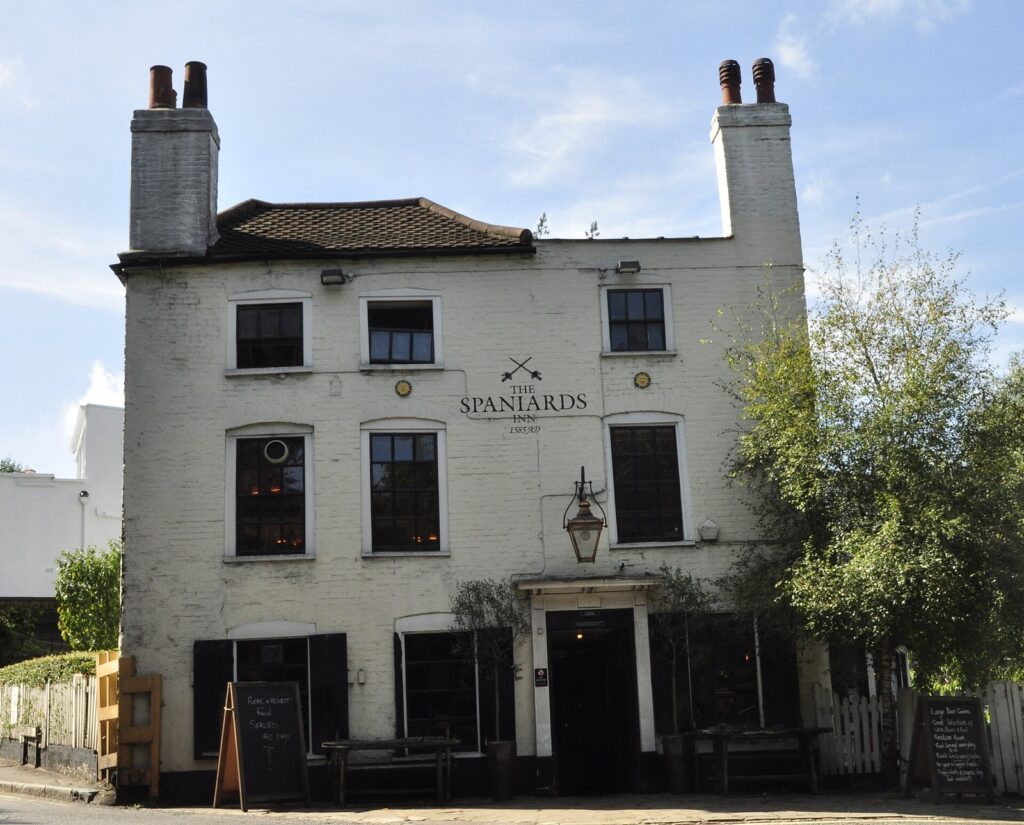
The Spaniards Inn has stood on the edge of Hampstead Heath since around 1585. The road was barely wide enough for two coaches to pass when the pub was built, and the tollhouse opposite forced every traveller to slow down.
Dickens made good use of it.
In The Pickwick Papers, Mrs Bardell and her friends travel to the Spaniards for tea on the heath. The scene is comic, warm, and entirely specific — Dickens wrote it knowing exactly what the place looked like, because he drank there regularly throughout his life.
He was not alone in that habit. John Keats walked to the Spaniards from his home nearby. Lord Byron came. Percy Shelley came. The highwayman Dick Turpin supposedly hid out there, though the literary connections carry more weight than the criminal ones.
The pub survives in almost the same form it held in Dickens’ time. Low beams, old fireplaces, a garden that looks out over the heath. The same road still narrows at the tollhouse. If you stand outside on a grey afternoon and look at the building, it takes very little imagination to see the coaches pulling up.
Where to go: The Spaniards Inn, Spaniards Road, Hampstead, NW3 7JJ. Take the Northern Line to Hampstead and walk, or take the 210 bus from Finchley Road station. The walk across the heath from the tube takes about twenty minutes.
The City Dickens Walked: Holborn and the Inns of Court
Dickens arrived in London as a teenager and spent his twenties learning it on foot. He covered twenty miles in a day without effort. That physical knowledge of the streets pours out of every novel he wrote.
He worked as a legal clerk at the offices of Ellis and Blackmore in Grey’s Inn, one of London’s four ancient Inns of Court. He hated the law but absorbed it completely. When he came to write Bleak House, the interminable chancery case of Jarndyce and Jarndyce came from someone who had watched the machinery grind up real people from the inside.
Lincoln’s Inn, just south of Grey’s Inn, features directly in Bleak House as the home of the Jarndyce case. The court itself, the buildings around it, the perpetual paper and dust — Dickens described them from memory. Visitors can walk through Lincoln’s Inn today during weekday morning hours; the gardens are open to the public.
Chancery Lane connects the two inns. Ely Place, just off Holborn Circus, leads to St Etheldreda’s Church, one of only two surviving buildings from the reign of Edward I. Dickens knew this street as well as his own name.
🏙️ Enjoying this? 3,000 London lovers get stories like this every week. Subscribe free →
Where to go: Grey’s Inn, WC1R 5ET (open to visitors on weekday afternoons). Lincoln’s Inn, WC2A 3TL (gardens open weekday mornings, Monday to Friday).
The Charles Dickens Museum: His London Home
Between 1837 and 1839, Dickens lived at 48 Doughty Street in Holborn. He was twenty-five when he moved in and already famous — The Pickwick Papers had made him a sensation across England and America. In these rooms he finished that book, wrote Oliver Twist in full, completed Nicholas Nickleby, and began The Old Curiosity Shop.
The house is now the Charles Dickens Museum, and it’s the only surviving London home of Dickens. Developers demolished the others or fire destroyed them. The Dickens Fellowship saved this one in 1925 and opened it to the public the following year.
Inside, the rooms hold the shape of the years the family spent there. The study where he wrote, the drawing room where Catherine Dickens received guests, the dining room where the household gathered. Original manuscripts, letters, and personal objects fill the display cases throughout. The kitchen downstairs gives a sense of how a prosperous Victorian household actually ran day to day.
It’s a small, personal museum — nothing overwhelming, nothing designed to impress. Just the rooms of a young man in a hurry, writing at speed, turning out pages that would outlast everything around them.
Where to go: Charles Dickens Museum, 48 Doughty Street, WC1N 2LX. Open Tuesday to Sunday, 10am to 5pm. An admission charge applies. Book in advance during the summer months. Nearest tube stations are Russell Square and Chancery Lane.
Oliver’s London: Saffron Hill and the Rookeries
Oliver Twist belongs to one of the most dangerous parts of Victorian London — the rookeries of Holborn and Clerkenwell. Dickens placed Fagin’s den on Field Lane, a real street that ran through the slum district of Saffron Hill. Receivers of stolen goods, second-hand clothes dealers, and thieves filled the lane. Dickens walked through it and described exactly what he saw.
Engineers demolished Field Lane in the 1840s to make way for the Farringdon Road. Saffron Hill still exists as a street, running between Charterhouse Street and Holborn Viaduct. The area looks entirely different now, but the name persists on every map.
Further south in Bermondsey, Bill Sikes meets his end on Jacob’s Island — a real district of rotting houses and filthy ditches where the River Neckinger once ran. When Dickens described it, the mayor of Southwark told the House of Commons the place did not exist. Dickens was furious and said so in the preface to a later edition, pointing out that Jacob’s Island was entirely real and that the denial only made it worse.
Authorities cleared and improved Jacob’s Island in the 1850s. Today it’s a fashionable neighbourhood of converted warehouses near Shad Thames, just east of Tower Bridge. The contrast with what Dickens described could not be more complete.
Where to go: Walk down Saffron Hill, EC1N, and continue to Holborn Viaduct. For Jacob’s Island, head to Shad Thames, SE1, and walk along the riverside between Tower Bridge and Bermondsey.
How to Walk in Dickens’ London Today
The Dickens Fellowship organises guided walks through his London several times a year. The Charles Dickens Museum sells self-guided walk maps at the front desk and offers downloadable versions from its website.
For a self-guided route, start at the museum on Doughty Street, walk south through Lincoln’s Inn to the Strand, cross to Southwark via London Bridge — the bridge Dickens crossed constantly — find the Marshalsea wall on Angel Place, then return via Borough Market and the George Inn. The whole route covers about four miles and takes three to four hours at a comfortable pace.
London has changed enormously since Dickens walked it. The blacking factory by the Strand is long gone. The Marshalsea Prison is a wall and a plaque. The rookeries of Holborn have disappeared under offices and roads. But the Spaniards Inn still stands on Hampstead Heath, the museum on Doughty Street still opens its doors each morning, and the names on the street signs — Saffron Hill, Jacob’s Island, Angel Place — still mark where Dickens put his characters through their lives.
That’s enough for a very good walk.
Join 3,000+ London Lovers
Every week, get London’s hidden history, heritage walks, and stories from the city’s remarkable past — straight to your inbox.
Subscribe free — enter your email:
Already subscribed? Download your free London guide (PDF)
Free forever · One email per week · Unsubscribe anytime