
On the evening of 7 September 1940, more than 300 German bombers crossed the Channel and turned London’s East End into an inferno. Docklands burned for hours. The Thames glowed red. Families sheltered under stairs, in church halls, and in Underground stations while the city shook above them.
That night marked the start of the London Blitz — 57 consecutive nights of German bombing followed by sporadic raids that stretched into May 1941. By the end, around 43,000 British civilians had died and more than one million London homes lay damaged or destroyed. Yet the city refused to break. Understanding the Blitz tells you more about London — and about the British character — than almost anything else.
This guide covers what actually happened, how Londoners survived it, and where you can walk in their footsteps today.
What Was the Blitz?
Hitler launched the Blitz — from the German word Blitzkrieg, meaning lightning war — to break civilian morale and force Britain into surrender. The Luftwaffe targeted London first, then spread to cities across Britain: Coventry, Liverpool, Bristol, Southampton and others all suffered devastating raids.
London bore the heaviest weight. German bombers struck the city on 57 consecutive nights between September 1940 and November 1940. The raids killed more than 20,000 Londoners and flattened whole streets in the East End, Southwark, and the City. A further 23,000 people across Britain died in raids on other cities.
The Blitz did not break British morale. It hardened it. Churchill toured bomb-damaged streets. The King and Queen refused to leave Buckingham Palace, which German bombs struck nine times. Newspapers ran headlines about ordinary people carrying on. The phrase “London can take it” — used in a famous wartime short film — captured a city that bent but would not break.
How Londoners Survived
When the sirens sounded, Londoners had three choices: an Anderson shelter in the garden, a Morrison shelter inside the house, or the London Underground.
Around 170,000 people sheltered nightly in Tube stations at the height of the Blitz. They brought blankets, food, and books. Station platforms filled from around 4pm. Families staked out their regular spots. Children slept on the tracks (switched off at night). The shelters became makeshift communities — complete with singing, card games, and arguments over space.
Anderson shelters — corrugated steel half-buried in the garden — protected around 40 percent of London households. They worked well against anything except a direct hit. Morrison shelters, heavy steel cage tables placed indoors, protected people who had no garden at all.
The government also organised an evacuation of children from London to the countryside. More than one million children left the city between 1939 and 1940, many of them sent to live with strangers in rural England, Scotland, and Wales.
🏙️ Enjoying this? 3,000 London lovers get stories like this every week. Subscribe free →
Churchill War Rooms: The Bunker That Ran the War
From a basement below Whitehall, Winston Churchill and his Cabinet directed the British war effort. They called the bunker the Cabinet War Rooms. Churchill slept there on some of the worst bombing nights, though he spent most nights at 10 Downing Street or at Chequers in the countryside.
The rooms closed on 16 August 1945 — the day after Japan surrendered. Staff simply walked out and left everything in place. Today the Imperial War Museum runs the site as the Churchill War Rooms museum. You can walk into the Map Room, where officers tracked Allied forces around the world, and see the desk where Churchill worked, the phones that connected him to world leaders, and the plain iron bed where he slept.
The Churchill Museum, also in the complex, covers his entire life through exhibits, documents, and an interactive table that draws on thousands of archival sources. This is one of London’s most absorbing museums — visitors often spend three hours inside.
Visiting: Churchill War Rooms, Clive Steps, King Charles Street, London SW1A 2AQ. Open daily 9:30am–6pm. The entrance stands near Westminster and St James’s Park Underground stations.
St Paul’s Cathedral: The Symbol of Survival
On the night of 29 December 1940, the Luftwaffe launched one of the most destructive raids of the entire Blitz. The bombers targeted the City of London, dropping incendiary bombs that started hundreds of fires. The Thames ran so low at ebb tide that fire crews couldn’t draw enough water to fight them.
Photographer Herbert Mason climbed to a high vantage point and took a photograph that would define the Blitz for generations: St Paul’s Cathedral rising above billowing smoke, its dome intact while the city burned around it.
The cathedral survived largely because Churchill personally ordered it protected. Fire watchers stationed on the roof worked through the night to push incendiary bombs off the stone before they could ignite. A bomb did pierce the dome and fall onto the cathedral floor — but failed to explode.
Inside St Paul’s today, the crypt holds memorials to those who died during the Second World War, including the American Chapel — a gift from the American people to Britain, honouring the 28,000 American servicemen and women based in Britain who died in the war. For American visitors in particular, this chapel carries great meaning.
St Dunstan-in-the-East: A Blitz Ruin Left as a Garden
Not every bombed church could be rebuilt. After the Blitz, the City of London stood with dozens of ruined church shells. Some got demolished. Others became car parks. A few the city chose to preserve as living memorials.
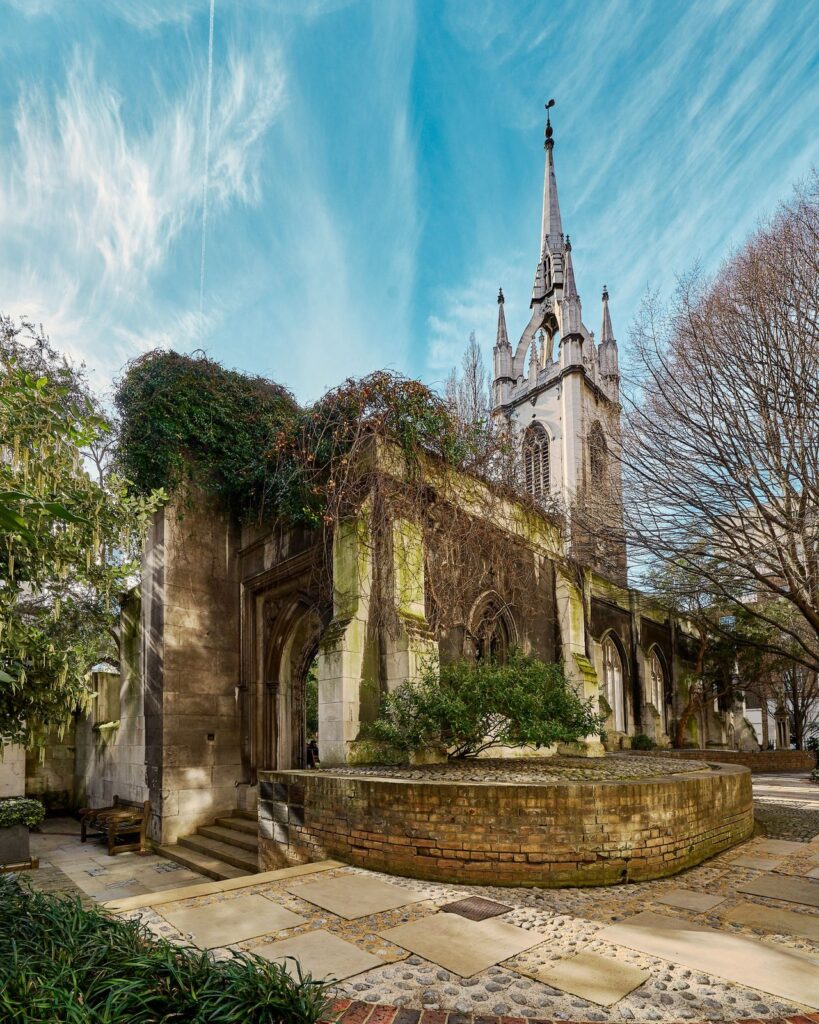
St Dunstan-in-the-East tells that story better than anywhere else. Christopher Wren built the church’s distinctive tower and steeple after the Great Fire of 1666 — the same fire that destroyed an earlier medieval building on the site. German bombs gutted the church in 1941. The outer walls and Wren’s steeple survived.
The City of London converted the ruin into a public garden in 1967. Today ivy climbs the stone arches. Trees grow inside what was once the nave. You can sit on benches in the roofless shell and look up through medieval Gothic windows at the sky. The garden stays quiet even on busy City weekdays — most office workers walk past without knowing it exists.
Find it at St Dunstan’s Hill, London EC3R 5DD, a short walk from Monument station. No admission charge. Open daily during daylight hours.
The Imperial War Museum
The Imperial War Museum occupies a Victorian building in Lambeth — originally built as a hospital for people suffering mental illness, later repurposed as one of Britain’s most important museums of conflict. Its First World War galleries include a reconstructed trench. Its Holocaust galleries are among the most moving exhibits in Europe.
The A Family in Wartime exhibition takes visitors inside the story of a single London family — the Allpress family of Stockwell — through six years of war. It uses their own photographs, letters, and possessions to show what the Blitz actually looked and felt like from ground level. Children who visited the exhibition with school groups have said it made the war feel real for the first time.
Visiting: Imperial War Museum, Lambeth Road, London SE1 6HZ. Free admission to the main collection. Open daily 10am–6pm. Lambeth North or Elephant and Castle stations are the nearest Underground stops.
Other WWII Sites Worth Visiting
London holds more WWII history than most visitors realise. A short walk from Parliament, the Cenotaph on Whitehall serves as Britain’s national memorial to war dead. Wreaths cover its base throughout November. Nearby, Horse Guards Parade saw military formations and wartime ceremonies throughout the conflict.
In the East End — the area that suffered most severely in September 1940 — the Museum of London Docklands covers the history of the area including the Blitz and the rebuilding of the docks. The area itself changed beyond recognition after the war, with postwar housing replacing streets wiped out by German bombs.
Bethnal Green Underground station, on the Central line, became the site of Britain’s worst civilian disaster of the war. On 3 March 1943, a crowd rushing into the shelter after an alert (not a bombing raid) panicked on the staircase. One hundred and seventy-three people died in the crush. A memorial outside the station marks the spot.
Planning Your WWII London Visit
You can cover the main Blitz heritage sites in two days of walking and museum visits. Start with the Churchill War Rooms and Westminster area on day one — this is where decisions were made. Cross the Thames to the Imperial War Museum in the afternoon.
On day two, walk through the City of London. Visit St Paul’s Cathedral in the morning (book tickets in advance). Then walk east along the riverfront to Monument station and find St Dunstan-in-the-East a few minutes’ walk away. The garden costs nothing to visit and needs no booking.
Several tour operators run dedicated Blitz walking tours through the East End, lasting around two hours. These cover streets where the bombing concentrated, visit surviving air raid shelters, and tell the stories of specific families who lived through the raids. Reviews consistently rate these tours as among the most affecting London heritage experiences available.
Frequently Asked Questions About the London Blitz
How many people died in the London Blitz?
Around 20,000 Londoners died during the Blitz, which ran from September 1940 to May 1941. Across Britain, German bombing killed approximately 43,000 civilians in total during this period. The East End of London sustained the heaviest civilian casualties in the early raids.
Where did Londoners shelter during the Blitz?
Londoners used several types of shelter. Around 170,000 people sheltered nightly in Underground stations at the height of the raids. Others used Anderson shelters (steel structures buried in gardens), Morrison shelters (indoor steel cage tables), or public shelters built by local authorities. The government also organised the evacuation of more than one million children from London to rural areas.
Can you visit WWII Blitz sites in London today?
Yes. The Churchill War Rooms museum in Westminster preserves the underground bunker where Churchill and his Cabinet worked. St Dunstan-in-the-East in the City of London is a bombed church left as a public garden. The Imperial War Museum in Lambeth covers the Blitz in depth and is free to enter. St Paul’s Cathedral survived the bombing and its crypt includes the American Chapel, a gift from the American people after the war.
How long did the Blitz last?
The German bombing campaign that people call the Blitz ran from 7 September 1940 to 16 May 1941. London suffered 57 consecutive nights of bombing between September and November 1940. After a pause, raids continued sporadically through winter and into the spring of 1941, when Germany shifted its attention to the invasion of the Soviet Union.
Join 3,000+ London Lovers
Every week, get London’s hidden history, heritage walks, and stories from the city’s remarkable past — straight to your inbox.
Subscribe free — enter your email:
Already subscribed? Download your free London guide (PDF)
Free forever · One email per week · Unsubscribe anytime