
London has more parkland than almost any other capital city in the world. Within the boundaries of Greater London, there are over 3,000 parks covering more than 18% of the city’s total area. That’s an extraordinary amount of green space for a city of nearly nine million people — and it means that no matter where you are in London, a proper park is rarely more than a short walk away.
But not all parks are equal. Some are better for long walks. Some are better for people-watching. Some have lakes, wildlife, historic buildings, or views that make them worth crossing the city for. If you’ve got a free afternoon and you want to make the most of it, here’s a guide to London’s best parks and what makes each one worth your time.
Love London? Get the best of the city delivered to your inbox every week — parks, history, food, hidden gems and more. Subscribe to the Love London newsletter →
Hyde Park: The One Everyone Knows
Hyde Park is the most famous of London’s Royal Parks, and for good reason. At 350 acres, it’s large enough that you can spend a full afternoon there without seeing the same stretch of path twice. The Serpentine lake divides the park roughly in half, and on warm days it fills up with pedalos, rowboats, and — in a dedicated lido section — swimmers who don’t mind cold water.
The park connects directly to Kensington Gardens to the west, effectively doubling your walking territory. Kensington Gardens is home to the Albert Memorial, the Italian Gardens (ornamental fountains built in 1860 on the orders of Prince Albert), and the Diana Memorial Playground at the northern edge. The two parks flow into each other with no obvious boundary, so most visitors explore both in a single outing.
If you visit on a Sunday, make time for Speaker’s Corner at the northeast entrance near Marble Arch. It’s been a lawful spot for public speeches and open debate since 1872, and the quality of oratory ranges from the genuinely compelling to the entertainingly eccentric. There’s nothing quite like it elsewhere in London.
Best for: Long walks, the Serpentine Gallery, boat hire, and Speaker’s Corner. Central access from Marble Arch, Hyde Park Corner, or Lancaster Gate tube stations.
Regent’s Park: Formal Gardens and a Boating Lake
Regent’s Park sits in the north of central London and has a more structured feel than Hyde Park. The Inner Circle — a road that loops around the park’s central section — encloses Queen Mary’s Gardens, which contains the largest collection of roses in London: around 12,000 plants across 85 varieties. They’re at their best from late May through to September.
The Boating Lake in the western section offers rowboat and pedalo hire from spring through early autumn. The lake is also home to a large population of waterfowl, including herons that stand fishing motionless at the water’s edge for hours at a time.
The Open Air Theatre, which has been running summer performances since 1932, stages four productions each season between May and September. Tickets sell quickly, but returns sometimes become available at short notice. It’s one of the better ways to spend a summer evening in London.
Best for: The rose garden, boat hire, and summer theatre. Access from Baker Street, Regent’s Park, or Great Portland Street tube stations.
St James’s Park: The Best View in London
St James’s Park is the oldest of the Royal Parks, and it has what many consider the single best view in London: stand on the Blue Bridge in the centre of the park, look west, and you’ll see Buckingham Palace. Look east, and you’ll see the Foreign, Commonwealth and Development Office building above the trees. It’s a view that photographers come from around the world to capture, and it costs nothing.
The park is also home to a resident colony of pelicans — they’ve been in the park since 1664, when the Russian Ambassador gave a pair as a gift to King Charles II. The pelicans are fed daily by park staff at around 2:30pm near the Duck Island Cottage, and it’s a reliable spectacle. The lake itself has 15 species of wildfowl, some resident and some migratory.
Because St James’s Park sits between Buckingham Palace and the Houses of Parliament, it’s always busy. But the southern edge along Birdcage Walk is quieter, and the café on the island offers a decent place to sit with a coffee and watch the ducks.
Best for: The lake view, pelican feeding, and proximity to Buckingham Palace. Access from St James’s Park tube station.
Victoria Park: The Best Park You Might Not Have Visited
Victoria Park in Hackney opened in 1845 and was the first public park created specifically for the working-class population of East London. It’s still very much a locals’ park, and that’s what makes it worth the journey. On a weekend morning, the café by the west lake has a queue stretching out the door, and the paths fill up with dog walkers, joggers, families, and cyclists — but never in a way that feels overcrowded.
The park has two lakes, both with bird populations that include swans, coots, and moorhens. The Model Boating Lake on the western side is where remote-control enthusiasts take their boats on Sunday afternoons. The Victoria Park Lido — a 50-metre outdoor swimming pool — reopened in 2023 after a major renovation and is open to the public from spring through early autumn.
The park also hosts several major outdoor events each summer, including All Points East Festival and various food markets. Check the council calendar before visiting in summer if you want to avoid the festival crowds — or plan your visit around them.
Best for: An authentic East London afternoon, the lido, and weekend markets. Access from Mile End or Cambridge Heath stations.
Don’t miss a thing: From park guides to neighbourhood walks and London history, we cover it all in our free weekly newsletter. Sign up here →
Hampstead Heath: Wild Space at the Top of the City
Hampstead Heath is 790 acres of largely unmanicured open land in north London. It doesn’t feel like a city park. Parts of it — particularly the ancient woodland sections — feel more like countryside. There are 25 ponds on the heath, three of which are open for wild swimming: one each for men, women, and mixed bathing. The men’s and women’s ponds are open year-round, including in winter, to members who pay an annual fee.
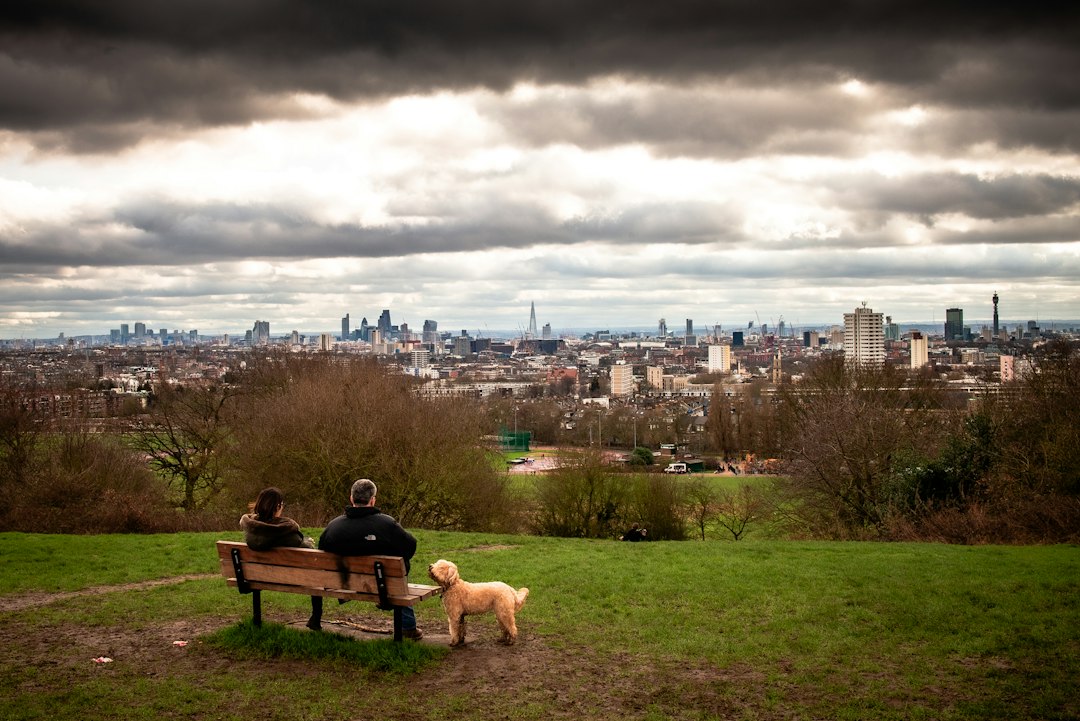
Parliament Hill, in the southern section of the heath, gives one of the best panoramic views of central London — you can see the Shard, the City, the BT Tower, and on clear days, the hills of Surrey in the distance. Runners and kite-flyers claim the hill on weekends.
Kenwood House, at the northern edge of the heath, is a Grade I listed 17th-century country house managed by English Heritage and free to enter. The interior has paintings by Rembrandt, Vermeer, and Turner. The grounds host outdoor classical music concerts in summer.
Best for: Wild swimming, proper walking, city views, and Kenwood House. Access from Hampstead or Gospel Oak stations. Wear walking shoes — it’s uneven terrain.
Greenwich Park: History, Views, and the Prime Meridian
Greenwich Park is the oldest enclosed Royal Park in England, established in 1433 by Henry VI. It sits on a hill overlooking the Thames and the Isle of Dogs, and the view from the top — with the Cutty Sark, the National Maritime Museum, the Canary Wharf towers, and the river all visible at once — is one of the defining London panoramas.
The Royal Observatory sits at the top of the hill. You can stand on the Prime Meridian Line at zero degrees longitude — the line that divides east from west. Entry to the grounds is free; entry to the Observatory itself requires a ticket. The telescope dome, the camera obscura, and the Time Ball (which drops at 1pm daily as it has since 1833 to allow ships on the Thames to set their chronometers) are all worth seeing.
The park also has a herd of around 30 fallow deer, which have been in the park since the 17th century. They’re visible most mornings in the enclosed deer park on the eastern side.
Best for: City views, history, and the Royal Observatory. Access via Cutty Sark DLR station or Greenwich National Rail station, then a 10-minute uphill walk.
Practical Notes for Visiting London’s Parks
All of London’s Royal Parks — Hyde Park, Regent’s Park, St James’s Park, Greenwich Park, and several others — are free to enter and open every day of the year. Opening hours vary by season; most open at dawn and close at dusk, though some have specific gate-closing times.
Cafés in the Royal Parks are managed by private operators and vary in quality and price. The café in St James’s Park and the Serpentine Bar & Kitchen in Hyde Park are reliable options. Bringing your own food and drink is perfectly fine in all London parks.
Dogs are welcome in most London parks, though they must be kept on leads in certain areas — particularly near wildlife and children’s play areas. Check individual park websites for current rules, as these do change seasonally.
If you’re visiting in summer, early mornings (before 10am) are significantly quieter in all of the central parks. The light is also better for photographs. Evening visits — particularly in the Royal Parks — can be genuinely special when the crowds thin out and the light changes.
Which Park Should You Choose?
The honest answer is that the right park depends entirely on what you want from your afternoon. If you want the most iconic London experience, go to St James’s Park. If you want room to walk without feeling hemmed in, choose Hyde Park or Hampstead Heath. If you want somewhere that feels genuinely local and unpretentious, make the trip to Victoria Park. If you want history and views together, Greenwich Park is the answer.
London’s parks are one of the few things in the city that are entirely free, available to everyone, and consistently worth your time regardless of the season. That’s rarer than it sounds.
Stay in the loop: Every week we share the best of London — from parks and walks to history, food, and things most visitors never find. It’s free, and you can unsubscribe any time. Join the Love London newsletter →