
Poets’ Corner is the south transept of Westminster Abbey, where more than a thousand years of English writers lie buried or carry a memorial. You can walk through it in 15 minutes. Most visitors stay for an hour, because every wall panel names someone you studied at school.
What Poets’ Corner Actually Is
Poets’ Corner sits in the south transept of Westminster Abbey. It holds two kinds of tribute. Some writers lie in the floor and walls here. Others have a memorial stone, bust or plaque only, while their bodies rest elsewhere.
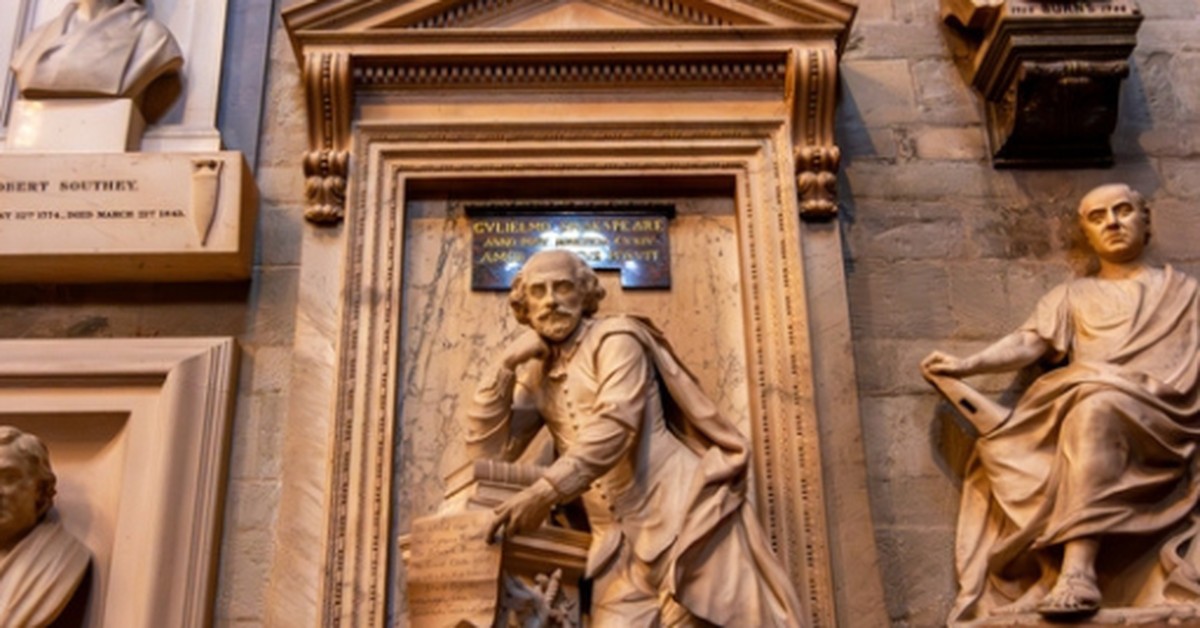
That second group surprises many visitors. William Shakespeare, the most famous name in the corner, lies in Holy Trinity Church in Stratford-upon-Avon. The Abbey placed his statue here in 1740, more than 120 years after his death in 1616. The figure leans on a pile of books, and a carved scroll carries lines from his own play The Tempest.
Did you know? Poets’ Corner honours several writers whose bodies lie elsewhere. Shakespeare rests in Stratford, while Keats and Shelley rest in Rome, yet each has a place on the wall.
How the Tradition Began With Chaucer
Geoffrey Chaucer started it all. He died in 1400 and the Abbey buried him in its grounds. Chaucer held a lease on a house within the Abbey precincts, which is why the monks accepted him. Nobody planned a literary corner. People later noticed that the poet of The Canterbury Tales lay in the south transept, and the area slowly became a place for writers.
Edmund Spenser, author of The Faerie Queene, joined Chaucer in 1599. Writers of the following centuries wanted to lie near them. By the 1700s the Abbey’s south transept already carried its name, and the practise of adding memorials was well established.
Ben Jonson, the Jacobean playwright, has a famous story attached to his grave. Tradition says the Abbey buried him standing upright. Historians still argue about the details, but the story shows how much affection visitors have for the corner’s characters.
The Writers You Can Find Here
The memorials sit close together, so a short walk covers several centuries. Here are the names most visitors look for.
- Charles Dickens: He died on 9 June 1870 and the Abbey buried him in Poets’ Corner. He had asked for a plain funeral, and the Abbey kept the ceremony private. Crowds still filed past the open grave for days, and fresh flowers covered the stone. For the streets he wrote about, read our guide to Charles Dickens’ London.
- Samuel Johnson: The man who compiled A Dictionary of the English Language in 1755 lies here. He died in 1784. His friend the actor David Garrick had already joined the corner in 1779.
- Alfred, Lord Tennyson and Robert Browning: Two giants of Victorian poetry lie close to each other. Browning died in 1889 and Tennyson in 1892.
- Thomas Hardy: The Abbey buried his ashes here in 1928. His heart went to the churchyard at Stinsford in Dorset, near his birthplace. Two funerals took place on the same day.
- Rudyard Kipling: The author of The Jungle Book joined the corner in 1936.
- Keats and Shelley: Two round memorials on the wall above Shakespeare’s statue carry their names and dates, 1795 to 1821 for Keats and 1792 to 1822 for Shelley. Both poets died young and far from London, and both lie in Rome.
- Jane Austen and the Brontë sisters: Memorial tablets recognise them. The Brontë memorial dates from 1947, and the Austen brass plaque from 1967.
- Oscar Wilde and Dylan Thomas: A stained-glass window honours Wilde, installed in 1995. Thomas has a stone, added in 1982.
Look at the floor as well as the walls. Many of the names are cut into the stone beneath your feet, and the Abbey asks you to step carefully around them.
🏙️ Enjoying this? 3,000 London lovers get stories like this every week. Subscribe free →
The Americans in the Corner
American visitors often ask whether any of their own writers appear here. Several do. The Abbey unveiled a bust of Henry Wadsworth Longfellow in 1884, which made him the first American writer honoured in Poets’ Corner. T. S. Eliot, born in St. Louis, has a memorial stone from 1967. Henry James, who moved to England and took British citizenship in 1915, also has a memorial here.
The corner therefore tells a wider story than English literature alone. Many writers on the walls crossed the Atlantic, in one direction or the other, and their work still shapes how Americans see Britain.
Why Some Writers Waited Centuries
The Abbey does not simply admit anyone it admires. The Dean of Westminster decides who receives a memorial, and the Abbey often waits for years after a writer’s death. Lord Byron shows the point best. His reputation for scandal kept him out of the Abbey for almost 150 years, and the memorial finally appeared in 1969.
This slow pace gives the corner its character. Every name on the wall has passed a test of time as well as taste. When you stand in front of a memorial, you stand in front of a judgement that generations of readers have confirmed.
Planning Your Visit to Poets’ Corner
Poets’ Corner lies inside Westminster Abbey, so you need an Abbey ticket. Book on the official Westminster Abbey website before you travel, because opening hours and prices change and the Abbey closes to sightseers during services and special events.
- Getting there: Westminster Underground station (Circle, District and Jubilee lines) sits a five-minute walk from the Abbey’s entrance. St James’s Park station is another option.
- Best time: Go early on a weekday. The transept feels calm then, and you can read the inscriptions without a crowd at your shoulder.
- Photography: The Abbey restricts photography inside, so check the current rules at the entrance before you lift your phone.
- Time to allow: Give the whole Abbey around 90 minutes, with a good 20 minutes of that for Poets’ Corner.
The Abbey sits at the heart of one of London’s best walking areas. Pair it with our guide to Westminster and the South Bank, then follow the writers across the city with our walk through Shakespeare’s London.
Where to Go Next
If the corner leaves you wanting more, London has plenty of other places where writers and the city meet. Virginia Woolf’s Bloomsbury shows you where a twentieth-century novelist lived and worked. Highgate Cemetery shows you a different kind of memorial, with Victorian graves among the trees, including that of the novelist George Eliot.
Frequently Asked Questions
Is Shakespeare buried in Westminster Abbey?
No. Shakespeare lies in Holy Trinity Church in Stratford-upon-Avon. Westminster Abbey carries a memorial statue to him in Poets’ Corner, which it set up in 1740.
Who was the first writer buried in Poets’ Corner?
Geoffrey Chaucer, who died in 1400. He lived within the Abbey’s precincts, and that link led to his burial in the south transept.
Do you need a separate ticket for Poets’ Corner?
No. Poets’ Corner forms part of the Westminster Abbey visit, so one Abbey ticket covers it. Check the Abbey’s website for current prices and opening times before you go.
Is Charles Dickens buried in Poets’ Corner?
Yes. Dickens died in June 1870 and the Abbey buried him in Poets’ Corner, even though he had asked for a plain funeral elsewhere.
Join 3,000+ London Lovers
Every week, get London’s hidden history, heritage walks, and stories from the city’s remarkable past — straight to your inbox.
Subscribe free — enter your email:
Already subscribed? Download your free London guide (PDF)
Love more? Join 64,000 Ireland lovers → · Join 43,000 Scotland lovers → · Join 30,000 Italy lovers →
Free forever · One email per week · Unsubscribe anytime