
The Great Exhibition of 1851 filled a glass palace in Hyde Park for five months. It also reshaped London. Its profits bought the land where the Victoria and Albert Museum, the Natural History Museum, the Science Museum and the Royal Albert Hall now stand. If you walk from South Kensington station to Hyde Park, you walk through the legacy of one summer.
This guide tells the story in order: the glass palace, the crowds, the money, and the museum district that grew from it. It ends with a practical route and a short note on tracing family members who visited or exhibited.
A Glass Palace in Hyde Park
Prince Albert chaired the Royal Commission that organised the show. He wanted a vast international fair of industry and design, and he wanted it in London in 1851. The organisers needed a building fast, and conventional designs would take too long and cost too much.
Joseph Paxton, a gardener turned designer, solved the problem. He drew on his glasshouse work and sketched an iron and glass hall. Workers built it from standard prefabricated parts, which they bolted together on site. The finished Crystal Palace stood 1,851 feet long, one foot for each year, and it enclosed full-grown elm trees that the builders refused to cut down.
The Great Exhibition opened on 1 May 1851 and closed on 15 October. Inside, exhibitors from Britain, its empire and dozens of other countries showed machines, textiles, tools, ceramics and curiosities. Visitors saw the Koh-i-Noor diamond, steam hammers, early American farm machinery and a great deal of ornate Victorian furniture.
🏛️ Free Guide: How to Trace Your English & British Ancestry
Step-by-step: GRO records, census 1841–1921, parish registers, the National Archives (Kew), London Metropolitan Archives, and planning a heritage trip. Completely free.
Get the Free Guide → Subscribe free at the guide page to receive weekly London heritage storiesWho Came, and How
About six million visits took place over the five months,. Railways made that possible. Tour organisers, including Thomas Cook, ran excursions from northern towns, and many working families saw London for the first time. The organisers set low-priced days so that ordinary people could attend, and the crowds on those days were the biggest.
The exhibition also introduced a small piece of London history that many visitors still use. The organisers opened public retiring rooms with flush toilets, and hundreds of thousands of people paid a penny to use them. Historians often point to this as the start of the public convenience in Britain.
The Money That Built a District
The exhibition made a surplus. Most accounts put it at roughly £186,000, a large sum in 1851. Prince Albert and the Royal Commission chose not to spend it on a one-off memorial. Instead, they bought about 87 acres of farmland and market garden in South Kensington, and they planned a permanent centre for science, art and education there.
People nicknamed the area Albertopolis. The Royal Commission for the Exhibition of 1851 still exists, and it still funds scholarships and research. You can read about its work on the Royal Commission for the Exhibition of 1851 website.
🏙️ Enjoying this? 3,000 London lovers get stories like this every week. Subscribe free →
What Albertopolis Became
The Victoria and Albert Museum
The South Kensington Museum opened in 1857 and bought objects from the exhibition to teach good design to British manufacturers. Queen Victoria laid the foundation stone of the grand new building in 1899, and the museum took the name Victoria and Albert Museum. Today it is one of the world’s great museums of art and design. Visit the V&A’s official site for current opening details.
The Natural History Museum
The natural history collections moved to South Kensington from the British Museum, and Alfred Waterhouse designed the Romanesque building that opened in 1881. Its terracotta walls carry carved animals and plants. The Natural History Museum keeps the site’s founding idea alive: it collects, studies and shows.
The Science Museum
The Science Museum grew out of the scientific and industrial collections of the South Kensington Museum. It became a separate institution in the early twentieth century. The Science Museum now sits next door to the other two.
The Royal Albert Hall
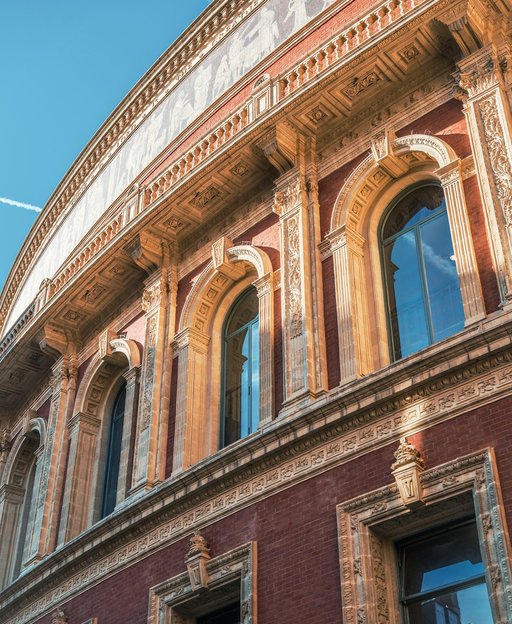
Prince Albert died in 1861, and the Royal Albert Hall became part of his memorial. Captain Francis Fowke and Henry Scott designed the round hall in red brick and terracotta. Queen Victoria opened it on 29 March 1871. A band of mosaic panels runs around the outside, and it shows scenes of the arts, crafts and sciences. The photograph above shows part of that curved brick and terracotta wall. Check the Royal Albert Hall’s site for what is on.
What Happened to the Crystal Palace
The Crystal Palace did not stay in Hyde Park. Workers took it apart and rebuilt it, larger, on a hill at Sydenham in south London, where it reopened in 1854. It stood there as a concert hall, museum and amusement venue for more than 80 years. A fire destroyed it on 30 November 1936. The name survives in the Crystal Palace area, and the park there still holds the Victorian dinosaur sculptures.
How to Walk the Great Exhibition Route
You can see the whole story on foot in a day, and the route is easy to follow.
Start at South Kensington station and walk to the V&A, then the Natural History Museum and the Science Museum along Exhibition Road. The road takes its name from the 1851 show. Next, walk north to the Royal Albert Hall and look at its frieze from the pavement. Finally, cross Kensington Gardens to Hyde Park. The glass palace stood on the southern part of the park near the Serpentine, and no building marks the spot, so a quiet look at the grass is the right ending.
Allow time for one museum rather than all three. Each one fills a day for most visitors, and the free entry policies and opening hours change, so check each official site before you go.
Tracing Family Who Visited or Exhibited
If your ancestors lived in Britain in 1851, you have a useful starting point. The census took place on 30 March 1851, a month before the doors opened, and it records where your family lived and what they did for work. Craftspeople and manufacturers listed in the exhibition’s official catalogue often appear in the census under the same trade. Many libraries hold copies of the catalogue, and the National Archives can point you to related records.
Do not expect to find a visitor list. Most of the six million visitors left no individual record. Family stories about a trip to the Crystal Palace are common, though, and they are worth writing down with a date and a relative’s name.
Frequently Asked Questions
When was the Great Exhibition held?
It ran from 1 May to 15 October 1851 in Hyde Park, London.
Who designed the Crystal Palace?
Joseph Paxton designed it, and Prince Albert’s Royal Commission organised the exhibition.
Is the Crystal Palace still standing?
No. Fire destroyed the rebuilt palace in Sydenham on 30 November 1936.
Which London museums came from the Great Exhibition?
The profits bought the South Kensington land. The V&A, the Natural History Museum and the Science Museum all grew there, along with the Royal Albert Hall.
One summer in 1851 gave London a museum district that visitors still cross the Atlantic to see. Pick one building, give it a morning, and notice how much of it started with a glass palace and a surplus.
Join 3,000+ London Lovers
Every week, get London’s hidden history, heritage walks, and stories from the city’s remarkable past — straight to your inbox.
Subscribe free — enter your email:
Already subscribed? Download your free London guide (PDF)
Free forever · One email per week · Unsubscribe anytime