
Westminster Abbey has crowned the monarch of England, and later Britain, at almost every coronation since 1066. William the Conqueror took the crown here on Christmas Day that year, and King Charles III followed him in 2023. This guide traces that long line, from the Anglo-Saxon church to the Gothic building you see today, and shows what to look for when you visit.
Most US visitors come to the Abbey for the tombs, the poets and the royal weddings. The coronation story sits underneath all of it. Once you know it, the building reads differently: the oak chair, the carved stone and the sanctuary floor all have jobs in a ceremony that has changed surprisingly little in nine centuries.
A Church Built for a King
Edward the Confessor started the story. He ruled England from 1042 and chose a site on Thorney Island, a patch of dry ground beside the Thames west of the City of London. There he built a large new church in the Norman Romanesque style, an unusual choice for an English king before the Norman Conquest. Monks had worshipped on the island for generations, and Edward wanted a church grand enough to hold his own tomb.
The church was ready for its consecration in December 1065. Edward was too ill to attend, and he died in early January 1066. Mourners laid him in front of the high altar. The name Westminster comes from this place: it means the minster, or monastery church, in the west, to set it apart from St Paul’s in the east.
Edward’s burial gave the Abbey its royal identity. A church that held a king’s body, and later a saint’s shrine, made a natural stage for the next king’s crowning. Historians generally agree that Harold Godwinson, Edward’s successor, took the crown here within hours of the funeral, although the sources are thin.
Christmas Day 1066
The Norman Conquest turned the Abbey into a fixture of the English crown. William of Normandy defeated Harold at Hastings in October 1066 and marched towards London. He chose Westminster Abbey for his coronation, and he picked Christmas Day. The choice sent a message: William claimed to be Edward’s lawful heir, and he wanted the same church, the same rites and the same holy day.
The ceremony nearly turned into a disaster. Chroniclers say the congregation shouted its approval in English and in French. Norman guards outside heard the noise, took it for a riot and set fire to nearby houses. The new king, shaken, reportedly trembled as he received the crown. Treat the details with care, because medieval writers loved a dramatic scene, but every account agrees on the date and the place.
After William, the habit stuck. Kings and queens chose Westminster because earlier kings had chosen it. Each coronation added a layer of precedent, and by the later Middle Ages nobody questioned the venue.
Henry III Rebuilds the Abbey
The building you can visit today owes most of its shape to Henry III. He admired Edward the Confessor and wanted to honour him with a church that matched the great cathedrals of France. In 1245 he ordered the Norman church pulled down and began again in the Gothic style, with soaring pointed arches, tall windows and a ring of chapels at the east end.
Henry spent a fortune on the project. Masons worked on it for decades, and later kings and abbots added the nave, the towers and the Lady Chapel. The vault of the nave rises about 31 metres, the highest Gothic nave in England. Henry also moved Edward’s remains into a magnificent new shrine behind the high altar, and that shrine still stands.
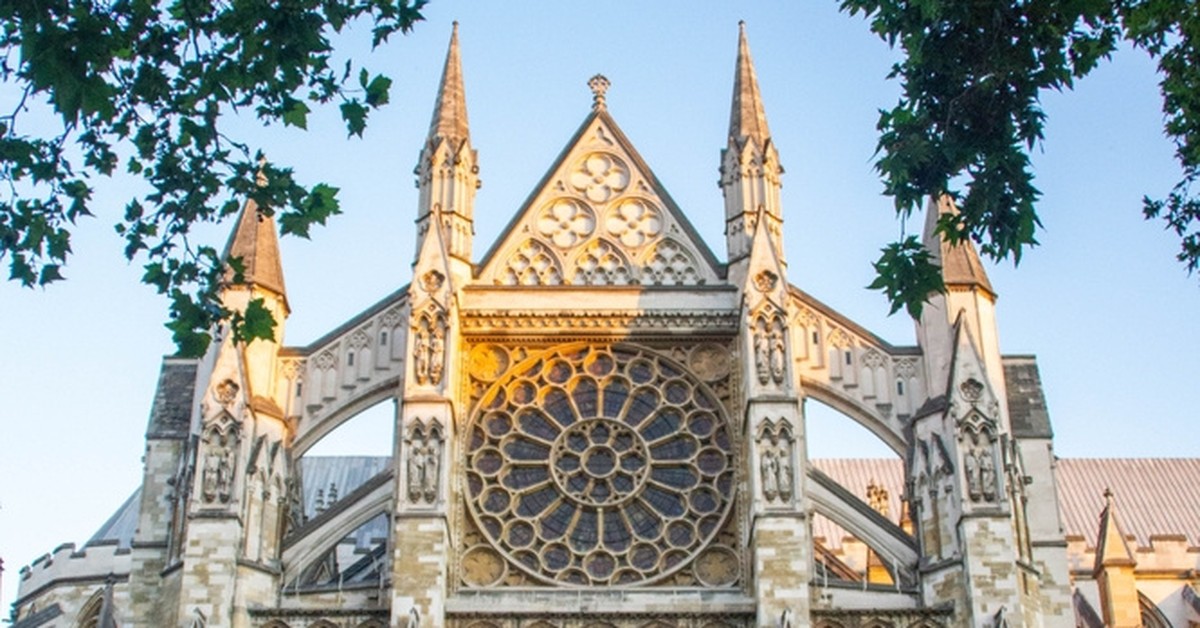
If you look at the photograph above, you see the north front, the side most visitors meet first. The big rose window and the pointed gables show Gothic design at its most confident. Victorian architects restored a good deal of this front in the nineteenth century, so you are looking at medieval planning with later repairs.
🏙️ Enjoying this? 3,000 London lovers get stories like this every week. Subscribe free →
The Coronation Chair
Every coronation since the early fourteenth century has used the same piece of furniture. Edward I ordered the Coronation Chair around 1300 to hold a prize he had taken from Scotland, the Stone of Scone. Craftsmen made the chair from oak and painted and gilded it. Time has worn most of the decoration away, but the shape of a Gothic throne remains.
The chair has survived seven centuries of use and some rough treatment. Visitors and Westminster schoolboys carved their names and initials into it, and you can still pick out some of the graffiti. A bomb exploded in the Abbey in 1914 and damaged the chair, and in 1950 the Stone itself vanished for a few months when four Scottish students removed it. We tell that story in full in our article on the students who took the Stone.
The Stone returned to Scotland in 1996 on the understanding that it would come back to London for future coronations. It did, in 2023, and then it went north again. The chair stays in the Abbey. Check the Abbey’s official site before you visit, because access to the chapel around it changes with events and conservation work.
What Happens at a Coronation
The ceremony follows a pattern that goes back a thousand years, even though the details have shifted. The monarch arrives in procession and the Archbishop of Canterbury presents them to the congregation. The monarch swears an oath, then takes a seat in the Coronation Chair for the most solemn moment: the anointing.
Clergy hold a canopy over the monarch and pour holy oil from an ancient ampulla, a vessel in the shape of an eagle, using the Coronation Spoon. The spoon dates from the twelfth century and is the oldest piece of the regalia. It survived the 1640s and 1650s because someone kept it safe. The Commonwealth government sold or melted down almost everything else.
When Charles II returned in 1660, goldsmiths made new regalia. St Edward’s Crown, the crown placed on the monarch’s head at the climax, dates from 1661. After the crowning the new monarch receives the orb, the sceptres and the ring, and the congregation cheers. The whole service takes place on the raised platform, called the theatre, in the crossing of the church, where the nave, choir and transepts meet.
From Victoria to Charles III
Americans know the modern coronations best. Queen Victoria took the crown on 28 June 1838, aged 19, and the service was famously muddled: the clergy lost their place in the order and the Archbishop forced the ring onto the wrong finger. Edward VII had planned his coronation for June 1902, but an emergency operation for appendicitis forced a delay, and the Abbey held the ceremony in August.
Elizabeth II took the crown on 2 June 1953. Cameras filmed most of the service, and millions around the world, including many in the United States, watched it on television. The Archbishop anointed her, as in every coronation, out of the cameras’ sight beneath a canopy. Charles III took the crown on 6 May 2023. His service was shorter than his mother’s and kept the old structure, but it added the voices of leaders from several faiths and a congregation that was smaller than in 1953.
Two monarchs never received a crown at Westminster. Edward V disappeared in the Tower of London before his coronation, and Edward VIII abdicated in 1936, before his had taken place. Lady Jane Grey, who held the throne for nine days in 1553, had no coronation either.
Visiting Westminster Abbey as a US Traveller
Westminster Abbey is a working church, a Royal Peculiar under the direct authority of the monarch, and a major attraction. Book ahead through the official site, where you will find current opening times and ticket details. We do not print prices here because they change. The Abbey’s own page on coronations gives the official account.
A few practical tips help. Go early on a weekday, since the queue grows by mid-morning. Allow at least two hours inside. Look up at the sanctuary floor, the patterned Cosmati pavement, where the monarch stands for the crowning. Then walk on to the shrine of Edward the Confessor, where the story began. Poets’ Corner, which we cover in our guide to the writers’ memorials, sits in the south transept and makes a good second stop. If the queue puts you off, this free cathedral is a strong alternative.
The nearest Underground stations are Westminster and St James’s Park, and the Abbey stands across the road from the Houses of Parliament. Wear comfortable shoes. The floors are stone, and you will stand a lot.
Frequently Asked Questions
When was the first coronation at Westminster Abbey?
Historians usually point to Harold Godwinson in January 1066. The first coronation that nobody disputes is William the Conqueror’s on 25 December 1066. Every English or British monarch since has received the crown there, with the exceptions listed above.
Can I see the Coronation Chair?
The chair stays in the Abbey, but access to its chapel varies. Check the official website for the latest visitor information before you go, and ask a steward on the day.
Is Westminster Abbey the same as Westminster Cathedral?
No. Westminster Abbey is the Gothic church beside Parliament. Westminster Cathedral is a Roman Catholic cathedral in Victoria, a short bus ride away, built in the late nineteenth and early twentieth centuries in a Byzantine style.
Join 3,000+ London Lovers
Every week, get London’s hidden history, heritage walks, and stories from the city’s remarkable past — straight to your inbox.
Subscribe free — enter your email:
Already subscribed? Download your free London guide (PDF)
Free forever · One email per week · Unsubscribe anytime