
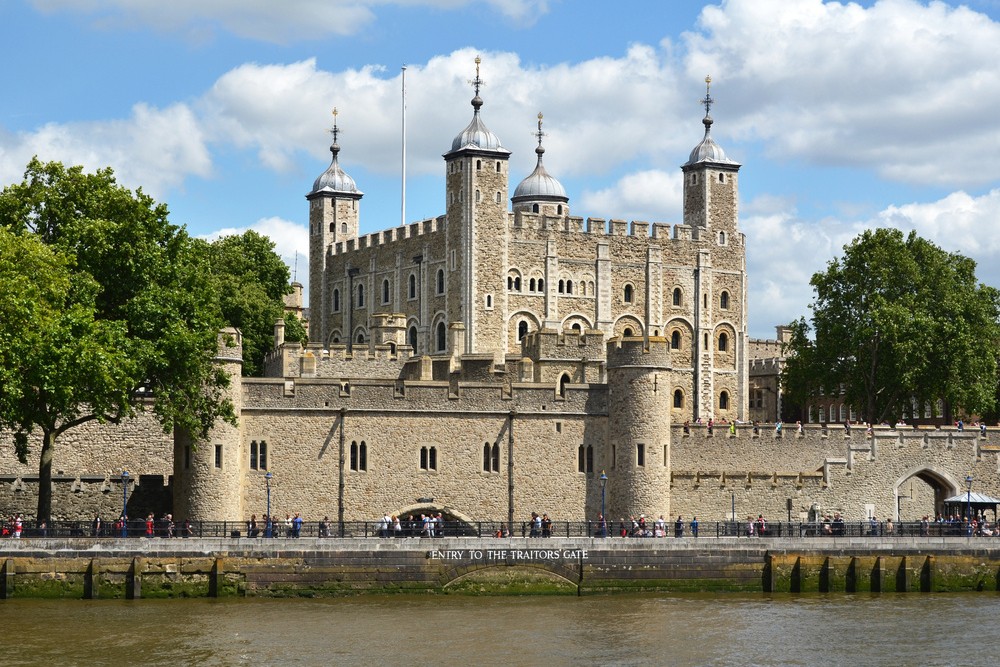
The Tower of London is a royal fortress that William the Conqueror began soon after 1066. Over nine centuries it has served as palace, prison, mint, armoury and zoo. Its White Tower, started around 1078, still stands at the heart of the site, and the walls around it tell the story of English monarchy better than almost any other building in the capital.
This guide walks through that history in order, from the first Norman timber fort to the ravens that visitors photograph today. It is written for American visitors who want to know what they are looking at before they arrive.
Why William Built a Fortress on the Thames
William won the Battle of Hastings in October 1066, but he still had to hold a hostile, rich and crowded city. London sat on the Thames, the main road for trade and for any invading fleet. So he built a fortress at its eastern edge, in the corner of the old Roman city wall.
The first fort was earth and timber. Around 1078 the Normans began a stone keep, which we now call the White Tower. Builders brought pale Caen stone from Normandy for the corners and the fine detail. The keep rises about 27 metres (roughly 90 feet), and its walls are thick enough at the base to hold off a long siege. It was the tallest and most solid building most Londoners had ever seen. That was the point. The Normans meant it to frighten people.
Work on the keep ran on into the reign of William’s sons, and by about 1100 the tower was largely finished. The name White Tower came later. Whitewash on the walls under Henry III gave it that look in the 13th century.
Henry III and Edward I Build the Castle You See Today
The Tower you walk around today is mostly the work of two kings. Henry III spent heavily from the 1220s onward, adding walls, towers and a royal residence beside the river. His son Edward I then finished the job. Between about 1275 and 1285 he added a second ring of walls, a wide moat and a new main entrance on the western side. Historians call the result a concentric castle: one ring of defences inside another, so attackers who broke through the outer wall still faced the inner one.
Edward also built St Thomas’s Tower on the riverside, with the water gate beneath it. Centuries later it earned the name Traitors’ Gate, because prisoners of state arrived by boat and stepped ashore there. You can see the gate in the photograph above, under the words on the quay wall. Not every prisoner entered that way, and the name is a later one, but the image stuck.
Palace, Mint and Menagerie
For much of the Middle Ages the Tower was a working royal palace, not a dungeon. Kings stayed here and kept their treasure, records and weapons here. Medieval monarchs also traditionally spent the night before their coronation at the Tower. The custom ended after Charles II, who rode in procession from the Tower to Westminster in 1661. If you enjoy that thread of the story, our guide to Westminster Abbey coronations picks up where the procession ended.
The Tower held other businesses too. The Royal Mint struck coins here from about 1279 until the early 19th century, when it moved to a new site nearby. The Royal Menagerie began in the 13th century as a collection of gifts from foreign rulers. Henry III received a polar bear from the King of Norway in 1252, and the bear fished for its dinner in the Thames on a long chain. Henry also received an elephant in 1255, a gift from the King of France. The Menagerie lasted until the 1830s, when its remaining animals went to the new zoo in Regent’s Park.
Prisoners and Famous Stories
The Tower’s grim reputation grew mainly in the Tudor age. Powerful people used it to lock up rivals, and Yeoman Warders still tell a few of its stories every day.
The Princes in the Tower. In 1483 officials lodged the young Edward V and his brother Richard in the Tower. The boys then vanished from the record. Nobody has proved what happened to them, and historians still argue about it.
Anne Boleyn. A swordsman from France beheaded Henry VIII’s second wife inside the Tower on 19 May 1536, on a scaffold on Tower Green.
Lady Jane Grey and Elizabeth. Jane Grey, who ruled for only nine days in 1553, died here in 1554. In the same year Mary I held her half-sister, the future Elizabeth I, in the Tower for several weeks.
Sir Walter Raleigh. The explorer spent about thirteen years in the Tower from 1603. He wrote part of his History of the World during that time.
Guy Fawkes. Officers brought Fawkes here in November 1605 after the Gunpowder Plot and questioned him. We tell that night in our Bonfire Night guide.
The Tower was still in use as a prison in the 20th century. Soldiers shot German spies in its grounds during the Second World War. Josef Jakobs, who died in August 1941, was the last person executed at the Tower.
The Crown Jewels and Colonel Blood
The Tower’s Jewel House holds the Crown Jewels, and the collection is the best-known reason Americans visit. In 1671 an Irish adventurer named Colonel Thomas Blood nearly walked out with them. He befriended the keeper, tied him up, flattened the crown with a mallet and tucked the orb into his clothes. Guards stopped him at the gate. Charles II then did something nobody expected: he pardoned Blood and gave him land in Ireland. Historians still debate why.
Ravens, Beefeaters and the Ceremony of the Keys
Three living traditions are worth planning around.
The ravens. Legend says the kingdom will fall if the ravens leave the Tower. The story is probably much younger than it sounds, and historians doubt it goes back before the Victorian period. The Tower keeps ravens anyway, and a Ravenmaster looks after them.
The Yeoman Warders. People call them Beefeaters. They guard the Tower and give guided tours. Their post goes back to the Tudor age. They live with their families inside the walls, so the Tower is still a village as well as a monument.
The Ceremony of the Keys. Every evening the Chief Yeoman Warder locks the main gate in a short ritual that dates back centuries. Guests need to book a place in advance through Historic Royal Palaces, the charity that runs the Tower. Check their official site for dates, opening hours and ticket prices, because those change.
🏙️ Enjoying this? 3,000 London lovers get stories like this every week. Subscribe free →
How the Tower Changed Over Time
Georgian and Victorian architects cleared away clutter and restored the medieval look. In the 19th century the Tower became a tourist attraction, a role it keeps today. Bombs damaged parts of the site in the Second World War, and builders have repaired and rebuilt parts of it many times since. When you walk the walls, you see layers from the 11th century through to modern repairs.
The Tower stands next to a stretch of the Roman city wall, and the two together give you almost two thousand years of London in a single visit. Allow a half day if you want to see the Jewel House, the White Tower and the walls without rushing.
If you are building a trip around the capital’s royal story, our guide to the Palace of Westminster makes a good companion piece.
Planning Your Visit: Quick Answers
When was the Tower of London built?
William the Conqueror began the first fortress soon after 1066. Builders started the stone White Tower around 1078 and largely finished it by about 1100.
How long do you need at the Tower of London?
Plan for three to four hours. That gives you time for the Crown Jewels, the White Tower, the walls and a Yeoman Warder tour.
Is the Tower of London still a prison?
No. It stopped holding prisoners long ago. Its last prisoners came during the Second World War. Today it is a historic site and a home for the Yeoman Warders and their families.
Which Tube station is closest?
Tower Hill station on the District and Circle lines is a short walk from the main entrance. Check Transport for London for current service updates before you travel.
Join 3,000+ London Lovers
Every week, get London’s hidden history, heritage walks, and stories from the city’s remarkable past — straight to your inbox.
Subscribe free — enter your email:
Free forever · One email per week · Unsubscribe anytime