
Deep beneath the streets of Westminster lies a place where the fate of the world was decided. In a series of low-ceilinged rooms cut into the basement of a government building, Winston Churchill directed Britain through its darkest hours. Today, those rooms are open to the public — preserved exactly as they were the day the war ended.
The Churchill War Rooms are one of London’s most compelling heritage sites, and one of the least understood by first-time visitors. Most people add them to their list as an afterthought. Those who visit rarely forget them.
What Are the Churchill War Rooms?
In 1938, as war with Germany appeared increasingly likely, British officials began searching for a secure location where the government could continue to function during bombing raids. They found it beneath the Treasury building on King Charles Street in Westminster — a labyrinth of basement rooms that could be reinforced and protected.
The rooms were ready by August 1939, just days before Britain declared war on Germany. They served as the nerve centre of Britain’s war effort until the final day of the Second World War in 1945. During those six years, the War Cabinet met here more than one hundred times. Churchill held late-night meetings, received military reports, and made the decisions that shaped Allied strategy. In these rooms, the history of the twentieth century turned.
When the war ended on 15 August 1945, staff walked out of the rooms and locked the doors. They sat almost untouched for nearly four decades. The rooms opened to the public in 1984, preserved as closely as possible to how they were on that final wartime day. What you see today is what Churchill’s staff saw when they came to work.
The War Cabinet Room — Where History Was Made
The War Cabinet Room is the heart of the Churchill War Rooms. It is a surprisingly modest space — a long table lined with chairs, maps pinned to the walls, a single electric bulb hanging from the ceiling. Churchill sat at the centre of the table, his back to the wall. Around him sat the military chiefs, the foreign secretary, and the men who ran Britain’s war.
The chair with the slightly different arms is Churchill’s original chair — the same one he occupied for every Cabinet meeting held in this room. That worn piece of furniture has been here since 1939.
The room is preserved with extraordinary care. Original papers remain on the table. The ashtrays — Churchill was a dedicated cigar smoker throughout his life — are still in place. The sense of standing in a room where those conversations actually happened is unlike anything you will find in most museums. There are no reconstructions here. This is the real thing.
Churchill’s Bedroom and the Transatlantic Telephone
Churchill rarely slept in the War Rooms. He much preferred to remain at Downing Street or at Chequers, his official country residence, even during the heaviest bombing raids of the Blitz. The man had a gift for cheerful defiance of obvious danger.
But the complex includes a small bedroom he used for occasional naps and on nights when raids made movement above ground genuinely dangerous. It is furnished simply — a narrow bed, a bedside table, a reading lamp. Beside the bed is the telephone line he used to speak directly with President Franklin Roosevelt in the United States.
That transatlantic telephone was one of the most closely guarded secrets of the war. To disguise it, the door to the telephone room was marked as a lavatory. Anyone who tried the handle was told it was an ordinary bathroom and sent away. Behind that door, Churchill and Roosevelt spoke about Allied strategy in conversations no one else was permitted to hear. Standing beside that door today, it is easy to feel the weight of what was said on the other side of it.
🏙️ Enjoying this? 3,000 London lovers get stories like this every week. Subscribe free →
The Map Room — Six Years Without a Day Off
The Map Room is perhaps the most haunting space in the complex. It was staffed twenty-four hours a day, seven days a week, from August 1939 to August 1945 — not a single day’s break across six years of war.
Officers worked in shifts, plotting the movements of Allied and enemy forces on the large maps that still cover the walls. The pins, the strings, the handwritten annotations — all of it remains exactly as it was on 15 August 1945, the day Japan surrendered and the last duty officer walked out for the final time.
The original maps show Allied convoy routes in the Atlantic, the progress of the North African campaign, and the movements during the D-Day landings. They are a record of the war written in real time by the people who were living it. No other room in London gives you quite this connection to the machinery of the Second World War.
The Churchill Museum
In 2005, the Imperial War Museum opened the Churchill Museum within the War Rooms complex. It is the world’s first major museum dedicated to Churchill’s life, and it goes far beyond a collection of personal objects.
The museum covers Churchill’s journey from his birth at Blenheim Palace in 1874, through his turbulent political career, his years of warning about the Nazi threat during the 1930s when few in Westminster were listening, and his emergence as wartime Prime Minister at the age of 65. It follows his story through the postwar years to his state funeral in 1965.
The centrepiece is an interactive table that provides access to Churchill’s entire personal correspondence — every letter, memo, and telegram across his long career. Visitors can search by date, by recipient, and by subject. It gives a direct and genuinely moving connection to how this man thought and communicated under the most extreme pressure imaginable.
The American Connection
For American visitors, the Churchill War Rooms carry a particular resonance. Churchill’s mother, Jennie Jerome, was born in Brooklyn, New York. She met Lord Randolph Churchill at a social event in 1873 and married him within months. Winston Churchill, born the following year, always described his American blood as a source of deep personal pride.
That heritage shaped his attitude to the United States throughout the war. Churchill understood American politics and culture in ways that most British politicians simply did not. He knew that Britain’s survival depended on American support, and he pursued the relationship with President Roosevelt with singular determination. The two men spoke on that disguised telephone in Churchill’s bedroom. They met on naval ships in the Atlantic. They planned the Allied strategy that eventually ended the war.
More than 300,000 American servicemen and women came to Britain in the years before and after D-Day. Many of them walked the streets above these rooms, past the same government buildings, through the same Westminster that Churchill was determined to defend. The Churchill War Rooms are, in a very real sense, part of a shared Anglo-American heritage — a place where the alliance between Britain and the United States was hammered out under enormous pressure.
Planning Your Visit
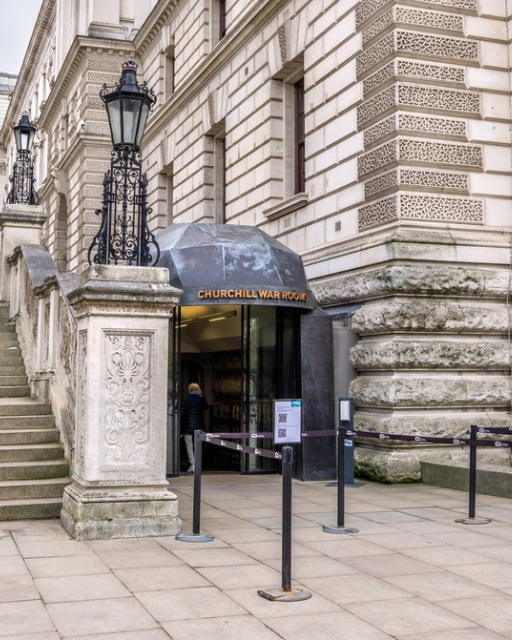
The Churchill War Rooms are located on King Charles Street in Westminster, just off Parliament Square. The entrance is at the foot of Clive Steps on the side of the Treasury building — it is easy to walk past if you are not looking for it. Look for the Imperial War Museum signage on the stone steps.
The nearest Underground stations are Westminster (District, Circle, and Jubilee lines) and St James’s Park (District and Circle lines), both a short walk away. The site is open daily. Book tickets in advance through the Imperial War Museum website — this is strongly recommended during summer months, when the rooms are among the busiest heritage sites in central London.
Allow at least two hours. The underground rooms take around ninety minutes to explore properly on their own. The Churchill Museum adds significantly to that if you engage with it fully. Audio guides are included with admission and are genuinely worth using — they bring the rooms to life with firsthand accounts, recorded voices, and some of Churchill’s most famous wartime broadcasts, delivered here in these very rooms.
The Churchill War Rooms make an excellent pairing with the nearby Houses of Parliament, Westminster Abbey, and the Palace of Westminster — all within easy walking distance. Together they form one of the most concentrated collections of British political heritage anywhere in the world.
Join 3,000+ London Lovers
Every week, get London’s hidden history, heritage walks, and stories from the city’s remarkable past — straight to your inbox.
Subscribe free — enter your email:
Already subscribed? Download your free London guide (PDF)
Love more? Join 64,000 Ireland lovers → · Join 43,000 Scotland lovers → · Join 30,000 Italy lovers →
Free forever · One email per week · Unsubscribe anytime
Frequently Asked Questions
What are the Churchill War Rooms and where are they located?
The Churchill War Rooms are a network of underground bunkers located beneath the Treasury building on King Charles Street in Westminster, London SW1A 2AQ. They served as the British government’s secret wartime headquarters during the Second World War and are now a museum run by the Imperial War Museum. The nearest Underground stations are Westminster and St James’s Park.
Did Churchill actually live and work in the War Rooms during the Blitz?
Churchill held most of his wartime Cabinet meetings in the War Rooms and did use them as a workplace throughout the war. However, he generally preferred to sleep at Downing Street or Chequers rather than underground. He was famously resistant to taking shelter unnecessarily, and his presence in the rooms was often driven by military necessity rather than personal preference. The bedroom is preserved for visitors, but Churchill was not a permanent underground resident.
How long should I plan to spend at the Churchill War Rooms?
Most visitors spend between ninety minutes and three hours at the Churchill War Rooms. The underground rooms and Cabinet offices take around ninety minutes to see properly, particularly if you use the audio guide, which is included in admission. The Churchill Museum on the same site adds considerably to the visit and is worth building time into your schedule for. Booking tickets in advance through the Imperial War Museum website is recommended, especially from June to August.
Is there a connection between the Churchill War Rooms and the United States?
Yes — a significant one. Churchill’s mother, Jennie Jerome, was American, born in Brooklyn, New York. Churchill felt a deep personal connection to the United States as a result. During the war, the famous transatlantic telephone in Churchill’s underground bedroom connected him directly to President Roosevelt for private strategic conversations. The room where that telephone sat is one of the most poignant spaces in the War Rooms for American visitors.