
London’s Underground and Overground network is enormous, and most of the time you’re staring at a tunnel wall. But two routes break that mould. The Jubilee line between Canning Town and North Greenwich, and the DLR between Shadwell and Woolwich Arsenal, both give you stretches of proper scenery above ground — the Thames, East London’s skyline, and one of the capital’s most recognisable landmarks. So which one is worth going out of your way for?
Here’s a straightforward look at both routes, what you’ll see, when to go, and how to make the most of a trip that doubles as sightseeing.
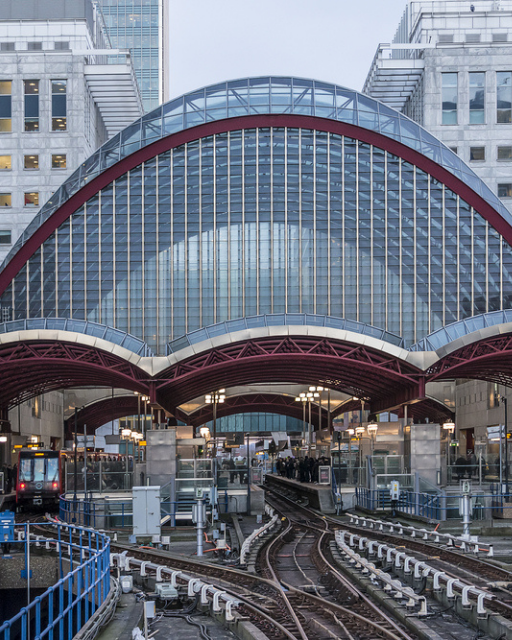
Canary Wharf DLR station — one of the most striking stations on the networkWant more London tips like this delivered to your inbox? Subscribe to our free newsletter — practical guides, hidden routes, and what’s on each week.
The Jubilee Line: Crossing the Thames and the O2
The Jubilee line runs from Stanmore in the north-west all the way to Stratford in the east. For most of its route it’s underground. But between Canning Town and North Greenwich, the track rises out of the tunnel and crosses the Thames on a viaduct. This is where the scenery opens up.
As the train leaves Canning Town heading south, you get a clear view across the Jubilee line’s elevated section. Then, rounding the bend towards North Greenwich station, the O2 dome comes into view — massive, white, and unmistakable. At 365 metres in diameter, it’s one of the largest domed structures in the world, and from the train you get a straight-on view that you simply can’t replicate from ground level.
North Greenwich station itself is worth a mention. It was designed by Roland Paoletti and won the Royal Institute of British Architects Award when it opened in 1999. The cavernous blue interior is a deliberate architectural contrast to the industrial landscape outside. If you’re arriving to attend an event at the O2, you’ll walk through one of the more impressive stations on the network.
The above-ground stretch on the Jubilee line is brief — roughly three to four minutes between Canning Town and North Greenwich — but it delivers one of the most iconic views available from any London train. Sit on the left side of the train travelling east (southbound towards Stratford is the direction to the O2) to get the best angle on the dome.
The DLR: An Elevated Railway Through East London
The Docklands Light Railway is a different experience entirely. Unlike the Jubilee line, the DLR runs almost entirely above ground. From its opening in 1987, it was built on elevated viaducts and repurposed railway infrastructure across the old docklands area. There are no drivers — the trains are automated — so the front seats give you a full, unobstructed forward view of the track ahead.
The most scenic stretch for most visitors runs between Bank or Tower Gateway and Greenwich or Cutty Sark. From the elevated tracks around Shadwell and Limehouse, you look out over a landscape that has changed dramatically in the last 40 years. Old warehouses sit alongside glass office towers. The Canary Wharf cluster rises on the left. Beneath the viaduct, you can see the narrow streets, the old dock basins now used for leisure, and the occasional glimpse of the Thames.
Canary Wharf DLR station is worth a look in its own right. The station is below ground here — a rare exception on the route — but the surroundings above are the centrepiece of London’s second financial district. If you get off and walk around, you’re on the old West India Docks site, which handled sugar, rum and other goods from the Caribbean from the early 1800s until the docks closed in 1980.
Heading south from Canary Wharf towards Greenwich, the train crosses the Isle of Dogs. You’ll see old dock water on both sides at points, and the skyline shifts as the towers of Canary Wharf recede behind you. Coming into Cutty Sark station, you get a glimpse down to the River Thames and the edge of the old town of Greenwich.
Greenwich from the DLR — What You Actually See
The DLR’s arrival at Cutty Sark is probably its most evocative moment. The elevated track drops you off right beside the Cutty Sark clipper ship — the last surviving tea clipper from the 19th century — and a short walk takes you to the Old Royal Naval College, the Thames foreshore, and the foot tunnel to the Isle of Dogs.
From the train as it pulls in, you can see the masts of the Cutty Sark rising above the roofline. It’s a rare moment on the network where a heritage landmark appears at eye level from the carriage window. Greenwich itself is a UNESCO World Heritage Site, home to the Royal Observatory, the Prime Meridian line, and the National Maritime Museum.
If you’re visiting Greenwich for the day, the DLR is clearly the better arrival. It drops you within 200 metres of the main sights, gives you elevated views for most of the journey, and the Cutty Sark station approach is one of the best platform arrivals in London.
Enjoying this? Sign up for our London newsletter — free, weekly, and written for people who actually visit rather than just read about it.
Practical Details: Fares, Frequency, and Timing
Both routes accept Oyster cards and contactless payment at standard TfL Tube fares. There’s no premium for the views. A single journey within Zone 2 costs £1.75 with an Oyster card (2026 rates). Both routes are included in the daily cap, so if you’re already travelling around London on a pay-as-you-go basis, riding either line adds nothing to your bill beyond a normal journey.
The Jubilee line runs every two to four minutes in peak hours, so you won’t wait long. The DLR runs every eight to ten minutes on the Greenwich branch depending on the time of day, with trains splitting between different destinations at Westferry — check the front of the train for “Cutty Sark” or “Lewisham” to make sure you’re on the right service.
Both routes are busiest on weekday mornings and evenings. If you’re travelling purely for the views, a midday trip on a weekday or a Saturday morning gives you a better chance of a window seat. Weekday rush hours pack both lines with commuters, which makes it harder to position yourself for the best view.
For the Jubilee line O2 view, aim for the left side of the train heading from Canning Town to North Greenwich. For the DLR, the front carriage going south from Tower Gateway gives you the driver’s-eye view of the track, which is worth the walk to the front of the platform.
Can You Do Both in One Trip?
Yes, and it makes for a decent half-day out. The two routes connect at Canning Town, where you can change between the Jubilee line and the DLR. A practical loop would look like this:
- Take the DLR from Bank or Tower Gateway south to Cutty Sark, stopping in Greenwich for a couple of hours
- Head back north on the DLR to Canning Town
- Switch to the Jubilee line and ride it one stop to North Greenwich, passing the O2
- Return via the Jubilee to central London, or continue east to Stratford if you’re heading that way
The whole loop without stopping in Greenwich takes less than an hour and covers both headline views. With a couple of hours in Greenwich included, it’s a straightforward full-morning or full-afternoon trip from central London.
If the O2 is your destination — for a concert, the climbing experience on the roof, or the entertainment complex — then the Jubilee line is the obvious choice. North Greenwich station sits directly outside the main entrance, and the approach by train gives you that aerial view of the dome before you arrive.
The Verdict
These are two different kinds of scenic ride. The Jubilee line delivers one standout moment: the O2 dome, close up, from above. It’s brief but striking. The DLR gives you a longer, more varied experience — elevated tracks for most of the route, a shifting skyline, the docklands landscape, and that approach into Greenwich alongside the Cutty Sark.
If you’re choosing one, the DLR edges it on total scenic value. The ride is longer above ground, the views are more varied, and the Greenwich arrival is genuinely memorable. But the Jubilee’s O2 moment is hard to beat for sheer impact — especially if you’ve never seen the dome from that angle before.
Both are free to ride on a standard Tube fare. Given that they connect at Canning Town, there’s a good argument for doing both and letting you decide for yourself.
More like this every week — subscribe to our free London newsletter for practical guides, seasonal recommendations, and the kind of local knowledge that makes a visit actually work.