
The Blitz ran from 7 September 1940 to 11 May 1941. During those eight months, German aircraft dropped more than 30,000 tonnes of bombs on London. The campaign killed approximately 20,000 Londoners and injured thousands more. German bombs damaged or destroyed around one million homes. Today, the physical traces of that period are still there — if you know where to find them.
This guide covers the key places where you can still see and feel the impact of the Blitz — from ruined churches to underground bunkers to the tube stations where tens of thousands of Londoners slept each night during the bombing.
Like what you’re reading? Join 3,000 London history lovers who get stories like this every week, free.
The Night the Blitz Began
At 4:43pm on Saturday, 7 September 1940, air raid sirens screamed across London. The Luftwaffe had sent 348 bombers and 617 fighter escorts across the English Channel and straight up the Thames towards the East End. Their targets were the docks — Millwall, Stepney, Bermondsey, Poplar. These neighbourhoods held the heart of London’s working-class population and its commercial lifeline.
By nightfall, fires lit the sky so brightly that the second wave of bombers, arriving at 8pm, needed no navigation aids at all. The pilots simply followed the orange glow on the horizon.
That was the first night. German aircraft then returned to London for 57 consecutive nights. Only a thick November fog kept them away on one occasion. By the following May, the Luftwaffe had flown more than 100 major night raids against the capital.
The human cost shocked the world. The Blitz killed approximately 20,000 Londoners and left many thousands more permanently injured. German bombs damaged or destroyed around one million homes across Greater London. The East End, Southwark, Lambeth, and the City of London lost entire streets to fire and high explosives.
And yet the city did not break. The stories of how Londoners fought back — and the physical traces that remain — are scattered across the capital, waiting for you to find them.
St Dunstan-in-the-East: The Ruin That Became a Garden
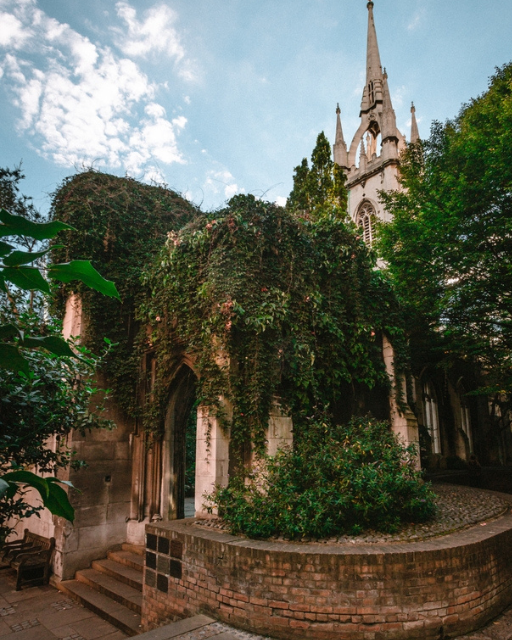
In the heart of the City of London, a short walk from London Bridge, you will find one of the most extraordinary spaces in the entire capital. The church of St Dunstan-in-the-East dates from the 12th century. Sir Christopher Wren rebuilt its tower in 1698 after the Great Fire of London reduced the original structure to rubble. The tower survived the Blitz. The body of the church did not.
German bombs gutted the building in 1941. The walls still stood, but the interior burned completely. Planners debated what to do with the ruin for years after the war. In the end, the City of London Corporation took an unusual decision: instead of demolishing the shell or restoring the church, they turned it into a public garden.
The garden opened in 1971. Today, ivy climbs the old stone walls. Trees grow through what was once the nave. Wren’s Gothic tower rises above it all, untouched and intact, as if oblivious to the destruction below it. On a quiet weekday morning, you can sit here in almost complete silence — birdsong, the rustle of leaves, the occasional distant hum of the City — while the ruins of the Blitz surround you.
Most tourists walk straight past the entrance. That makes it even more rewarding to find.
Visit: St Dunstan’s Hill, EC3R 5DD. Open daily, free entry. Nearest tube: Monument (Circle and District lines).
🏛️ Free Guide: How to Trace Your English & British Ancestry
Step-by-step: GRO records, census 1841–1921, parish registers, the National Archives (Kew), London Metropolitan Archives, and planning a heritage trip. Completely free.
Get the Free Guide →
Subscribe free at the guide page to receive weekly London heritage stories
Churchill’s Underground War Rooms
While German bombs fell on London, Winston Churchill directed Britain’s war effort from a reinforced concrete bunker beneath Westminster. Workers had dug out the Cabinet War Rooms beneath the Treasury building on King Charles Street in 1938, as war with Germany began to look inevitable. When bombing started in earnest in 1940, the rooms became the nerve centre of British resistance.
Churchill met his War Cabinet here. His staff slept, ate, and worked underground for months at a stretch. The Map Room — where officers tracked every Allied convoy and military operation across the globe — ran continuously from August 1939 until Japan surrendered in August 1945. Not a single shift went unmissed during those six years.
When the war ended, officials locked the door and walked away. The rooms sat sealed and largely forgotten for nearly four decades. The Imperial War Museum opened them to the public in 1984, and today they stand much as Churchill’s staff left them — complete with original maps, communications equipment, and the spartan sleeping quarters used by the most senior figures in British government.
The Churchill War Rooms rank among the most atmospheric heritage sites in London. You do not simply look at history here — you step into the building where some of the most consequential decisions of the 20th century were made.
Visit: Clive Steps, King Charles Street, SW1A 2AQ. A short walk from Westminster tube station. Admission charges apply — book in advance for busy weekends.
🏙️ Enjoying this? 3,000 London lovers get stories like this every week. Subscribe free →
How 177,000 Londoners Slept in the Tube
In the early weeks of the Blitz, the government strongly discouraged Londoners from using Underground stations as air raid shelters. Officials worried about public morale and the practical difficulties of running a transport network alongside tens of thousands of sleeping people. Londoners ignored them entirely. By mid-September 1940, ordinary people were simply buying platform tickets for a penny and refusing to leave when the last train ran.
At the peak of the bombing campaign, up to 177,000 people slept in the Underground every night. They brought blankets, pillows, food, playing cards, and books. They sang. They told jokes. Children did their homework on the platform floor. Trains continued to run on the live tracks just a metre or two from where people slept.
The government eventually relented and made improvements: bunk beds, sanitation facilities, canteen services, and first aid posts all appeared in the busiest stations. Several stations became genuine communities, with their own elected committees, unofficial libraries, and regular entertainment nights.
In March 1943, tragedy struck at Bethnal Green tube station. A crowd of 1,500 people surged towards the entrance during an air raid alert and a crush formed at the base of the staircase. The panic killed 173 people — mostly women, children, and elderly Londoners who had simply been trying to reach safety. It remains the worst civilian disaster on British soil during the entire war.
A memorial sculpture at the entrance to Bethnal Green station commemorates all 173 victims by name. It is sombre, powerful, and easy to miss — which makes stopping there all the more worthwhile.
St Paul’s Cathedral: The Dome That Would Not Fall
Of all the images the Blitz produced, one towers above every other. On the night of 29 December 1940 — one of the worst nights of the whole campaign — German bombers set the City of London ablaze. Nearly 1,500 individual fires burned across the Square Mile in what historians now call the Second Great Fire of London.
Photographer Herbert Mason climbed to the roof of the Daily Mail building and looked south across the inferno. Through the smoke and the flames, the dome of St Paul’s Cathedral rose clear against the sky. He took a single photograph. Every major newspaper in Britain ran it the following morning. The image immediately became a symbol of national defiance.
St Paul’s survived because of extraordinary human effort. A team of 85 volunteers — the St Paul’s Watch — patrolled the cathedral roof every single night during the Blitz, armed with stirrup pumps and sandbags. They extinguished 28 incendiary bombs before the fires could take hold. One night, a large bomb hit the roof of the dome itself but failed to detonate. A bomb disposal team removed it and safely detonated it in Hackney Marshes, where the explosion left a crater 30 metres wide.
Visit St Paul’s today, climb to the Golden Gallery at the top of the dome, and look out over the rooftops of the City. The same skyline burned below in 1940 while the dome above held firm. Few views in London carry more weight.
Tracing Your Family’s WWII London Story
Many Americans have a family connection to wartime London. Perhaps the British government evacuated your grandparents during Operation Pied Piper, which moved more than three million people — mostly children — out of London and other cities between 1939 and 1945. Perhaps a relative served with American forces stationed in Britain. Perhaps your family simply lived through the Blitz and survived.
Several archives can help you trace those connections. The National Archives at Kew holds civilian casualty records, evacuation registers, and Air Raid Precautions files. The London Metropolitan Archives holds bomb damage maps — detailed street-level surveys showing exactly which buildings survived and which the bombing destroyed.
The Commonwealth War Graves Commission (CWGC) maintains a free online database of every Commonwealth service person who died during the war. If the database lists a family member, it shows exactly where they rest or where their name appears on a memorial.
For tracing English and British ancestry more broadly — going back beyond WWII through census records, parish registers, and GRO records — our free English ancestry guide covers the full range of resources available at the National Archives and online.
Planning Your WWII London Visit
London’s WWII sites cluster into two main areas, each manageable in a half-day on foot.
The City of London — the ancient “Square Mile” at London’s historic core — sustained severe bombing because of its concentration of warehouses, docks, and transport links. St Dunstan-in-the-East, St Mary-le-Bow (also Blitz-damaged and rebuilt), and the Guildhall (which burned in the December 1940 firestorm) all sit within a 15-minute walk of each other. The Bethnal Green tube station memorial lies 20 minutes east by tube.
Westminster and the South Bank form the second cluster. The Churchill War Rooms, the Cenotaph on Whitehall, and the Imperial War Museum all sit within a 30-minute walk of each other. The IWM’s Blitz exhibition — which includes a reconstructed 1940s street and original artefacts — is free to enter.
The most atmospheric way to experience Blitz-era London is simply to walk and pay attention to the buildings around you. Look for gaps in otherwise continuous Victorian terraces. Notice where modernist 1950s and 1960s buildings interrupt the older streetscape. These breaks mark where the bombs fell. The city remembers in its silhouette, even decades after the scars healed.
What is the best way to visit the Blitz sites in London?
Combine the City of London and Westminster in a single day for maximum coverage. Start at St Dunstan-in-the-East in the morning — allow 20 to 30 minutes. Then walk to St Paul’s Cathedral. After lunch, take the tube west to Westminster for the Churchill War Rooms and the Imperial War Museum. Book the War Rooms in advance to avoid long queues, especially on weekends and school holidays.
Is St Dunstan-in-the-East free to visit?
Yes. The City of London Corporation maintains St Dunstan-in-the-East as a free public garden, open every day without charge. The garden sits on St Dunstan’s Hill, EC3R 5DD, about a five-minute walk from Monument tube station on the Circle and District lines. Opening hours follow daylight — the garden typically opens around 8am and closes at dusk.
How many people died in the London Blitz?
Approximately 20,000 Londoners died in the Blitz between September 1940 and May 1941. Across Britain as a whole, the campaign killed roughly 43,000 civilians. The East End — including Stepney, Poplar, and Bermondsey — suffered the heaviest civilian casualties, as those areas surrounded the docks the Luftwaffe targeted most systematically. The single worst night was 10 May 1941, the final major raid, which killed more than 1,400 Londoners.
Join 3,000+ London Lovers
Every week, get London’s hidden history, heritage walks, and stories from the city’s remarkable past — straight to your inbox.
Subscribe free — enter your email:
Already subscribed? Download your free London guide (PDF)
Love more? Join 64,000 Ireland lovers → · Join 43,000 Scotland lovers → · Join 30,000 Italy lovers →
Free forever · One email per week · Unsubscribe anytime