
When German bombers appeared over London on 7 September 1940, they changed the city forever. For 57 consecutive nights, then intermittently through to May 1941, the Luftwaffe targeted the British capital. Churches collapsed. Whole streets vanished. Families sheltered underground and listened to the city burn above them. But London did not break. Today, if you know where to look, the evidence of that survival is everywhere — in ruined churches transformed into secret gardens, underground bunkers preserved exactly as Churchill left them, and quiet memorials that catch you by surprise on ordinary street corners.
This guide takes you through London’s most powerful WWII heritage sites — places where the history of the Blitz is not just told but felt.
🏛 Love London history? 3,000 London lovers get stories like this every week. Subscribe free →
The Blitz: What Actually Happened
The word “Blitz” comes from the German Blitzkrieg — lightning war. Between September 1940 and May 1941, German aircraft bombed London and other British cities in a sustained campaign designed to break civilian morale and force a surrender. It did neither.
The first night of the Blitz, 7 September 1940, sent hundreds of bombers over London in daylight, then again after dark. The East End and the docks along the Thames took the heaviest early hits. Fires burned through the night, and the glow over London could reportedly be seen from many miles away.
What followed was not mass panic or collapse. Londoners adapted, as Londoners do. They sheltered in Underground stations, in Anderson shelters sunk into back gardens, and in purpose-built public shelters. They kept going to work the next morning. American journalist Edward R. Murrow broadcast the sounds of a city under fire to millions of listeners across the United States, helping shape how the world understood what Britain was enduring.
By the time the bombing eased in May 1941, more than a million London homes had been damaged or destroyed. Dozens of historic churches were in ruins. And yet the city held.
St Dunstan-in-the-East: The Church That Became a Garden
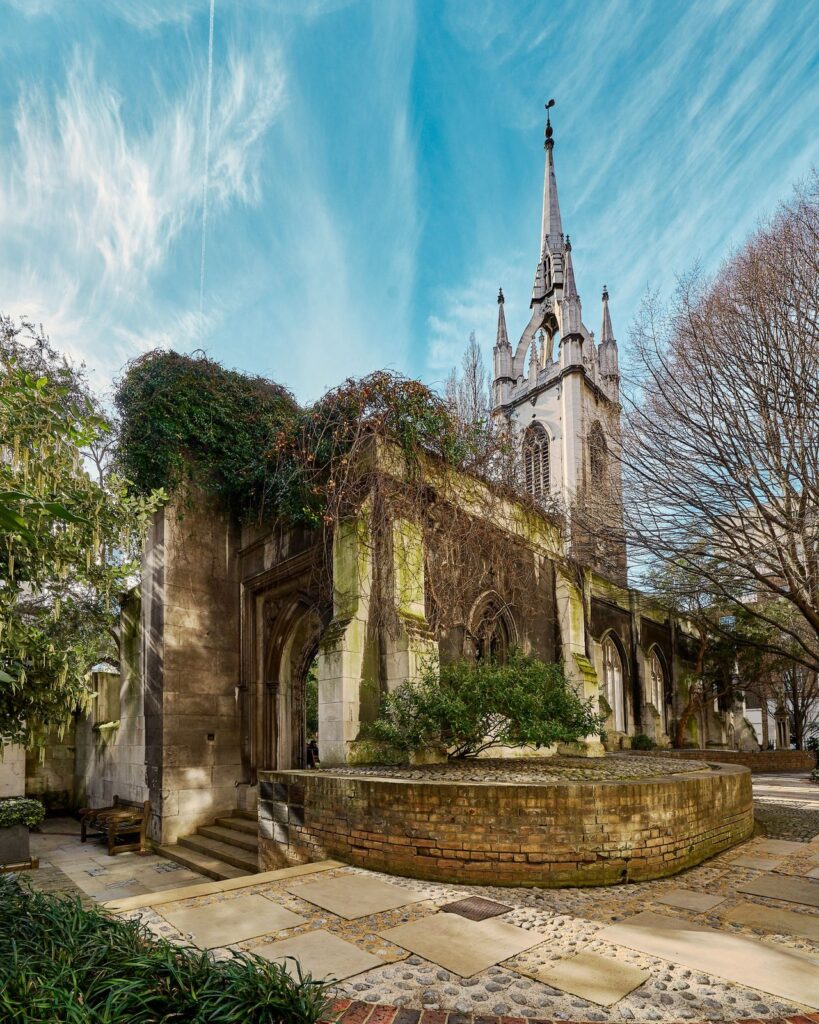
Hidden down a narrow alley in the City of London, just off Lower Thames Street, is one of the most atmospheric places in the entire city. St Dunstan-in-the-East is a medieval church that was bombed during the Blitz in 1940. Rather than restore it, the City of London transformed the roofless shell into a public garden.
Walking through its Gothic arches today, with ivy climbing the old stone walls and ferns growing where pews once stood, is a quietly extraordinary experience. The church tower — designed in part by Sir Christopher Wren after an earlier fire — still stands. Birdsong fills the air where sermons were once preached.
There are no dramatic signs telling you how to feel. The place does it without help. It is one of the most visited spots in London that most tourists have never heard of, and it is free to enter any time the gate is open. If you walk through the City and stumble upon it by accident, consider yourself lucky.
It is also a reminder that destruction and beauty are not always opposites. Sometimes, what survives the worst is more powerful than what came before.
The Churchill War Rooms: The War Fought Underground
Beneath the streets of Westminster, just a short walk from the Houses of Parliament, lies one of the most remarkable museums in London. The Churchill War Rooms preserve the underground bunker from which Winston Churchill and his War Cabinet directed Britain’s war effort during the Blitz and beyond.
When you walk in, the calendar on the wall reads August 1945 — the date the complex was sealed after victory. The rooms have been kept largely as they were left. You can see the transatlantic telephone room where Churchill spoke in secret to President Roosevelt. You can stand in the Map Room, where the course of the war was tracked hour by hour with coloured pins on enormous charts.
The museum also includes the Churchill Museum — a separate exhibition about the man himself. His early life, his political setbacks, and his rise to lead Britain at its most dangerous moment. It is detailed, honest, and genuinely gripping, even for visitors who think they already know the Churchill story.
The War Rooms are run by the Imperial War Museum and charge for admission. Booking in advance is strongly recommended, particularly during school holidays and summer months.
St Paul’s Cathedral: Symbol of London’s Survival
On 29 December 1940, during one of the most devastating raids of the Blitz, much of the City of London burned. Photographs taken that night show St Paul’s Cathedral emerging from a wall of smoke and flame, its dome intact, fires raging around it on all sides.
The cathedral’s survival became the defining image of London’s resilience during the war. St Paul’s had been protected by a team of volunteer fire watchers who spent each night on the roof, extinguishing incendiary bombs before they could take hold. Their work saved the building.
Today you can visit St Paul’s and see the Blitz memorials inside, including the American Memorial Chapel — built after the war as a tribute to the American servicemen and women who lost their lives while stationed in Britain. The names of more than 28,000 Americans are recorded in a book displayed in a glass case, turned one page per day. It is a small detail that is easy to walk past and impossible to forget once you have seen it.
The Whispering Gallery, the Golden Gallery at the top of the dome, and the crypt — where Lord Nelson and the Duke of Wellington are buried — are all worth exploring during your visit.
🏛 Enjoying this? 3,000 London lovers get stories like this every week. Subscribe free →
The East End: Ordinary People in Extraordinary Times
The East End of London — Whitechapel, Stepney, Bethnal Green, Poplar — bore a disproportionate share of the early bombing. The docks and the working-class streets surrounding them were targeted for strategic reasons, but the people who lived there had no say in that.
Bethnal Green Tube station was the site of one of the most devastating civilian disasters of the war. In March 1943, during an air raid warning, a crush on the staircase leading down to the shelter killed 173 people. A memorial now marks the entrance. It is modest, easy to miss, and absolutely worth pausing at if you pass by.
The Museum of London Docklands in Canary Wharf has a strong permanent exhibition on the East End during the Blitz — personal accounts, photographs, and objects that bring the civilian experience to life. It is free to enter and often quieter than the major central London museums.
The Imperial War Museum: London’s Most Powerful War Museum
South of the Thames in Lambeth, the Imperial War Museum occupies a striking building that was once a psychiatric hospital. Two large naval guns flank the entrance. Inside, it covers every major conflict involving British and Commonwealth forces since the First World War, and its Second World War galleries are exceptional.
The Blitz exhibition recreates the experience of being in London during the bombing — the sounds, the atmosphere, the physical conditions in which families sheltered night after night. It is immersive without being overwhelming, and the personal stories woven through it are what stay with you long after you leave.
The museum is free to enter, though special exhibitions sometimes charge separately. It sits south of the Thames and is well connected by bus from Westminster and Waterloo station.
Planning Your WWII Heritage Walk in London
Most of London’s WWII heritage sites connect naturally into a single walking day if you plan the route. The City of London — the historic square mile — is compact and full of Blitz-era details if you look carefully. Bombed churches turned into gardens, patched stonework, and quiet memorials are all woven into the fabric of everyday streets.
A suggested day:
- Morning: Churchill War Rooms, Westminster. Allow at least two hours.
- Midday: Walk east to St Paul’s Cathedral via the Embankment. Visit the American Memorial Chapel inside.
- Early afternoon: Continue east into the City to St Dunstan-in-the-East. Take your time here.
- Afternoon: Cross the river to the Imperial War Museum. The Blitz galleries are worth the journey on their own.
Total walking distance is roughly four to five miles depending on your route. The Tube or a bus can cover any gaps on a long afternoon.
Is the Churchill War Rooms worth visiting?
Yes — the Churchill War Rooms are among the best museums in London. The underground bunker has been preserved exactly as it was when it closed in 1945, and the Churchill Museum adds real depth to the experience. Allow at least two hours, and book tickets in advance, especially during summer.
Where is St Dunstan-in-the-East?
St Dunstan-in-the-East is on St Dunstan’s Hill in the City of London, EC3R 5DD. It is a short walk from Monument Tube station. The garden is free to enter and open during daylight hours. The entrance gate is easy to walk past without noticing — look carefully for the turning off Lower Thames Street.
How long did the London Blitz last?
The main phase of the London Blitz ran from 7 September 1940 to 11 May 1941. London was bombed on 57 consecutive nights at the start of the campaign. After May 1941, bombing continued intermittently. London was also targeted by V-1 flying bombs and V-2 rockets in 1944 and into 1945.
🇬🇧 25 London Places Most Visitors Miss
From secret riverside walks to hidden Victorian tunnels, centuries-old pubs to rooftop gardens with skyline views — our free guide reveals the London most visitors never discover. Join 3,000+ London lovers who get it free.
Get Your Free 25-Places Guide →Already subscribed? Download your free London guide (PDF)
Free forever · One email per week · Unsubscribe anytime