
When you stand in the middle of a busy London street, you are walking on ground that has been inhabited for nearly 2,000 years. Beneath the pavements, the glass towers, and the Victorian terraces lies a different city entirely — Londinium, the Roman city that gave birth to everything you see today.
This is London’s oldest secret. And once you know where to look, the Roman city is still there, waiting to be found.
How Rome Founded London in 43 AD
When the Emperor Claudius sent his legions across the Channel in 43 AD, Britain was a land of tribes, forests, and scattered settlements. The Romans marched north from the coast and reached a broad tidal river they called the Tamesis. Here, where the Thames narrowed just enough to bridge, they established a crossing point.
Within a decade, a small Roman settlement had grown on the north bank. The Romans called it Londinium. They built a timber bridge across the Thames — the first London Bridge — and the town grew quickly around it.
By the end of the first century, Londinium had become the largest city in Roman Britain. Merchants arrived from across the Empire. A bustling port filled the waterfront. A forum, bathhouses, temples, and homes spread across the two low hills north of the river.
The city you walk through today follows remarkably similar lines. The street plan of the Square Mile — London’s financial district — still echoes the grid the Romans laid down nearly twenty centuries ago. When you walk from Cornhill to Cheapside, you are following a route first trodden by Roman legionaries.
The Queen Who Burned London to the Ground
London’s first century was not peaceful. In 60 AD, Boudica, Queen of the Iceni tribe in what is now East Anglia, led an uprising against Roman rule that came within a hair’s breadth of ending the city before it had properly begun.
After Roman authorities seized Iceni lands and treated her family with great cruelty, Boudica assembled a force estimated at tens of thousands of warriors. Her army swept south and destroyed three Roman settlements in quick succession — Camulodunum (Colchester), Verulamium (St Albans), and Londinium itself.
Archaeologists have found a thin layer of dark red ash beneath the streets of the City of London — the physical trace of Boudica’s fires, buried under two thousand years of subsequent history. When you descend into any archaeological dig in the Square Mile, this scorched layer appears like a bookmark placed in the earth by history itself.
The Romans defeated Boudica in battle shortly afterwards. London was rebuilt, this time more permanently and ambitiously. A magnificent bronze statue of Boudica riding her chariot stands at the north end of Westminster Bridge, beside the Houses of Parliament — a permanent tribute to the warrior queen who once threatened to erase London entirely from the map.
The Roman Wall You Can Still Touch
Between around 190 and 225 AD, the Romans enclosed Londinium within a massive defensive wall. It ran for approximately three miles, stood up to six metres high, and was up to three metres thick at the base. It defined the boundaries of the city for more than a thousand years after the Romans departed Britain.
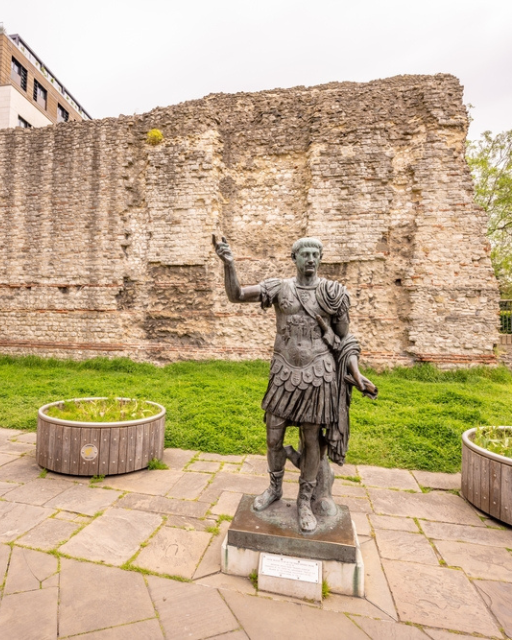
Remarkably, significant sections of this wall still survive. The best place to find them is Tower Hill, in the shadow of the Tower of London. Here you can stand beside a stretch of Roman stonework that has endured for eighteen centuries. The base courses are original Roman work — a distinctive mix of Kentish ragstone and tile — while the upper sections were rebuilt in medieval times. The difference in the masonry is clearly visible if you look closely.
Other sections of the Roman wall survive around the Barbican, on Noble Street, and at St Alphage Garden near London Wall. At each location, you can lay your hand on stones that Roman builders quarried in Kent, transported to London by river, and mortared into place in the third century. No admission fee. No booking required. Just a direct connection across two millennia.
A walk along the surviving sections of the Roman wall is one of London’s most atmospheric and underrated heritage experiences. The route is free, open at all hours, and often quiet even in the middle of a busy week.
🏙️ Enjoying this? 3,000 London lovers get stories like this every week. Subscribe free →
The Hidden Amphitheatre Under the Guildhall
Perhaps the most dramatic Roman discovery in London’s history came in 1988, when workers preparing foundations beneath the Guildhall Art Gallery stumbled upon the curved walls of London’s Roman amphitheatre. The find stunned archaeologists. Nobody had known it was there.
Built around 70 AD and extended to hold approximately 7,000 spectators, the amphitheatre once stood at the heart of Londinium. It hosted gladiatorial contests, public executions, and wild animal hunts — the shared entertainments that bound Roman society together across the Empire.
You can descend into its remains today through the Guildhall Art Gallery on Gresham Street. The experience beneath street level is genuinely extraordinary. Curved green barriers mark the outline of the original arena. Roman drainage channels and walls run along the perimeter. Lighting and sound bring the space to life. Standing there, you understand viscerally that London is not just a modern city built on old ground — it is an old city that never stopped building on itself.
Entry to the Roman amphitheatre is free. The Guildhall Art Gallery above it holds a fine collection of Victorian paintings and is also worth a look while you are there.
The Temple of Mithras at Bloomberg’s London HQ
In 1954, workers constructing an office building on Queen Victoria Street made one of the most significant Roman finds of the twentieth century. They uncovered the ruins of a temple dedicated to Mithras, a god particularly popular with Roman soldiers and merchants across the Empire.
The Temple of Mithras was carefully excavated and later moved to a temporary location for display. When Bloomberg built their European headquarters on the same site, they made the decision to reconstruct the temple at its exact original position, nine metres below street level — one of the most thoughtful acts of heritage preservation in modern London.
Today, visitors can descend into the Bloomberg SPACE and enter a darkened chamber where the reconstructed temple walls surround you. Sound, mist, and lighting recreate the atmosphere of Roman religious ceremony. It is a haunting experience, free to visit, and one that the majority of Londoners have never seen. Few places in London make the ancient city feel so immediate.
Planning Your Roman London Walk
The great advantage of Roman London is that most of its sites are free to visit, relatively close together, and accessible year-round. A half-day walk through the Square Mile can take in the Temple of Mithras, the site of the Roman forum on Cornhill, sections of the Roman wall, and the Guildhall amphitheatre.
Start at the Bloomberg SPACE on Queen Victoria Street for the Temple of Mithras (check opening hours and book a free ticket in advance online). Walk east along Queen Victoria Street, then north to the Guildhall Art Gallery on Gresham Street for the amphitheatre. From there, the Roman wall sections at Noble Street and Aldersgate Street are a short walk north.
Finish at Tower Hill, where the best-preserved section of the Roman wall stands beside the Emperor Trajan statue. From Tower Hill station, you can connect to the rest of the city easily.
If you want to go deeper into Roman London, the London Museum — reopening in the historic Smithfield Market building in West Smithfield — holds one of the finest collections of Roman artefacts in the world. Its Roman gallery includes everyday objects: sandals, brooches, surgical instruments, children’s toys. These are not grand imperial monuments but intimate human remains. They bring Londinium’s inhabitants very close indeed.
Roman London rewards the curious visitor. You only need to know where to look — and the city that has been there for nearly two thousand years will reveal itself.
Frequently Asked Questions About Roman London
What was London called in Roman times?
London was called Londinium by the Romans. It was founded around 43 AD following the Roman invasion of Britain under Emperor Claudius. By the second century AD, Londinium had become the largest city in Roman Britain, with an estimated population of 30,000 to 60,000 people, and served as the capital of the province of Britannia.
Where can I see Roman remains in London today?
Several Roman remains are open to visitors in London. The best-preserved section of the Roman city wall stands at Tower Hill, near the Tower of London. The Roman amphitheatre can be seen beneath the Guildhall Art Gallery on Gresham Street. The Temple of Mithras has been reconstructed at Bloomberg’s European headquarters on Queen Victoria Street. Additional wall sections survive near the Barbican and on Noble Street. All of these sites are free to visit.
When did the Romans leave London?
The Romans left Britain in stages during the early fifth century. By around 410 AD, Roman administration had effectively ended and the legions had been withdrawn to defend other parts of the Empire. Londinium was gradually abandoned over the following decades. The population shrank dramatically and the city fell largely silent for several centuries before being resettled by the Anglo-Saxons, who established a new trading settlement they called Lundenwic, west of the old Roman walls.
Join 3,000+ London Lovers
Every week, get London’s hidden history, heritage walks, and stories from the city’s remarkable past — straight to your inbox.
Subscribe free — enter your email:
Already subscribed? Download your free London guide (PDF)
Love more? Join 64,000 Ireland lovers → · Join 43,000 Scotland lovers → · Join 30,000 Italy lovers →
Free forever · One email per week · Unsubscribe anytime