
Most people turn left at Tower Bridge. They follow the tourist path to the river, the glass towers, the souvenir stands. Turn right instead — through a narrow opening between the buildings — and you step into a different London entirely.
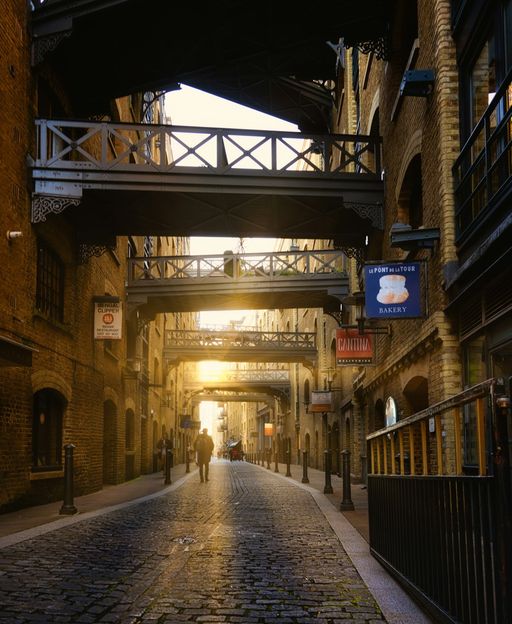
Shad Thames is a cobbled street in Bermondsey, tucked behind Tower Bridge and almost invisible from the main road. Victorian brick warehouses rise on either side. And above your head, crossing the street at two, three, and sometimes four storeys, iron walkways span the gap between buildings.
The Warehouses That Held an Empire’s Cargo
Before the container revolution transformed global shipping in the 1960s and 70s, the stretch of the Thames between Tower Bridge and London Bridge was one of the world’s busiest working rivers.
The Pool of London, as this section was known, received ships from across the British Empire. Tea from Assam, coffee from East Africa, spices from the Banda Islands, grain from Australia — all of it arrived by ship and had to be offloaded somewhere.
It went here. The warehouses of Shad Thames and the wider Butler’s Wharf area held millions of pounds of cargo at any one time. Workers became so accustomed to the smell of spice that they reportedly stopped noticing it after a few weeks on the job.
The street names that developers preserved when converting the buildings in the 1980s are more than branding — they are a record. Cardamom Building, Cinnamon Wharf, Vanilla and Sesame at Butler’s Wharf. This street earned those names through decades of unloading ships.
Why Victorian Workers Walked Through the Air
The most striking feature of Shad Thames — those iron walkways crossing overhead — were not built for atmosphere. They were working infrastructure.
Dock workers moved goods between floors and between buildings constantly. Taking a loaded barrow down a warehouse staircase, across the cobbled street, and up into the next building was slow, dangerous, and inefficient.
The walkways solved the problem. Workers pushed heavy loads across them at height, connecting the upper storage floors of one warehouse directly to the upper floors of the building opposite. Goods moved continuously without ever touching the street below.
At the height of the dock trade, multiple walkways above the street would have been busy at the same time. Men pushing loaded barrows over iron-grilled floors, the Thames just visible at the far end of the street, the smell of ground spices rising from the cobblestones below.
Today those walkways carry nothing heavier than morning light. They give Shad Thames its defining quality — the sense that you can see inside a Victorian engineering solution that solved a real problem, and is still standing because it worked.
How Shad Thames Survived the Developers
By the late 1970s, Shad Thames was derelict.
The London docks had closed. Containerisation had shifted the entire global shipping industry, almost overnight. Warehouses like these, built for a different way of moving goods, were obsolete. The streets around them were empty.
Proposals circulated for clearing the site. Modern housing estates, suited to the 1970s vision of progress, were drawn up for the same footprint.
What stopped them was a combination of stubborn Victorian construction and shifting cultural values. The conservation movement that had already saved parts of the City of London began to look at Bermondsey. The warehouses were structurally sound and expensive to demolish. Attitudes toward Victorian architecture were slowly changing.
In the early 1980s, the designer and restaurateur Terence Conran took on Butler’s Wharf. He converted the warehouse complex into flats, restaurants, and the original home of the Design Museum. The cobblestones survived. The walkways survived. The original loading crane brackets, still bolted to the brickwork on some facades, survived.
Shad Thames was transformed rather than erased — and what remains today is genuine rather than reconstructed.
Enjoying this? 3,000+ London lovers get stories like this every week. Subscribe free →
Exploring Shad Thames Today
The street runs for a few hundred metres between Tower Bridge Road and the Bermondsey riverside, opening onto the Thames at each end. There is no entrance fee, no queue, no tour group required.
At ground level, independent restaurants and cafes occupy the old warehouse arches. The Butler’s Wharf Chop House — one of Terence Conran’s original restaurant openings — still occupies a riverside terrace with direct views up to Tower Bridge. Cantina del Ponte, a long-standing Italian restaurant within the converted warehouse arches, is a reliable option for lunch or dinner after exploring the street.
The street is at its most atmospheric in the early morning or at dusk. The golden light catches the brick and iron walkways differently at each end of the day, and the quiet of a weekday morning makes the whole place feel genuinely discovered.
Above the restaurants, the original warehouses are now luxury flats. If you look up at the walkways, you will sometimes see a resident crossing between buildings — exactly as the dock workers did, more than a century ago, though carrying rather different cargo.
What Else Is Nearby
Shad Thames sits in a part of south London that rewards a full afternoon of exploration.
Tower Bridge is immediately to the west. If you have never seen what is inside Tower Bridge — the Victorian steam engines, the glass-floored high-level walkways, the engine rooms that most visitors walk past — it is worth the admission either before or after exploring Shad Thames.
Borough Market, London’s oldest surviving food market, is a ten-minute walk west along the South Bank. A Saturday morning at Borough Market followed by an afternoon in Shad Thames is one of the better ways to spend a day in this part of the city.
For visitors planning their first trip to London, the 3-day London itinerary puts Shad Thames in context with the wider city and helps you build a route that makes geographical sense.
What is Shad Thames and why is it worth visiting?
Shad Thames is a Victorian cobbled street in Bermondsey, directly behind Tower Bridge, famous for its overhead iron walkways connecting former spice warehouses. It is one of London’s best-preserved Victorian streetscapes and remains largely unknown to first-time visitors — making it one of the city’s most atmospheric free discoveries.
Is Shad Thames free to visit?
Yes. Shad Thames is a public street and costs nothing to walk through. The iron walkways and Victorian architecture can be explored at any time of day without charge. Restaurants and cafes along the street are available but entirely optional.
What is the best time to visit Shad Thames in London?
Early morning or late afternoon are the best times. The golden light on the Victorian brick and iron walkways is most striking at those hours, and the street is quiet enough to feel like a genuine discovery. Weekday mornings before 9am are particularly good.
How do you get to Shad Thames in London?
Take the Tube to London Bridge (Jubilee or Northern line) or Tower Hill (District or Circle line). From Tower Bridge, walk to the Bermondsey riverside and head a short distance east — the cobblestone street and overhead walkways are immediately visible. The walk takes around five minutes from either station.
Victorian London was remade so thoroughly, and so many times, that most of what defined it is long gone. The gaslit alleyways went. The covered markets went. The cobblestone streets went, one by one.
Shad Thames stayed. Not through grand plan or political will, but because it was built well enough, and someone decided it was worth keeping.
Turn right at Tower Bridge. You will understand why.
🇬🇧 25 Hidden Gems of London Most Tourists Never Find
From secret riverside walks to hidden Victorian tunnels, centuries-old pubs to rooftop gardens with skyline views — our free guide reveals the London most visitors never discover. Join 3,000+ London lovers who get it free.
Get Your Free London Hidden Gems Guide →📲 Know someone who’d love this? Share on WhatsApp →
Love more? Join 65,000 Ireland lovers → · Join 43,000 Scotland lovers → · Join 29,000+ Italy lovers →
Free forever · · Unsubscribe anytime
Subscribe Free