
Every year, millions of people stand in Trafalgar Square and look up at Nelson’s Column. They photograph the lions. They toss coins in the fountains. Almost none of them notice that one of the four corner plinths holds no statue — and hasn’t for most of its existence.
That empty plinth stood bare for 154 years. There’s a reason nobody talks about it. And it turns out, the whole square is full of stories like that.
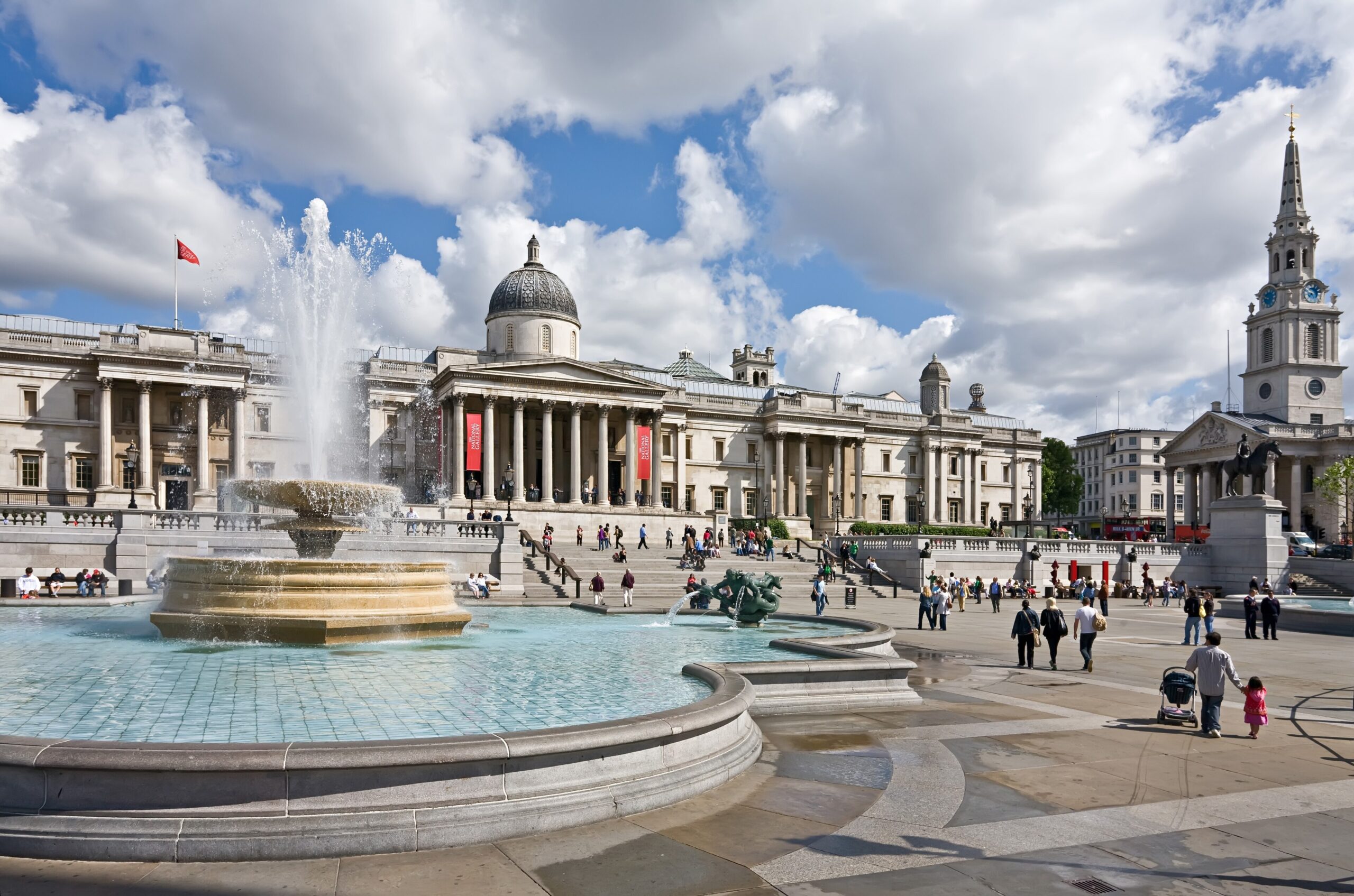
Before the Square: Five Centuries of Royal Horses
Trafalgar Square didn’t always exist. Before it was built, the land was occupied by the King’s Mews — a vast royal stable and falconry that had stood there since the 14th century.
The Mews housed the monarch’s horses, hawks, and falconers. It was a working royal complex right in the heart of London. For five hundred years, the spot that millions now visit for selfies was essentially a very grand stable yard.
When King George IV moved the royal stables to Buckingham Palace in the 1820s, the land was finally freed up. The architect John Nash saw an opportunity. He envisioned a grand public space that would connect the government buildings of Whitehall to the cultural institutions of the north. The square that emerged from his vision was named after the Battle of Trafalgar — the 1805 naval battle in which Admiral Horatio Nelson defeated Napoleon’s fleet and lost his own life.
Why Nelson Stood Alone for 24 Years
Nelson’s Column was completed in 1843. The statue of Nelson at the top — which looks tiny from street level — is actually 5.5 metres tall. That’s taller than most houses. The full column rises 51.6 metres into the London sky.
But here’s the thing most people miss. The four giant lions that now guard the base of the column weren’t installed until 1867. Nelson stood there for 24 years without them.
The lions were designed by Edwin Landseer, a celebrated Victorian artist known for painting animals. He was commissioned to produce the sculptures in 1858 — already 15 years after the column went up — and then took another nine years to deliver them. Stories circulated in London that he had been studying a dead lion obtained from London Zoo, working from the decomposing body in his studio. Whether true or not, the lions he produced are magnificent. Each one weighs seven tonnes. They are arranged in pairs, two facing Parliament, two facing the National Gallery.
If you’re planning a visit to the square and want to explore more of central London, the London planning hub has everything you need to put together your itinerary.
The Plinth That Baffled Britain for 154 Years
Trafalgar Square has four corner plinths — stone pedestals designed to hold statues. Three were filled relatively quickly. King George IV occupies the north-east corner. Two military generals — Sir Charles Napier and Major General Sir Henry Havelock — stand in the south corners.
The fourth plinth, in the north-west corner, was meant to hold an equestrian statue of King William IV. But the commission ran out of money. No royal patron stepped forward to fund it. The plinth sat empty from 1844 onwards, a stone platform going nowhere, in the middle of one of the most visited squares in the world.
It remained empty for 154 years.
Londoners noticed, of course. Over the years, various proposals were made — statues of monarchs, generals, politicians. None were accepted. The plinth became a kind of running joke, an embarrassment, a gap in an otherwise grand composition.
Enjoying this? 3,000+ London lovers get stories like this every week. Subscribe free →
The Living Art Gallery That Finally Filled the Gap
In 1998, the Royal Society of Arts launched something bold. Instead of choosing a permanent statue, they decided to use the Fourth Plinth for temporary contemporary art commissions. The plinth would rotate, displaying new works every year or two.
It was a gamble. London wasn’t sure how to feel about it. But the results have been extraordinary.
Over the years, the Fourth Plinth has hosted a ship in a bottle by Yinka Shonibare, a giant blue thumbs-up sculpture by David Shrigley, and Antony Gormley’s One & Other — a project in which ordinary members of the public spent one hour each on the plinth, 24 hours a day for 100 days. Thousands of Londoners climbed up there. Some sang, some slept, some made speeches, some dressed in costumes. The plinth became, briefly, the most democratic piece of public art in the world.
The commission is now one of the most prestigious in global public art. Artists compete for it. The works are discussed and debated and argued about in newspapers and pubs across the country. For a plinth that stood empty for 154 years, it’s made up for lost time.
If you enjoy discovering the lesser-known histories of London’s most famous spots, you might also like reading about the hidden medieval worlds that still survive in central London.
What Else You’re Missing When You Stand in the Square
The scale of the square itself tends to fool visitors. Trafalgar Square is enormous — far larger than most people realise until they stand in it. From the National Gallery steps to the south fountain is over 300 metres. The fountains themselves, which look decorative, were actually installed in 1845 partly to reduce the amount of usable space available for large public gatherings and demonstrations.
Look at the north wall of the square and you’ll find four small bronze measuring bars set into the stone — the Imperial Standard measures of length used in Britain before metrication. They’re the official standards for an inch, a foot, two feet, and a yard. Millions of people walk past them every day without a second glance.
Look up at Nelson himself and consider this: the statue is 5.5 metres tall and stands on top of a column 51.6 metres high. If you could somehow bring Nelson down to street level, he’d tower over the crowds. His hat alone is half a metre tall. The sculptor, Edward Hodges Baily, carved him from Craigleith sandstone quarried in Scotland, and Nelson faces south — towards the sea, and towards France, and towards the battle that made him immortal.
Most visitors never look that carefully. But that’s the thing about London’s landmarks — the closer you look, the more there is to find. For more ideas on what to discover, browse the London planning hub before your trip.
Frequently Asked Questions About Trafalgar Square
What is the Fourth Plinth in Trafalgar Square?
The Fourth Plinth is the north-west corner pedestal in Trafalgar Square that stood empty for 154 years after the commission to fill it ran out of money in 1844. Since 1998 it has hosted rotating contemporary art installations, and is now one of the world’s most prestigious public art commissions.
Why did it take 24 years to install the lions in Trafalgar Square?
The four bronze lions at the base of Nelson’s Column were designed by Edwin Landseer, who was commissioned in 1858 — already 15 years after the column was erected — and took another nine years to deliver the sculptures. They were finally installed in 1867, giving Nelson a 24-year wait for his guardians.
What was on the site of Trafalgar Square before it was built?
Before Trafalgar Square was built in the 1820s–1840s, the land was occupied by the King’s Mews — the royal stables and falconry that had stood there since the 14th century. When the stables were relocated to Buckingham Palace, the area was cleared and redesigned as a grand public square.
How tall is Nelson’s Column in Trafalgar Square?
Nelson’s Column stands 51.6 metres (169 feet) tall, including the statue of Admiral Nelson at the top. The statue itself is 5.5 metres (18 feet) tall — meaning if it were placed at ground level, it would be taller than a three-storey building. From street level, it looks surprisingly small.
London rewards curiosity. The more you slow down and look, the more the city reveals itself — and Trafalgar Square is a good place to start.
🇬🇧 25 Hidden Gems of London Most Tourists Never Find
From secret riverside walks to hidden Victorian tunnels, centuries-old pubs to rooftop gardens with skyline views — our free guide reveals the London most visitors never discover. Join 3,000+ London lovers who get it free.
Get Your Free London Hidden Gems Guide →Love more? Join 65,000 Ireland lovers → · Join 43,000 Scotland lovers → · Join 29,000+ Italy lovers →
Free forever · Unsubscribe anytime
Subscribe Free