
On the night of 29 December 1940, the skies over London turned orange. German bombers dropped thousands of incendiary bombs on the City of London — the ancient square mile at London’s heart. By morning, dozens of churches built by Christopher Wren after the Great Fire of 1666 lay destroyed or badly damaged.
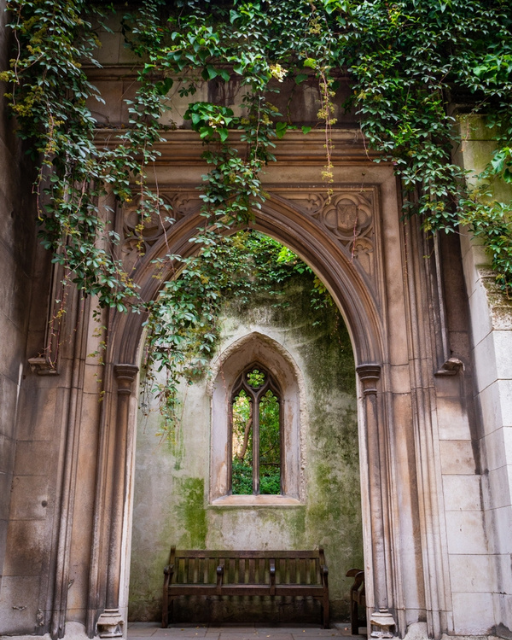
In all, the Blitz killed more than 30,000 Londoners and damaged or destroyed over a million homes. But something unexpected happened in the decades that followed. Instead of demolishing the roofless ruins, London let some of them stand. It planted gardens inside their walls. Today, these Blitz ruins are among the most quietly moving places in the city — and among the least visited.
This guide covers the bombed churches you can still walk through, and why they matter to anyone with family ties to wartime Britain.
St Dunstan-in-the-East: London’s Most Haunting Ruin
St Dunstan-in-the-East stands in a narrow lane off Lower Thames Street, a few minutes’ walk from Tower Bridge. The church dates back to the 12th century, though Christopher Wren rebuilt much of it after the Great Fire of London in 1666. His Gothic tower still stands today — a rare example of Wren working in the medieval style.
The main body of the church did not survive the Blitz. German bombing in 1941 destroyed the nave and left only the outer walls standing. After the war, the decision was made not to rebuild. Instead, the Corporation of London turned the ruins into a public garden.
Today, ivy covers the old stone arches. Trees grow where pews once stood. A small fountain sits at the centre of what was the nave. On a quiet weekday morning, you can sit here in almost complete silence, surrounded by ancient walls, with the sounds of the City barely audible outside.
Most visitors walk straight past without noticing. There is no big sign. There is no queue. It is simply there — a secret tucked between office buildings, exactly as it has been since the Corporation opened it as a public garden in the 1960s.
The Scale of What the Blitz Destroyed
Between September 1940 and May 1941, German bombers attacked London on 71 out of 76 consecutive nights. The Luftwaffe dropped around 18,800 tonnes of bombs on the city over that period.
Christopher Wren built 51 churches after the Great Fire of 1666. The Blitz destroyed or severely damaged 19 of them. Sixteen were rebuilt in the years after the war. Three — St Dunstan-in-the-East, Christ Church Greyfriars, and St Mary Aldermanbury — were left as ruins.
The City of London suffered worst of all. The Guildhall, which had stood since 1411, lost its great hall roof. St Paul’s Cathedral survived — famously — but only through extraordinary effort. The cathedral’s fire watch volunteers spent the night of 29 December 1940 throwing incendiary bombs from the roof before they could take hold. Photographs of the dome rising above the surrounding smoke became one of the defining images of British wartime resistance.
🏙️ Enjoying this? 3,000 London lovers get stories like this every week. Subscribe free →
Christ Church Greyfriars: A Wren Shell Near St Paul’s
A short walk from St Paul’s, at the corner of Newgate Street and King Edward Street, stands another bombed Wren church. Christ Church Greyfriars was built in 1687 on the site of a medieval Franciscan friary. The Blitz gutted it in December 1940.
The shell of the church was preserved, and today the interior is a garden. The building’s tower has been converted into a private home by the Landmark Trust — an organisation that saves historic buildings across Britain by letting them as holiday accommodation.
What makes Christ Church Greyfriars particularly interesting is its history before Wren. The original medieval church here was the burial place of Margaret of France, second wife of King Edward I. The area around it was known in medieval times as Stinking Lane — a clue to what the neighbourhood once smelled like before centuries of city development transformed it.
St Mary Aldermanbury: The Church That Crossed the Atlantic
The third great Wren ruin tells an even more unusual story. St Mary Aldermanbury was bombed in December 1940 and left as a ruin in the City of London for decades. Then, in 1966, the entire building was dismantled stone by stone and shipped to Fulton, Missouri.
It was rebuilt there as a memorial to Winston Churchill, who had given his famous “Iron Curtain” speech in Fulton in 1946. Today the church stands on the campus of Westminster College — rebuilt with original London stone, with a Churchill Museum beneath it.
The garden left behind in London still exists on Love Lane, near the Guildhall. A small memorial explains where the church went and why. For American visitors with ties to the Midwest, this transatlantic connection gives the Blitz a very direct link to their own part of the world.
A Self-Guided Blitz Heritage Walk: What to See
The City of London is compact enough to walk between the main Blitz heritage sites in two to three hours. You do not need a guide or a booked tour.
St Dunstan-in-the-East garden is open during daylight hours, seven days a week, free of charge. From Monument tube station, walk east along Lower Thames Street and turn down St Dunstan’s Hill. The gate is set into a stone archway in the lane.
Christ Church Greyfriars garden sits at the intersection of Newgate Street and King Edward Street, a short walk from St Paul’s Cathedral tube station. Free entry through an iron gate during daylight hours.
The Guildhall — the medieval civic heart of the City — is open to the public on weekdays. The 15th-century walls survived the Blitz; the roof was replaced after the war. The Guildhall Art Gallery next door holds an excavated Roman amphitheatre beneath it. Free entry.
The Churchill War Rooms in Westminster are not a Blitz ruin, but they are part of the same story. The underground bunker from which Churchill and his cabinet directed the war is preserved exactly as it was left in 1945, down to the maps still pinned to the walls. Allow two hours. Admission charges apply; the nearest tube is Westminster.
St Paul’s Cathedral is worth visiting to understand what London was fighting to protect. The crypt holds memorials to the fire watch volunteers who saved the building. The You Are Not Forgotten memorial to American servicemen and women who died in WWII sits near the west end of the nave.
The Blitz and British Family History
For many American visitors, the Blitz is not just history. It is family history.
Around 8.3 million Americans claim British ancestry. Many have grandparents or great-grandparents who lived through the war — in London, in other British cities, or as civilians who survived the bombing of Coventry, Bristol, or Liverpool. American GIs were stationed at bases across southern England from 1942 onwards and visited London in large numbers.
If your family has English roots, tracing their wartime experience is more possible than you might think. The National Archives at Kew holds civilian records including ARP (Air Raid Precautions) warden logs and records of damaged properties. The London Metropolitan Archives holds borough-level civil defence records from the Blitz period. Both are accessible to the public, in person and partially online.
Ancestry.com and Findmypast both hold British military service records. The Commonwealth War Graves Commission records every British and Commonwealth serviceman and woman who died — their database is free to search at cwgc.org and includes memorials across London and Britain.
Standing inside St Dunstan-in-the-East, looking up through the ruined arches at the sky, it is not difficult to imagine what this place looked like on the morning of 30 December 1940. The walls are the same walls. The stone is the same stone. London, in its own quiet way, has held onto this.
Frequently Asked Questions
Can you visit St Dunstan-in-the-East for free?
Yes. St Dunstan-in-the-East garden is open to the public at no cost during daylight hours, seven days a week. It is maintained by the City of London Corporation. There is no formal entrance fee — you walk in through the gate on St Dunstan’s Hill. The nearest tube station is Monument on the Central and District lines.
How many London churches were destroyed in the Blitz?
Of the 51 churches Christopher Wren built after the Great Fire of 1666, the Blitz damaged or destroyed 19. Most were rebuilt in the years after the war. Three — St Dunstan-in-the-East, Christ Church Greyfriars, and St Mary Aldermanbury — were left as ruins or relocated. The City of London converted the first two into public gardens.
Are the Churchill War Rooms worth visiting?
Yes, particularly for anyone interested in WWII history or Anglo-American heritage. The Cabinet War Rooms in Westminster are preserved exactly as they were when abandoned in August 1945. The attached Churchill Museum traces his life and wartime leadership in detail. Allow two hours at minimum. The site is on King Charles Street in Westminster and is managed by the Imperial War Museum.
Join 3,000+ London Lovers
Every week, get London’s hidden history, heritage walks, and stories from the city’s remarkable past — straight to your inbox.
Subscribe free — enter your email:
Already subscribed? Download your free London guide (PDF)
Love more? Join 64,000 Ireland lovers → · Join 43,000 Scotland lovers → · Join 30,000 Italy lovers →
Free forever · One email per week · Unsubscribe anytime