
It began before dawn on 2 September 1666 in a bakery on a narrow street called Pudding Lane. Within four days, fire had consumed the heart of London — 13,200 houses, 87 churches, and the medieval city that had grown since Roman times. When the flames finally died out, the skyline belonged to Christopher Wren, and the London we know today had been built from the ashes.
The Great Fire did not just reshape the streets. It destroyed much of the paper record of a city — the parish registers, the birth and burial lists, the marriage entries that researchers use today to trace their family histories. If your family lived in London before 1666, the fire almost certainly took some trace of them.
The Night It Started
Thomas Farriner ran a bakery on Pudding Lane in the City of London, supplying bread to the Royal Navy. On the night of 1–2 September 1666, he or someone in his household failed to properly extinguish the ovens. Shortly after midnight, the building caught fire.
London in 1666 was extraordinarily vulnerable. The summer had been one of the driest in living memory. The city consisted almost entirely of timber — houses leaned out over narrow lanes, beams nearly touching across the street, thatch roofs packed close together. A strong wind blew in from the east.
Farriner later claimed he had checked the ovens before bed. He almost certainly had not. He and his family escaped through an upstairs window. His housemaid, who refused to jump, became one of the few confirmed victims of the fire.
The Lord Mayor of London, Sir Thomas Bloodworth, received the alarm. He came to assess the situation and famously dismissed the danger: “Pish! A woman might piss it out.” He returned to bed. By morning, the fire had broken free of Pudding Lane and was racing west through the medieval city.
As the fire spread, it consumed not just timber and straw but something far harder to replace: the paper records of generations of Londoners. Parish registers — the books where clergy recorded baptisms, marriages, and burials — burned in their dozens. For anyone researching English ancestry today, that first terrible morning in Pudding Lane still casts a shadow.
🏛️ Free Guide: How to Trace Your English & British Ancestry
Step-by-step: GRO records, census 1841–1921, parish registers, the National Archives (Kew), London Metropolitan Archives, and planning a heritage trip. Completely free.
Get the Free Guide → Subscribe free at the guide page to receive weekly London heritage storiesWhat Four Days of Fire Cost London
The scale of the destruction was almost beyond comprehension. The fire burned for four days. It swept through roughly 373 acres of the City of London — most of the ancient area enclosed within the old Roman walls. Approximately 13,200 houses vanished. Eighty-seven parish churches burned to the ground.
The old St Paul’s Cathedral, which had stood for centuries on Ludgate Hill, collapsed. The lead roof melted and ran through the streets in rivers. The heat was so intense that stones exploded and the air itself seemed to glow. Samuel Pepys, the diarist who watched the fire from across the river, described pigeons that refused to leave the windowsills of burning houses until their wings caught fire.
The official death toll was just six. Historians believe the real number was higher — particularly among the poor, the people least able to flee and least likely to have their deaths formally recorded. Around 70,000 of London’s 80,000 inhabitants lost their homes. Most fled to the fields outside the city walls, carrying whatever they could.
Among the losses that mattered least in the immediate aftermath and most in the centuries since: the records. Vestry books. Parish registers going back to the 1530s. Probate records. Trade guild papers. For the genealogist, the fire drew a line across London’s family histories that no amount of research can always cross.
How London Fought Back Against the Flames
King Charles II rode out himself to help fight the fire. His brother James, Duke of York, took practical charge of the response — organising demolition gangs who used gunpowder and hand tools to pull down buildings ahead of the flames, creating firebreaks that would starve them of fuel.
These firebreaks proved critical. Without them, the fire might have consumed Westminster as well. The Tower of London survived because soldiers demolished the buildings immediately surrounding it before the fire arrived.
The fire finally died out on 5 September, partly because of the firebreaks and partly because the wind eased. It stopped at Smithfield, a market district to the northwest of the city. A small gilded statue — the Golden Boy of Pye Corner — still marks the spot where the fire ran out of fuel. It has hung on the wall at the corner of Cock Lane and Giltspur Street since 1688, a quiet footnote to four days of catastrophe.
🏙️ Enjoying this? 3,000 London lovers get stories like this every week. Subscribe free →
Tracing Your Family Through the Great Fire Gap
The fire destroyed records across dozens of parishes, but the picture is not as bleak as it first appears. Many parish registers had moved to safety before the flames reached their churches. Others survived because the clergy kept them in stone vestries rather than wooden naves. Bishop’s Transcripts — annual copies of parish records sent to the Bishop of London — survived for many parishes and now sit in the collections at the Guildhall Library and the London Metropolitan Archives.
The London Metropolitan Archives (LMA) holds the largest collection of London’s surviving pre-fire records. Many parishes have registers going back to the 1530s despite the fire. The LMA is the starting point for any serious London family history research before 1837, when central registration of births, marriages and deaths began at the General Register Office.
The National Archives at Kew holds a vast range of complementary records — wills proved at the Prerogative Court of Canterbury, hearth tax returns, lay subsidies — many of which predate the fire and survived because they were held outside the city. FamilySearch has indexed many surviving London registers online, making it possible to search from home before visiting in person.
The key gaps are real, however. If you are searching for a baptism in a parish like St Clement Eastcheap before 1666, you may simply find nothing — because the church burned, and no copy survived. Sometimes that absence is itself a discovery: it tells you the parish your ancestor most likely came from and gives you a date range to work with.
Christopher Wren and the City That Rose From the Ruins
King Charles II issued his rebuilding proclamation within a week of the fire’s end. He called for a new city built in brick and stone, not timber. Several architects submitted plans — Christopher Wren among them — but the sheer speed of reconstruction meant that London largely rebuilt on its old medieval street plan. What changed was the skyline.
Wren designed the new St Paul’s Cathedral, consecrated in 1697 and completed in 1710, and 51 new churches scattered across the City. Many still stand. St Bride’s on Fleet Street, its distinctive wedding-cake spire visible from the Strand. St Mary-le-Bow in Cheapside, whose bells traditionally defined the boundary of true Cockney London. St Stephen Walbrook, a short walk from the Monument, which architects often cite as Wren’s finest interior.
In 1677, workers completed the Monument to the Great Fire — a column standing exactly 61 metres high, which is the precise distance from its base to the site of the Pudding Lane bakery where the fire began. Christopher Wren designed this detail deliberately: if the column fell eastward, its tip would point to where the bakery had stood. The 311 steps to the viewing platform remain open to visitors, and the view from the top takes in the skyline the fire created.
Walk the Great Fire Trail in London Today
You can follow the fire’s path on foot in under an hour. The core walk — from Monument station west to St Paul’s — covers the heart of the fire’s destruction.
The Monument (Monument Street, EC3R 8AH) stands near Pudding Lane. The column bears a detailed Latin inscription listing what the fire consumed. The viewing platform, 311 steps up, provides the best perspective on how compact the medieval City actually was — and how quickly fire could have travelled through it.
Pudding Lane itself (now a short, quiet street off Monument Street) has a small blue plaque marking the approximate site of Farriner’s bakery. There is nothing dramatic to see — which is, in its own way, the point. The entire catastrophe grew from an ordinary street corner.
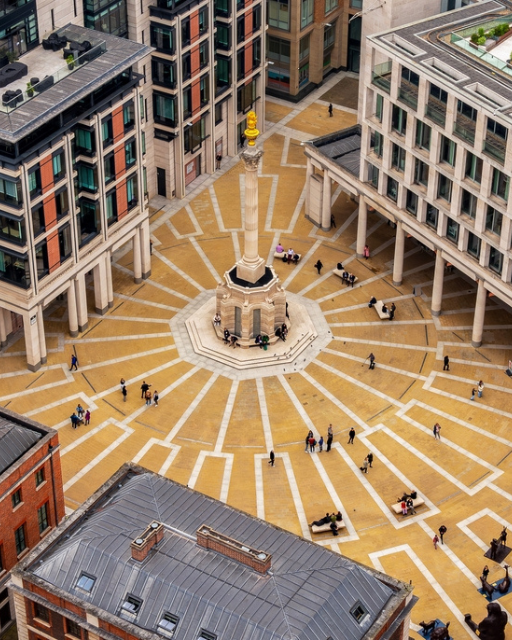
Paternoster Square, immediately beside St Paul’s Cathedral, occupies the site of the old Paternoster Row — London’s famous street of booksellers and printers. Before the fire, the booksellers stored their stock in the crypt of the old St Paul’s for safekeeping. The fire burned so hot that even the stone crypt failed them, and thousands of books were destroyed along with the building above.
St Paul’s Cathedral itself rewards a full visit — not just the famous dome, but the Whispering Gallery and the crypt where Wren lies buried. His son wrote the inscription above the tomb: Si monumentum requiris, circumspice — “If you seek his monument, look around you.”
The Golden Boy of Pye Corner (Giltspur Street, EC1A 9DE) marks the western edge of the fire’s reach. The small gilded cherub, fixed to the wall at the corner of Cock Lane, has watched over the junction since 1688. It is easy to miss — which makes finding it one of those small, satisfying London discoveries.
Frequently Asked Questions
How long did the Great Fire of London last?
The Great Fire of London burned for four days, from the early hours of 2 September to 5 September 1666. Firebreaks created by demolition gangs, combined with a change in the wind direction, brought it under control before it could reach Westminster or the Tower of London.
Where exactly did the Great Fire of London start?
The fire started at a bakery on Pudding Lane, in the City of London, in the early hours of 2 September 1666. The baker Thomas Farriner failed to extinguish his ovens fully. Extremely dry summer conditions and strong easterly winds allowed the fire to spread rapidly through the timber buildings of the medieval city.
Can I still visit the site of the Great Fire of London?
Yes. The Monument to the Great Fire stands near the corner of Monument Street and Fish Street Hill, a short walk from Monument underground station. Pudding Lane, where the fire started, runs nearby. St Paul’s Cathedral and Paternoster Square are a 15-minute walk west, and the Golden Boy of Pye Corner marks the fire’s western extent at Giltspur Street in Smithfield. All four sites form a straightforward walking trail through the City.
Join 3,000+ London Lovers
Every week, get London’s hidden history, heritage walks, and stories from the city’s remarkable past — straight to your inbox.
Subscribe free — enter your email:
Already subscribed? Download your free London guide (PDF)
Love more? Join 64,000 Ireland lovers → · Join 43,000 Scotland lovers → · Join 30,000 Italy lovers →
Free forever · One email per week · Unsubscribe anytime