
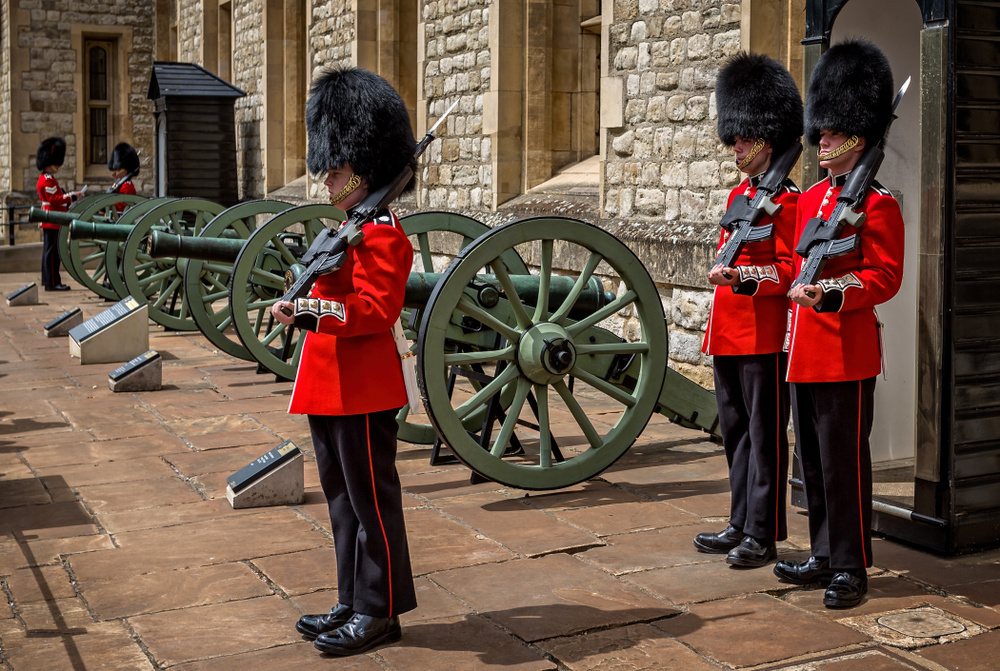
Few sights in London are as instantly recognisable as a King’s Guard standing at attention in a scarlet tunic and a tall black bearskin hat. At the Tower of London, these soldiers are more than a photo opportunity — they are working members of the British Army, carrying out a duty that stretches back centuries. If you are planning a visit to the Tower, knowing a little about the Guards will make the experience far more rewarding.
Who Are the King’s Guards?
The soldiers you see at the Tower of London are drawn from the Household Division, specifically the five Foot Guards regiments: the Grenadier Guards, Coldstream Guards, Scots Guards, Irish Guards, and Welsh Guards. Each regiment has its own distinct insignia, though at a distance most visitors simply notice the uniform — the red tunic in summer, the grey greatcoat in winter, and always the bearskin cap.
These are not ceremonial actors. They are fully trained infantry soldiers who have served, or will serve, on active deployments around the world. Mounting guard at the Tower is one of several duties these regiments rotate through. The other key post is at Buckingham Palace and St James’s Palace.
The Tower of London is guarded because it remains a working royal palace and a military site. It holds the Crown Jewels, which is reason enough for a serious armed presence. The Guard is not just tradition — it is genuine security.
Love London? Get stories, tips and hidden gems straight to your inbox.
The Tower of London: More Than a Backdrop
The Tower of London was founded by William the Conqueror in 1066. The central White Tower, which gives the whole fortress its name, was completed around 1078. Over the centuries the complex grew to include multiple towers, a moat (now dry), and enough history to fill several books.
The site served as a royal palace, a prison, an armoury, a mint, and a menagerie at various points in its history. Notable prisoners held here include Anne Boleyn, Catherine Howard, Sir Walter Raleigh, and Lady Jane Grey. Two of Henry VIII’s queens were executed on the Tower Green. Rudolf Hess was the last prisoner to be held here, during the Second World War.
Today the Tower is a UNESCO World Heritage Site and one of the most visited tourist attractions in the UK. It is managed by Historic Royal Palaces and welcomes around 2.5 million visitors each year. The Crown Jewels — including the Imperial State Crown and the Sovereign’s Orb — are displayed in the Jewel House and can be viewed as part of your entry ticket.
The Ceremony of the Keys
One of the most remarkable traditions at the Tower of London is the Ceremony of the Keys. Every night without fail, the Tower is locked following a precise ritual that has taken place for over 700 years. The Chief Yeoman Warder carries the keys under escort, exchanges a formal challenge with the sentry, and locks the outer gates before the keys are secured overnight.
The ceremony takes place at 21:53 each night and lasts around seven minutes. A limited number of tickets are available to watch it, and demand is high. You need to book well in advance through the Historic Royal Palaces website. The ceremony is free to attend once you have a ticket, and it is entirely worth the effort — there is nothing quite like watching a tradition unchanged for over seven centuries play out in near silence.
What to See When You Visit
The Tower covers a large area, and it rewards time spent. Here is what to prioritise:
The Crown Jewels: The queue can be long, but the display is genuinely impressive. A moving walkway takes you past the most significant pieces. The Imperial State Crown alone contains 2,868 diamonds, 273 pearls, 17 sapphires, 11 emeralds, and 5 rubies.
The White Tower: The oldest part of the complex contains displays of royal armour, including a suit made for Henry VIII. The Chapel of St John the Evangelist on the upper floor is one of the best-preserved Norman chapels in England.
The Yeoman Warders: The Beefeaters, as they are commonly called, offer free tours throughout the day. They are entertaining and knowledgeable, and the tours depart regularly from the main entrance. Each Yeoman Warder is a retired member of the armed forces with at least 22 years of service.
Tower Green: The site of the scaffold where executions took place within the Tower walls. A glass memorial marks the spot today. It is a sobering reminder of just how much history this ground holds.
The Ravens: A small group of ravens live permanently at the Tower. Legend holds that if the ravens ever leave, the Crown and the Tower will fall. There are currently at least six ravens in residence at all times, cared for by the Ravenmaster.
Planning a London trip? We share practical guides every week.
Practical Tips for Visiting the Tower
Getting there: The nearest London Underground station is Tower Hill on the Circle and District lines. From there it is a short walk to the entrance. The Tower Gateway station on the DLR is also close. If you are arriving by river, Tower Pier is served by Thames Clipper services.
Tickets: Book online in advance to avoid queuing at the box office and to save some money. Adult tickets cost around £34 (prices vary and are updated regularly). Children under 5 enter free. Historic Royal Palaces members enter free.
When to visit: The Tower opens at 09:00 most days. Arriving early means shorter queues for the Crown Jewels and more space to move around. Weekdays are generally quieter than weekends. School holiday periods are the busiest times of year.
How long to allow: Realistically, plan for at least three hours. If you want to do a Yeoman Warder tour and see all the major attractions, four hours is more comfortable.
Changing of the Guard: The sentries at the Tower change approximately every two hours. There is no formal parade here comparable to the one at Buckingham Palace, but you can watch the handover happen at the Guard posts around the Outer Ward.
The History of the Bearskin Hat
The bearskin cap is the most distinctive element of the Guards’ uniform, and it has an interesting origin. Bearskins were originally worn as a sign of victory. After the Battle of Waterloo in 1815, the British Foot Guards adopted the bearskin hats worn by Napoleon’s elite Imperial Guard, who were known for wearing them in battle. The hats became a symbol of British military triumph.
A standard bearskin cap is approximately 18 inches tall and weighs around 1.5 pounds. It is made from the fur of the Canadian black bear. Each cap is expected to last around 20 years of regular use. The Ministry of Defence has explored synthetic alternatives, though tradition has been difficult to shift on this point.
The hats serve no practical military purpose today. They are purely ceremonial. But they are immediately recognisable the world over, which is itself a form of power — the kind that speaks to the depth and reach of British history.
A Visit Worth Making
The Tower of London is one of those places that can feel like a tourist trap from the outside — busy, expensive, and heavily signposted. But once you are inside, the scale and age of the place tend to win people over. Walking on ground where so much of English history was made, watching a Guard stand perfectly still while hundreds of cameras point at him, reading the graffiti carved by prisoners into stone walls — it all adds up to something genuinely affecting.
The King’s Guards are part of that experience. They are not there for the photographs, even if the photographs are inevitable. They are there because the Tower demands a real presence, and the British Army has provided one, every single day, for hundreds of years.
Get our weekly London guide delivered free to your inbox.