
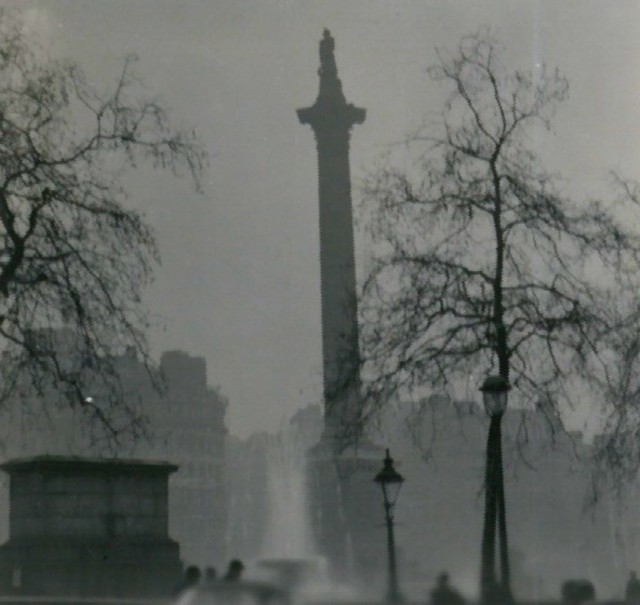
On the morning of Friday, 5th December 1952, Londoners woke to find their city had vanished.
Not metaphorically. The streets, the buildings, the river — all of it gone, swallowed by a yellow-green wall of sulphurous smoke so thick that bus conductors abandoned their vehicles and walked ahead on foot, holding lanterns, hoping to find the road. Pedestrians crawled along walls to navigate their own neighbourhoods. Cattle at the Smithfield livestock show collapsed and died before they could be sold.
By the time it lifted five days later, London had suffered the deadliest air pollution event in European history. And for two full years, the government told no one.
The Day the City Stopped
The Great Smog of 1952 was not a sudden disaster. It built quietly.
🏙️ Love London?
3,000 London lovers get hidden history, street-level stories, and local secrets every week. Free, forever — no spam, unsubscribe any time.
Subscribe free — enter your email:
A high-pressure weather system settled over the city on the 5th of December, trapping cold, still air close to the ground. London at the time ran almost entirely on coal — homes, factories, power stations, and even the buses. Every chimney in the city poured out sulphur dioxide and soot. With no wind to move it and nowhere for it to go, the pollution pooled.
Within hours, visibility had dropped to less than a metre. The smog smelled of rotten eggs and burnt coal. It turned a vivid yellow-green colour, unlike anything Londoners had seen before.
London ground to a halt. Buses stopped. Trains crawled. The Thames became impossible to navigate. At Sadler’s Wells, the audience of a performance of La Traviata began coughing so badly that the show had to be abandoned mid-act — the smog had seeped inside the theatre. Across the city, people simply sat down in the street, disoriented, unable to find their way home.
Five Days in the Dark
For five days, London lived in a world without light or direction.
Those who had to go outside wrapped scarves around their faces. The weak and elderly rarely left at all. Hospitals began filling with patients gasping for breath — people with bronchitis, asthma, and heart conditions whose lungs simply could not cope with the choking air.
The smog was worst in the East End and along the Thames, where industrial pollution was already heaviest. But it reached Mayfair, Westminster, and Kensington too. No neighbourhood was untouched.
At Smithfield Market, twelve prize cattle that had been brought in for the annual livestock show had to be slaughtered early because they were suffocating in their pens. Show organisers covered the animals’ heads in makeshift masks. It was not enough.
By the time the wind finally returned on 9th December and swept the smog eastward into the North Sea, thousands of Londoners had already been buried.
The Deaths Nobody Counted
In the weeks that followed, something strange appeared in London’s death records.
Mortality had spiked sharply. Far more people than usual were dying — elderly people, those with lung conditions, young children. But the official line from the government was reassuring: there had been an unusual bout of influenza, and the fog, though unpleasant, was simply weather.
The initial official death toll was placed at around 4,000. Even this figure was quietly disputed. Independent researchers later calculated the true toll from excess deaths at somewhere between 10,000 and 12,000 people.
Harold Macmillan, then Minister of Housing, was particularly resistant to acknowledging what had happened. His private letters from the time show he was anxious about the political consequences of admitting that Britain’s reliance on coal had killed thousands of its own citizens. Publicly, he continued to minimise the disaster.
Labour MP Norman Dodds refused to let the matter drop. He challenged the government in Parliament repeatedly and pushed hard for a formal inquiry. The Beaver Committee was eventually established — but its early recommendations were so cautious as to be nearly useless. It took two more years of campaigning, public pressure, and a second deadly smog event before Parliament finally moved.
The Law That Changed London’s Air
The Clean Air Act of 1956 was, by any measure, a turning point.
It created smokeless zones in urban areas, requiring homes and businesses to switch to cleaner fuels. It pushed power stations further outside city centres. It gave local councils authority to enforce new standards.
London did not transform overnight. A final deadly smog in December 1962 killed an estimated 4,000 more people before the Act’s provisions had fully taken effect. But by the late 1960s, the city’s air was measurably cleaner. The infamous London pea-soupers — the yellow fogs that had defined the city’s winters since the industrial revolution — were gone.
Writers had romanticised those fogs for generations. Dickens wrote about them. Conan Doyle sent Holmes through them. Impressionist painters crossed the Channel to capture their eerie glow on canvas. Claude Monet painted the Thames no fewer than 95 times, often staying in London specifically to paint the fog. What he never painted was the cost of it.
What London Carries From Those Five Days
Visit London today and the Great Smog has left almost no visible mark.
The air is cleaner than it has been since before the industrial revolution. The Thames runs fuller and clearer. But walk through Smithfield Market, or stand on Westminster Bridge on a cold December morning, and it’s worth pausing. This is where it happened. These streets, these buildings, this river — all of it was swallowed by something the government called “just weather.”
If you want to understand the city beneath the one you can see, our guide to London’s hidden medieval worlds is a good place to start. And if you’re planning your visit to London and want to know which neighbourhoods carry the most history, that guide covers the full city. The story of London’s ghost Tube stations shows just how much this city keeps buried beneath the surface.
The story of the Great Smog is, in the end, a story about what cities owe their people. London got that lesson the hardest way possible. And the clean winter air you breathe here today — that’s what 12,000 deaths eventually bought.
🇬🇧 25 Hidden Gems of London Most Tourists Never Find
From secret riverside walks to hidden Victorian tunnels, centuries-old pubs to rooftop gardens with skyline views — our free guide reveals the London most visitors never discover. Join 3,000+ London lovers who get it free.
Get Your Free London Hidden Gems Guide →Love more? Join 65,000 Ireland lovers → · Join 43,000 Scotland lovers → · Join 30,000 Italy lovers →
Free forever · Unsubscribe anytime