Every June, a single soldier’s ability to keep a nine-pound flag steady while marching becomes a matter of national ceremony. Trooping the Colour has marked the sovereign’s official birthday for more than 260 years, and the “colour” in the name is literal — it refers to the regimental flag that is slow-marched, or “trooped,” down the ranks so every soldier can recognise it. This is Guide № 002 in The Love London Guide series.
Get the Full Collectible Guide (Free PDF)
Trooping the Colour — in a beautifully designed, printable booklet. The Love London Guide № 002.
What the Ceremony Actually Is
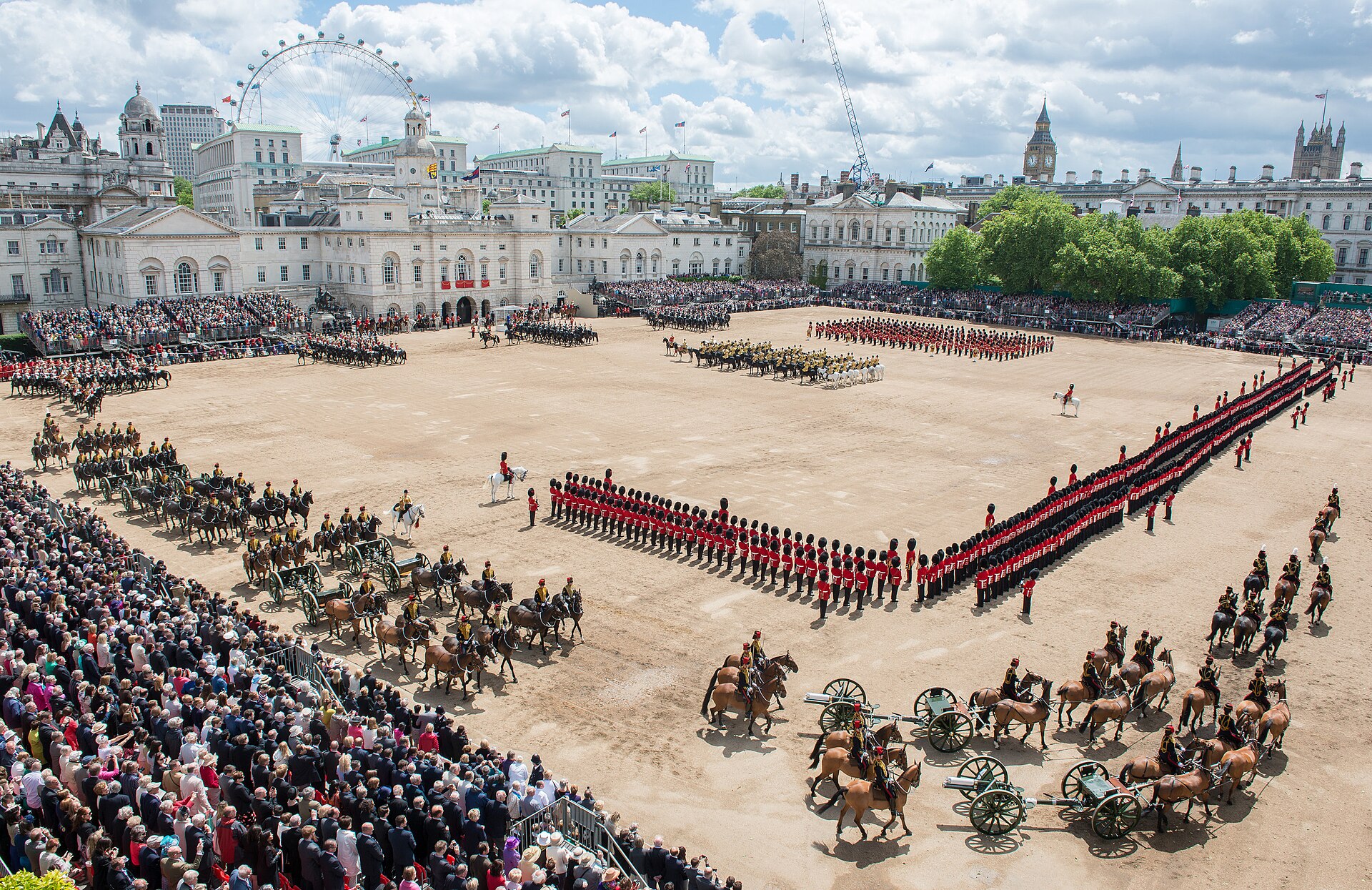
Trooping the Colour is a military parade performed by the Household Division to mark the official birthday of the British sovereign. It takes place on Horse Guards Parade, the large gravel square off Whitehall, usually on the second Saturday of June. The event involves around 1,400 soldiers, some 200 horses and 400 musicians, drawn from the Foot Guards and the Household Cavalry.
The “colour” being trooped belongs to one of the five regiments of Foot Guards, and the honour rotates between them each year. Historically, regimental colours were carried into battle as a rallying point, and parading them in front of the troops was a practical way of making sure soldiers could identify their own flag in the chaos of combat. The ceremony preserves that drill as a piece of living tradition.
Why the King Has Two Birthdays
The sovereign’s “official” birthday rarely falls on their actual date of birth. The custom of holding a summer parade dates back to the reign of George II in 1748, who was born in November — a month poorly suited to an outdoor military display. Fixing the celebration in June gave a better chance of decent weather for a large-scale parade.
King Charles III was born on 14 November, so the June parade continues this two-birthday arrangement. The date is not tied to any single monarch’s birth; it is set by convention to a Saturday in early-to-mid June each year.
How the Day Unfolds
The procession leaves Buckingham Palace and travels down The Mall to Horse Guards Parade, where the main ceremony takes place. After the colour is trooped through the ranks, the whole parade marches back to the Palace. The day traditionally closes with the Royal Family gathering on the Palace balcony to watch a Royal Air Force flypast, weather permitting.
Precision is the point. Guardsmen stand for long stretches in full dress, and it is not unusual for a soldier to faint in summer heat — the drill instruction is for those around them to remain still and leave the fallen soldier to be dealt with, so the parade is not disrupted.
The Uniforms and the Bearskins
The Foot Guards’ scarlet tunics and tall black caps are among the most recognisable images of British ceremony. The caps are known as bearskins, and they are made from the fur of bears — a point that has drawn sustained criticism from animal-welfare campaigners. A bearskin stands roughly 18 inches tall and can weigh around a pound and a half.
The five Foot Guards regiments can be told apart by the spacing of the buttons on their tunics and by the plumes on their caps. The Grenadier Guards, for example, wear a white plume on the left; the Coldstream Guards a red plume on the right; the Scots Guards wear no plume at all; the Irish Guards a blue plume; and the Welsh Guards a white-and-green plume.
Seeing It in Person
Seats in the stands on Horse Guards Parade are allocated by a ballot held each year, and demand far exceeds supply. Many people instead watch for free from along The Mall or near the Queen Victoria Memorial in front of Buckingham Palace, where you can see the procession pass and, on a clear day, the flypast overhead.
There is also a full rehearsal, the Colonel’s Review, on the preceding Saturday, and an earlier one called the Major General’s Review — both are genuine dress rehearsals with the troops in full uniform, and tickets for them are considerably easier to obtain than for the main day.
Myths Worth Retiring
Myth: “Trooping the Colour” means marching a colourful parade. The “colour” is a specific object — a regimental flag — and “trooping” is the act of carrying it down the ranks. The name describes a precise drill, not a general spectacle.
Myth: It is held on the monarch’s real birthday. It marks the official birthday, deliberately set in June for the weather, which is usually months away from the sovereign’s actual date of birth.
Myth: The guards’ caps are just decorative hats. The bearskins are functional items of ceremonial uniform made from real bear fur, and their material remains a subject of ongoing public debate.
Frequently Asked Questions
When does Trooping the Colour take place?
It is normally held on a Saturday in June, most often the second Saturday, to mark the sovereign’s official birthday. The exact date is confirmed each year, so it is worth checking ahead if you are planning a visit.
Can I watch it for free?
Yes. While seats on Horse Guards Parade require a ballot ticket, you can watch the procession for free along The Mall and near Buckingham Palace. Arriving early helps, as popular viewing spots fill up well before the parade begins.
What is the flypast at the end?
After the parade returns to Buckingham Palace, the Royal Family traditionally gathers on the balcony to watch a Royal Air Force flypast. It goes ahead only if weather conditions allow safe flying, so it is not guaranteed every year.
More The Love London Guides
The Love London Guide is a numbered series — one tightly focused subject at a time, each with its own downloadable collectible edition. Guide № 001 is Fish and Chips, This is Guide № 002. More editions are on the way.
🇬🇧 Join 3,000+ London Lovers
Every week, get hidden stories, local secrets, and travel inspiration from people who live and love it.
Subscribe free — enter your email:
