
London’s walls have been covered in graffiti for decades. Most people walk past without understanding what they’re looking at. Tags aren’t random vandalism. They’re a coded language with rules, hierarchy, and meaning. Once you know how to read them, the city looks completely different.
Love London? Get our free weekly newsletter — local stories, hidden spots, and the best of the capital. Subscribe here →
What Is a Graffiti Tag?
A tag is a stylised signature — the writer’s chosen name, rendered in a style that is recognisably theirs. Every writer has a tag. It is their ID in the scene. Tags are the simplest form of graffiti, usually done quickly in marker or spray paint, and they serve one main purpose: to get the writer’s name seen as widely as possible.
The name itself is usually short — two to five letters — chosen for how it looks in stylised lettering. Writers think about negative space, letter flow, and how lines connect. Names like Saner, Tox, Ozone, and Robbo aren’t random words. They’re brands, built over years of consistent repetition across the city.
Tags sit at the base level of graffiti writing. Above them are pieces (full-colour productions), throwies (quick bubble-letter fills), and wildstyle (highly complex interlocking letters). A writer who only tags is at the bottom of the hierarchy. A writer who can produce a clean, large-scale piece earns respect.
The Grammar of Tags — What the Marks Mean
Tags aren’t just signatures. The way they’re placed, stacked, and combined communicates specific things.
King of the spot: Whoever has the most tags in a location is considered to hold it. A lamppost covered in one writer’s tag, from top to bottom, is a territorial claim. Getting your tag above someone else’s — “going over” them — is a deliberate insult.
Crossing out: A line crossed through another writer’s tag is direct confrontation. It says: I was here, I know you were here, and I don’t rate you. Crews cross out rivals. It escalates.
Crew affiliation: Many tags include a crew name alongside the individual tag — often abbreviated to three letters. London has dozens of active crews. Some are borough-specific, some national. A tag reading “TOK DTR” means the writer is called TOK and belongs to the DTR crew. The crew name adds weight; it signals backup.
Date markers: Experienced writers sometimes add dates to significant pieces, especially in spots they’ve held for years. It’s a record of tenure.
Numbering: Some writers number their tags as they go — 1, 2, 3 — counting their hits in a single run. It’s both a flex and a method of tracking output.
Where to Find Graffiti in London
Brick Lane, Shoreditch, E1
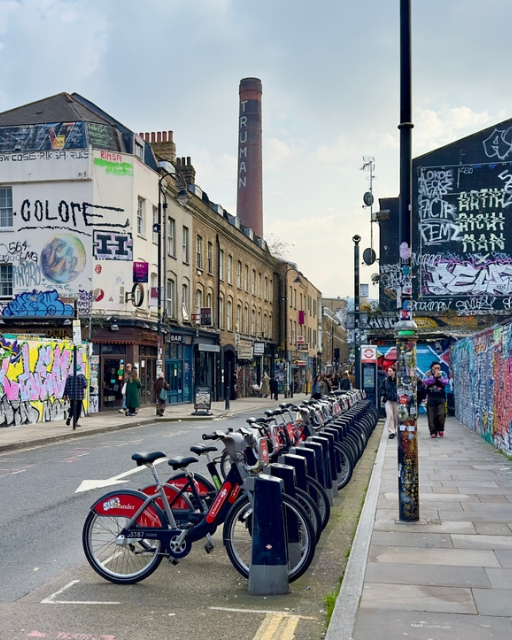
This is the most well-known area. The streets around Brick Lane — Hanbury Street, Fashion Street, Sclater Street — are covered year-round. The quality ranges from quick tags to large-scale commissioned murals. Writers from all over the world have left work here, making it the closest thing London has to an open-air gallery of the form.
Leake Street, Waterloo
Leake Street runs under the railway arches near Waterloo station. Banksy organised an event here in 2008 that effectively made the tunnel a legal, sanctioned space. It has been continuously painted since. The wall changes fast — a piece done on Monday may be covered by Wednesday. Visit after a weekend for the freshest work.
Croydon
Croydon has a significant graffiti scene that gets far less attention than east London. The Croydon Warehouse District, around Surrey Street and Mint Walk, has large-scale work. Local crews have deep roots here.
Stoke Newington and Hackney
Church Street and the surrounding area in Stoke Newington, and large stretches of Hackney, carry a consistent amount of tagging and street-level work. The lampposts, shutters, and utility boxes tell you who has been active in the area recently.
Under bridges and rail corridors
Some of London’s oldest surviving graffiti is on rail corridors and the underside of bridges. The trains themselves were a major target through the 1980s and 1990s. That era largely ended when London Underground and British Rail introduced routine pressure-washing. But the walls adjacent to rail lines, particularly in south London, still carry heavy work.
Love London? Get our free weekly newsletter — local stories, hidden spots, and the best of the capital. Subscribe here →
The Legal Side
Graffiti without permission is criminal damage under UK law. Section 1 of the Criminal Damage Act 1971 covers it. The penalty depends on the cost of the repair, and can result in a fine or community service. For repeated offences or high-value damage, it can go to Crown Court.
Enforcement is inconsistent. Resources are limited and many tags are never investigated. Writers are well aware of this.
There are legitimate outlets. Leake Street is the most prominent legal wall in London. Some councils and businesses commission graffiti artists directly. Waltham Forest, Lambeth, and Hackney have all run legal-wall or commissioned mural schemes at various points.
The commercial street art world — distinct from graffiti tagging — is now mainstream. Artists like Stik and Eine have been internationally exhibited. Banksy, who came up through the graffiti scene, is now the most commercially successful anonymous artist alive. The line between an illegal tag and a commissioned mural is real, but it isn’t always clear from the pavement.
Why Tags Are Territorial
In the 1970s, New York — where the modern tagging tradition originated — had a specific social context. Writers marked out space in a city that felt abandoned by its institutions. London’s graffiti culture arrived a few years later, shaped partly by that New York influence and partly by its own street geography.
In London, the borough matters. A tag from a Peckham writer that appears in Islington is making a statement about reach. It says: I’m not staying local. A writer whose tags are scattered across multiple zones is demonstrating both the willingness and the ability to move across the city.
The lamppost is a particularly common surface because it is vertical, visible from both directions, and difficult to clean cheaply. A single lamppost with multiple tags on it is a compressed social document. If you know the names, you can read which writers are active in the area and roughly in what order they came through.
Rainy Days and Reading Walls
London’s overcast weather is actually ideal for looking at graffiti. Strong sunlight creates glare on spray-painted surfaces. Even, diffused light brings out colour better, and paint saturation looks stronger when surfaces are damp.
If you’re waiting for rain to pass, the better option is to head out into it. Leake Street under the arches at Waterloo is fully covered overhead. Brick Lane’s back alleys are narrow enough to stay relatively dry. Both are worth an hour of slow looking — not sweeping the whole wall, but stopping at individual pieces and reading what’s there.
The more you look, the more you see. The same tag appearing ten times in two streets tells you something about how a writer moves through an area. A piece with a newer style layered over an older one tells you about time. Crossed-out tags tell you about conflict.
London’s walls are not random. They’re a running account of who has been here, who wants to be seen, and who doesn’t want to be forgotten.
Love London? Get our free weekly newsletter — local stories, hidden spots, and the best of the capital. Subscribe here →