
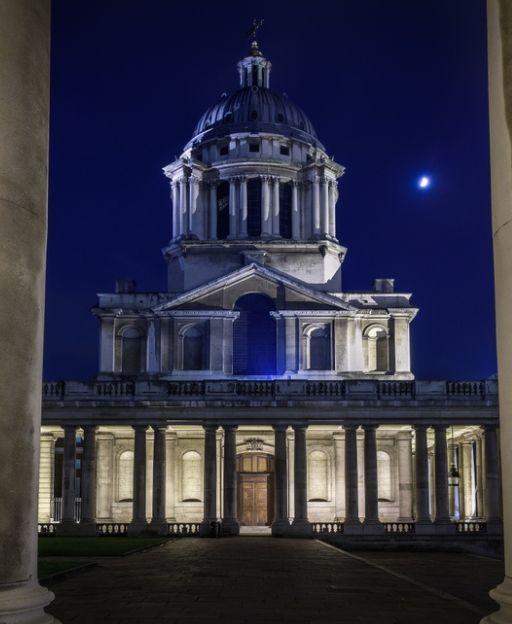
There is a bend in the Thames at Greenwich where the river slows and the view opens up. Two white baroque buildings frame a wide courtyard. A dome rises above each of them. Through the gap between the buildings, a smaller house sits further back, perfectly centred. Most people who pass on a river boat take a photograph. Very few know what happened here.
The Palace That Shaped England
The land at Greenwich had been royal ground for centuries before the building you see today was raised. In 1443, Humphrey, Duke of Gloucester, built a riverside manor here and called it Bella Court. It was later extended and renamed the Palace of Placentia.
🏙️ Love London?
3,000 London lovers get hidden history, street-level stories, and local secrets every week. Free, forever — no spam, unsubscribe any time.
Subscribe free — enter your email:
Henry VIII was born here in 1491. He was not expected to be king — his older brother Arthur died young and the crown passed to Henry instead. He grew up loving Greenwich. He jousted in the park, hunted in the grounds, and kept one of the most dazzling courts in Europe.
Mary I and Elizabeth I were also born at Greenwich. For more than a century, the Palace of Placentia was one of the most important royal buildings in England. Then the Civil War came. Cromwell’s soldiers used it as a biscuit factory and a prisoner-of-war camp. By the time Charles II was restored to the throne in 1660, there was almost nothing left worth saving.
The Architect Who Left a Gap on Purpose
Charles II began rebuilding at Greenwich, but the money ran out. Work stopped for decades. In 1694, Queen Mary II died of smallpox. Her husband, William III, decided to build a naval hospital in her memory — a place for injured and retired sailors. The Greenwich site, with its history and river access, was chosen.
Christopher Wren was brought in to design it. He was already rebuilding St Paul’s Cathedral and dozens of London churches in the aftermath of the Great Fire. The building at Greenwich was to be another great work.
There was a complication. The Queen’s House — a small, elegant palace by Inigo Jones — stood on the hill behind the site with a direct view to the Thames. William III insisted that view must not be blocked.
So Wren divided his design. Instead of one grand building, he designed two symmetrical wings with a wide courtyard open to the river between them. The gap preserved the Queen’s House view. It also created something no single building could have achieved: a framed perspective, the Queen’s House perfectly centred between the two domes, with the Thames stretching beyond.
Today this view appears on postcards, travel guides, and films. Most visitors assume it was planned as a piece of grand theatre. It was actually a compromise born from a queen’s love of a modest house on a hill.
The Hall That Was Too Grand to Use
The centrepiece of the hospital was to be a dining hall for the sailors. The artist James Thornhill was commissioned to paint it. He started in 1707. He finished in 1726. It took nineteen years.
The ceiling shows William and Mary in triumph, surrounded by allegorical figures representing Justice, Truth, Peace, and the four seasons. Astronomical instruments, maps, and navigational symbols cover the upper walls. The colours have held their brilliance for three hundred years — deep golds, rich reds, blues that still glow.
Thornhill was paid three pounds per square yard for the ceiling and one pound per square yard for the walls. He invoiced the government every few years as sections were completed. When the hall was finally finished, the authorities faced a problem: it was so magnificent that they could not bear to let sailors eat their dinners in it. The men took their meals elsewhere. The Painted Hall became a visitor attraction, charging entrance fees.
Today it is free to enter. On most afternoons, a handful of visitors crane their necks up at the ceiling. Most of London has no idea it exists.
The Night England Said Goodbye to Nelson
In October 1805, the British fleet met the French and Spanish navies off the Spanish coast at Cape Trafalgar. The British won decisively. Horatio Nelson, commanding from HMS Victory, was shot by a French sniper and died on deck before the battle ended.
His body was preserved for the long journey home in a cask of spirits. The ship arrived at Spithead in early December. A river procession brought Nelson up the Thames in January 1806.
For three days, his body lay in state in the Painted Hall. The hall was draped in black. Thirty thousand people came to pay their respects. The queue stretched down to the Thames and beyond.
Then Nelson was taken by barge to Whitehall Stairs and carried to St Paul’s Cathedral, where he was buried beneath the dome. The Painted Hall returned to its everyday life. But for those three days, the most celebrated sailor in British history lay beneath the ceiling that had been built to honour sailors like him.
What You Find There Now
The Old Royal Naval College — as it has been known since the Navy left in 1998 — is now part of Maritime Greenwich, a UNESCO World Heritage Site. The Painted Hall is free to visit. The chapel, rebuilt in neoclassical style after a fire in 1779, is open to the public too.
The courtyard between the buildings is open to everyone. Stand in the centre and look back towards the Queen’s House and Greenwich Park rising behind it. Then turn and face the river. You are standing on the same ground where Tudor kings were born and where England’s greatest naval hero lay before the nation.
Greenwich is easy to reach from central London — by river boat from Westminster Pier, or by DLR to Cutty Sark station. If you are planning a visit to London, Greenwich makes a full day on its own. The Cutty Sark, the National Maritime Museum, the indoor market, and Greenwich Park are all within easy walking distance. And while you are there, it is worth knowing that Greenwich is where every clock in the world is set — a story that makes the place feel even stranger and more significant than it already is.
Most visitors to London never cross the river to the south-east. They miss the Painted Hall, the courtyard, and the view that Wren designed around a queen’s wishes. That is their loss.
The ceiling Thornhill spent nineteen years painting has watched over three centuries of visitors. It will be there long after everyone who sees it today is gone. Come and look up.
🇬🇧 25 Hidden Gems of London Most Tourists Never Find
From secret riverside walks to hidden Victorian tunnels, centuries-old pubs to rooftop gardens with skyline views — our free guide reveals the London most visitors never discover. Join 3,000+ London lovers who get it free.
Get Your Free London Hidden Gems Guide →Love more? Join 65,000 Ireland lovers → · Join 43,000 Scotland lovers → · Join 30,000 Italy lovers →
Free forever · Unsubscribe anytime