
Most people who visit Holland Park walk right past it.
They come for the peacocks strutting across the lawns, the ruins of the old manor house, or the café beside the opera stage. They never find the waterfall.
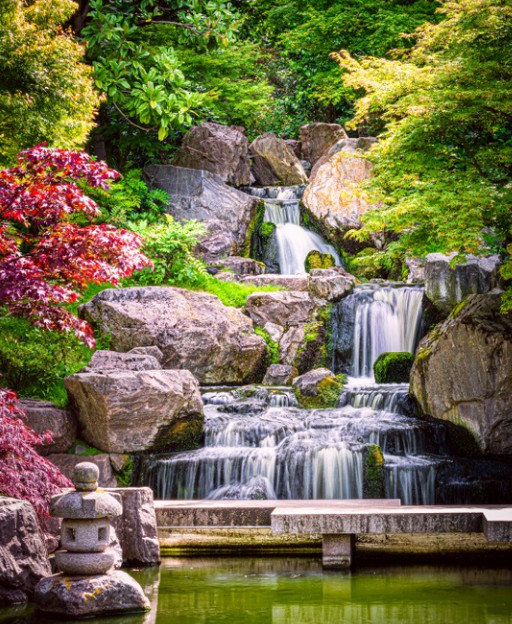
But tucked into the northern corner of Holland Park, past a gate that most visitors overlook, is the Kyoto Garden — a Japanese landscape of koi ponds, stone lanterns, cascading water and maple trees that burns red each autumn. It is, without question, one of the most beautiful places in London. On a quiet morning, it feels like another world entirely.
A Gift Between Two Great Cities
The Kyoto Garden did not grow here by accident. It was a deliberate act of friendship.
🏙️ Love London?
3,000 London lovers get hidden history, street-level stories, and local secrets every week. Free, forever — no spam, unsubscribe any time.
Subscribe free — enter your email:
In 1991, the city of Kyoto gifted the garden to London to mark the Japan Festival — a cultural exchange programme that celebrated ties between the two nations. Japanese craftsmen and gardeners travelled to London to design and plant it, bringing with them the philosophy of shizen, meaning naturalness, that shapes traditional Japanese landscape design.
The garden covers just under an acre. But within that space it manages to feel complete. There is a pond where orange-and-white koi drift below the surface. A stone lantern marks the water’s edge. A small waterfall — the kind that moves slowly enough to hear every note — tumbles over mossy boulders into the pool below.
The design follows a specific Japanese tradition: nothing looks arranged. Every rock, every path, every planted tree appears to have arrived there on its own terms. This careful artifice is the whole point.
What Waits Behind the Gate
Finding the Kyoto Garden takes a little intention. Holland Park stretches across 54 acres of lawns, woodland and formal gardens between Kensington and Notting Hill. The Kyoto Garden sits toward the northern end, marked by a simple sign most visitors miss.
Once inside, the noise of the city drops almost immediately. London — always loud, always moving — disappears. What remains is the sound of water, the occasional call of a peacock from somewhere beyond the hedge, and the soft crunch of gravel underfoot.
In autumn, the maple trees turn. The Japanese maples planted throughout the garden shift from green to amber to deep crimson over several weeks, and the effect — reflected in the still pond below — is extraordinary. Photographers come from across London for this brief window each year.
There is also a second garden nearby — the Fukushima Memorial Garden, added in 2012 as a gesture of solidarity after the earthquake and tsunami in Japan. It sits adjacent to the Kyoto Garden and is equally quiet.
The Ruins That Make Holland Park Extraordinary
Holland Park would be remarkable for the Kyoto Garden alone. But there is more to this story.
The park takes its name from Holland House, a grand Jacobean mansion that stood at its centre for over 300 years. It was one of London’s great aristocratic houses — a place of political intrigue, literary salons and remarkable parties. Napoleon III lived here in exile. Lord Byron was a guest. Charles Dickens visited. The historian Thomas Macaulay wrote here.
Then came the Blitz.
On the night of 27 September 1940, German bombers targeted Kensington. Holland House took a direct hit. By morning, three-quarters of the building was rubble. Only the east wing and the distinctive arched arcade survived.
Today, those ruins stand at the heart of the park. The surviving arcade hosts an open-air opera in summer. The roofless east wing houses a youth hostel. The gardens that once surrounded the house have been reimagined as public parkland — and the Kyoto Garden was planted at their edge, a quiet presence in a park that already carries a great deal of history.
The combination of bombed-out ruin and serene Japanese garden, all within walking distance of each other, is the kind of thing that makes London unlike anywhere else on earth.
Why It Stays So Quiet
Holland Park does not appear on most tourist itineraries. It lacks the scale of Hyde Park, the fame of Regent’s Park, and the central location of St James’s. Most visitors to London never reach it.
This is the Kyoto Garden’s greatest advantage.
On a weekday morning, you can sit on a bench beside the koi pond and have it almost entirely to yourself. In spring, azaleas and cherry blossoms arrive in waves. In winter, frost settles on the stone lanterns and the garden takes on a different kind of stillness.
Locals — particularly those from the Kensington and Notting Hill neighbourhood — have known about this place for years. It is the kind of spot people keep quietly to themselves, not out of selfishness, but because the sort of quiet it offers feels worth protecting.
Planning Your Visit
The Kyoto Garden is free to enter and open daily during daylight hours. It sits within Holland Park itself, reached most easily from Holland Park tube station on the Central line, or from Kensington High Street station, a short walk to the south.
Arrive early to avoid the school groups that gather in the wider park during weekday mornings. The garden is at its most peaceful before 10am, when the light comes low through the maple canopy and the pond is glass-still.
If you are planning your first trip to this part of London, our guide to planning your London trip covers everything you need to know, including how to build a day around the West London neighbourhoods most visitors never reach.
For the story of the neighbourhood surrounding the park, our piece on the real Notting Hill beyond Hugh Grant’s film paints a picture of the area as it actually is — far stranger and richer than the movies suggest.
There is something almost improbable about the Kyoto Garden — that such a thing could exist here, in a city of eight million people, behind a gate that most people walk past without looking up.
But London has always been this way. The extraordinary is hidden in plain sight. All you have to do is know where to turn.
🇬🇧 25 London Places Most Visitors Miss
From secret riverside walks to hidden Victorian tunnels, centuries-old pubs to rooftop gardens with skyline views — our free guide reveals the London most visitors never discover. Join 3,000+ London lovers who get it free.
Get Your Free 25-Places Guide →Love more? Join 65,000 Ireland lovers → · Join 43,000 Scotland lovers → · Join 30,000 Italy lovers →
Free forever · Unsubscribe anytime