
Walk along the towpath near Camden on a quiet morning and something stops you. Through a porthole, you spot a bookshelf, a string of fairy lights, a pot plant balanced on a ledge. A dog is asleep on the roof above. Someone inside is boiling a kettle. This is their home — and it’s floating on the water.
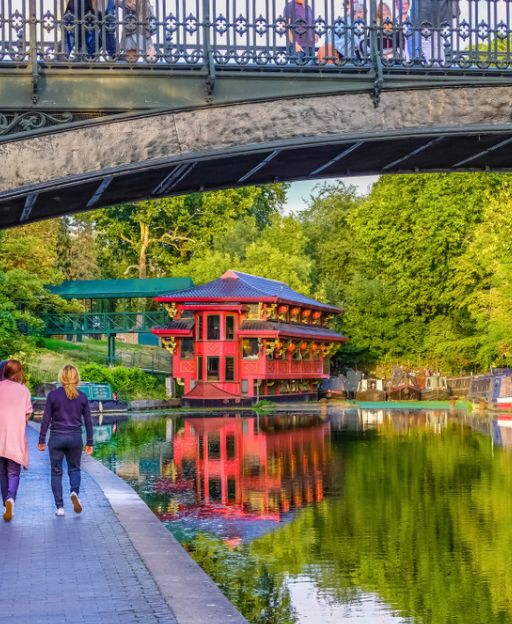
The Canal That Crosses the City
Regent’s Canal stretches 8.6 miles from Paddington in the west to Limehouse Basin in the east. It was built in 1820 to carry cargo through central London — coal, timber, and building materials moving through the city on horse-drawn barges.
🏙️ Love London?
3,000 London lovers get hidden history, street-level stories, and local secrets every week. Free, forever — no spam, unsubscribe any time.
Subscribe free — enter your email:
The horses are long gone. The cargo, too. But the canal itself has outlasted almost everything built around it. Today it’s a green, slow ribbon cutting through some of London’s most densely packed neighbourhoods. It passes behind the mansions of Regent’s Park, beneath the railway bridges of Camden, and through the Victorian terraces of Islington and Hackney. All the way, there are boats moored along the banks. And a surprising number of them have people living inside.
Why Some Londoners Choose the Water
London is one of the most expensive cities in the world to rent a home. A one-bedroom flat in Zone 2 can easily cost £1,800 to £2,200 a month. A narrowboat mooring — with most costs included — can work out to considerably less.
But the people who live on the canal don’t all choose it for the money. Many choose it for how it makes them feel.
There’s a different rhythm to canal life. The day begins with light on the water, not a commuter alarm. Neighbours wave across the towpath. Someone is always fiddling with a rope or repainting a hull. The boats have names — Wandering Star, Lucky Dip, The Restless Kind — and those names tell you something about the people inside.
Space is genuinely tight. Most narrowboats are just 7 feet wide. You learn to store things vertically, to make every corner useful. But the people who choose this life tend to say the same thing: after a few weeks on the water, a normal flat starts to feel like a box.
From Little Venice to Limehouse
The canal doesn’t have one character. It changes, mile by mile, as London changes around it.
At Little Venice in Paddington — so named by the poet Robert Browning, who compared it to the Italian city — the canal opens into a wide basin ringed with weeping willows. There are floating cafés here and an old Puppet Theatre barge that has been performing for children since 1951. It’s calm and generous and slightly unreal, especially in early morning light.
Heading east through Regent’s Park, the canal passes directly behind London Zoo. You don’t see the animals, but on quiet days you can hear them. There’s something memorable about standing on a London towpath and listening to sounds that have no business being in the middle of a city.
In Camden, everything changes. The market comes right down to the water’s edge. There are bars built into old brick arches, street food stalls, and music drifting out of open doors. And moored at Cumberland Basin since 1977, the Feng Shang Princess — a full-sized floating Chinese restaurant in bright red and gold — has been here for nearly fifty years. Most Londoners have walked past it dozens of times. Most tourists don’t know it exists at all.
Beyond Camden, through Islington and Hackney, the canal becomes quieter and more residential. This is where the largest communities of liveaboard boaters are concentrated. The towpath here smells of wood smoke from the stoves, and the boats are older, more individual, more worn-in.
The Tunnel Beneath Islington
One of the canal’s stranger features sits near Angel station in Islington: the Islington Tunnel, completed in 1819. It is 960 yards long, and too narrow for horses. So when a loaded barge needed to pass through, the horse was walked over the hill above while the boatmen lay flat on their backs on the roof of the barge and pushed against the tunnel walls with their feet to walk it through the darkness.
This process — called “legging” — took roughly 45 minutes. In winter, in complete darkness, with a full load aboard.
You can’t walk through the tunnel today, but the towpath diverts up and over the hill above it. That brief climb takes you out of the hidden canal world and onto the ordinary streets of Islington — a strange, satisfying contrast, and a reminder of how different London looks from down at water level.
Walking the Route
The towpath is free, flat, and largely free of road traffic. You can join it at many points — Paddington, Camden Road, Caledonian Road, or further east at various points through Hackney.
The most popular stretch is from Little Venice to Camden Lock — about 3.5 miles, with the most variety. Start early if you can. Before 9am, the canal belongs mostly to dog walkers and early cyclists, and the light on the water in the hour after sunrise is worth getting up for.
If you want a longer walk, continue east from Camden through King’s Cross — where the canal passes St Pancras International at close range, an odd pairing of Georgian waterway and Victorian cathedral of steel — then on through Islington and Hackney towards Hackney Wick and the Olympic Park. The full route can be walked in a single day at a leisurely pace.
For help planning which part of London to base yourself in, our London travel planning guide covers neighbourhoods, transport, and the best times to visit throughout the year.
What the Canal Teaches You
Walking Regent’s Canal teaches you to see London differently. From the towpath, you see the backs of things. The rear gardens of Victorian terraces that no one intended for public view. Old industrial infrastructure — iron bridges, loading bays, mooring rings set into stone centuries ago — that most visitors never find because they never come this way.
You see ordinary life at close range: someone working at a laptop in the bow of their boat; two teenagers fishing from a bridge with a length of string; a woman hanging laundry on a line strung between two posts on the roof of a narrowboat while a cat watches from the stern.
And you begin to understand why, in a city of 9 million people, some of them choose to live in homes that are 7 feet wide and floating. It isn’t a sacrifice. It’s a choice — to live close to the water, close to the sky, and a little apart from the noise of everything else.
If you want to explore the neighbourhoods that flank the canal — Camden, Islington, and Hackney among them — our guide to London’s neighbourhoods gives you a sense of what each one is really like for visitors.
🇬🇧 25 Hidden Gems of London Most Tourists Never Find
From secret riverside walks to hidden Victorian tunnels, centuries-old pubs to rooftop gardens with skyline views — our free guide reveals the London most visitors never discover. Join 3,000+ London lovers who get it free.
Get Your Free London Hidden Gems Guide →Love more? Join 65,000 Ireland lovers → · Join 43,000 Scotland lovers → · Join 30,000 Italy lovers →
Free forever · Unsubscribe anytime