
Samuel Johnson once told his friend James Boswell, “when a man is tired of London, he is tired of life.” Of all the places he lived in the city, only one still stands: a red-brick townhouse at 17 Gough Square, tucked off Fleet Street. Here Johnson compiled his Dictionary of the English Language, and today you can walk through the rooms where he did it. This guide explains the house, the dictionary and the stories that make it one of London’s best literary stops for American visitors.
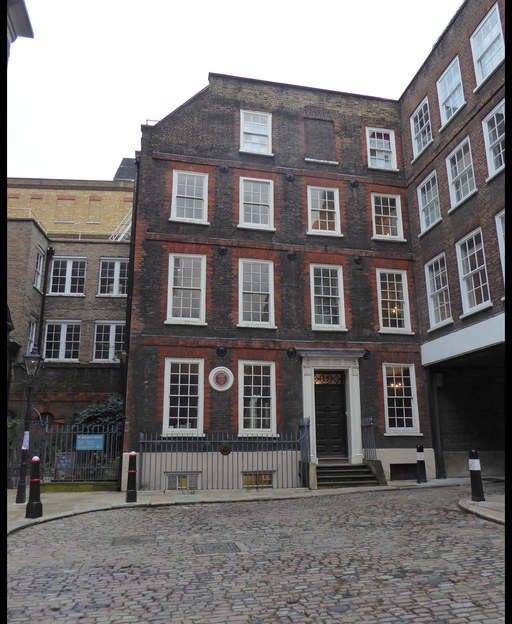
A house built by a City wool merchant
A City wool merchant named Richard Gough built the house at the end of the seventeenth century. It formed part of a small development around Gough Square, and number 17 is the only building from that group that survives. According to the house’s own history page, the timber-framed, brick townhouse still keeps its historic panelling, an open staircase, wooden floorboards and even its original door handles.
Look closely at the front door. The eighteenth-century door still carries its original anti-burglary devices: a heavy chain with a corkscrew latch, and a spiked iron bar over the fanlight. Londoners of Johnson’s day took security seriously, and the door shows it.
Visitors can enter all the rooms and sit on the chairs and window seats. That freedom sets this house apart from many museums, where velvet ropes keep you in the doorway. You step inside the house and feel the age of it.
Why Johnson came to Gough Square
Johnson arrived in London aged 28 and worked as a hack writer, producing and editing articles for The Gentleman’s Magazine. His poem London, published in 1738, brought him critical success, but it did not fix his money troubles. He stayed a struggling writer for years.
Then, in 1746, a group of publishers in and around Fleet Street approached him. They saw that English needed a far better dictionary. William Strahan and his partners signed a contract with Johnson worth 1,500 guineas on the morning of 18 June 1746. Johnson quickly printed his Plan for the work and moved into his rented home at 17 Gough Square in 1747.
He lived in London for almost 50 years and used at least 17 different addresses. Gough Square held him longest. The house tells you he wrote more here than anywhere else, and it is the only one of those homes still standing.
Nine years, 1755 and a house full of paper slips
Johnson promised to finish the dictionary in three years. He knew that the Académie Française supposedly had 40 scholars working for 40 years on its own dictionary, and he turned that into a joke about proportion: forty times forty is sixteen hundred, and three is to sixteen hundred as an Englishman is to a Frenchman.
The joke was better than the schedule. Johnson took nine years, not three, and published his Dictionary of the English Language in 1755. The title page noted that the University of Oxford had awarded him a Master of Arts degree in anticipation of the work. From then on, people called him “Dictionary Johnson.”
The method was hard, physical work. Johnson hired several assistants, called amanuenses, and the house filled with noise and clutter. He underlined words in hundreds of books and marked the sentences that showed how writers used them. His assistants copied each marked sentence onto an individual paper slip. They later put the slips in alphabetical order and added the examples. His friend John Hawkins described Johnson’s own books as a copious but miserably ragged collection, and borrowed volumes came back so defaced that they were scarcely worth owning.
Johnson himself summed up the task in his preface. He wrote that the dictionary came together “amidst inconvenience and distraction, in sickness and in sorrow.” If you have ever tried to finish a big project in a cramped, busy home, you will recognise the scene.
25 London places most visitors miss
Riverside walks, City courtyards, centuries-old pubs and rooftop gardens, each with a map link, in one free printable guide. Enter your email and we will send it.
The famous letter to a patron
Johnson’s dictionary story includes one of the most quoted insults in English literature. Philip Stanhope, the 4th Earl of Chesterfield, had acted as patron for the Plan, and Johnson felt that he then did little to help. Seven years after he first met Johnson to discuss the work, Chesterfield wrote two anonymous essays in The World that recommended the dictionary.
Johnson disliked the tone, and he wrote to Chesterfield to say so. His letter asked: “Is not a patron, my lord, one who looks with unconcern on a man struggling for life in the water, and when he has reached ground, encumbers him with help?”
Johnson did not sound modest about his craft, either. Years later he wrote that dictionaries are like watches: “the worst is better than none, and the best cannot be expected to go quite true.” That sentence shows his dry humour, and it is a good motto for anyone who writes for a living.
Hodge, the cat with a statue
Step outside the house and you meet its most famous four-legged resident. A statue facing 17 Gough Square honours Hodge, Johnson’s cat. The museum’s page on Hodge points out that Hodge lived with Johnson at a time when people in Britain had begun to keep animals as companions, in a way we would recognise as pet ownership today.
Boswell wrote the best-known description. He recalled that Johnson himself used to go out and buy oysters for Hodge, so that the servants would not take a dislike to the poor creature. Boswell admitted that he had an antipathy to cats, and he watched Hodge scramble up Johnson’s chest while the great man rubbed the cat’s back and pulled his tail. When Boswell called Hodge a fine cat, Johnson answered that he had owned better ones, then added quickly that Hodge was “a very fine cat indeed” so the animal would not feel offended.
The statue makes a fun photo, and it gives children a reason to enjoy a literary stop.
How the house survived
Johnson was only a tenant at 17 Gough Square, and he left in 1759. After that the house went through many uses. It had other lodgers, served as a small hotel and bed and breakfast, and even became a printers’ workshop and studio. By 1911 it had fallen into a sad state, with water leaking through the roof.
Cecil Harmsworth, a Liberal MP, saved and restored the house that year. The Dr Johnson’s House Trust has preserved it for the public since 1911.
The house faced another danger during the Second World War. The curator and her daughter received permission to run an informal canteen for the Auxiliary Fire Service, and the house became a social club for firemen during the Blitz and other air raids. Servicemen also used the building as a watch tower, because it stood among the tallest buildings in the area. Bombs struck the house on several occasions and badly damaged the garret, and builders had to put up a new roof after the war. Remarkably, the firefighters always put the fires out in time, and the house survived.
That history matters. When you stand in these rooms, you stand in a building that outlasted the fires of the 1940s, and that carries the marks of every century since it went up.
Planning your visit
Dr Johnson’s House sits in the City of London, a short walk from Fleet Street. Opening days, hours, ticket prices, events and any temporary closures change, so check the official Dr Johnson’s House website before you go rather than relying on a printed guide. The house runs lectures, walks and seasonal events, and the site lists them all.
Gough Square pairs well with other historic stops nearby. The medieval round church at Temple Church lies a short distance away, and if Johnson’s world of words appeals to you, our guide to Shakespeare’s Globe covers another great London home of the written and spoken word.
Allow time to read the displays at your own pace. Many visitors spend an hour or more inside the house, then take a few minutes in the square to see the Hodge statue.
Frequently asked questions
Where did Samuel Johnson write his dictionary?
Johnson compiled the dictionary at 17 Gough Square in the City of London. He moved in during 1747 and published the work in 1755.
Is Dr Johnson’s House the only Johnson home left in London?
Yes. Johnson lived at at least 17 addresses in London, and 17 Gough Square is the only one that still stands.
Who was Hodge?
Hodge was Samuel Johnson’s cat. A statue facing the house in Gough Square honours him, and James Boswell recorded how Johnson bought oysters for the animal.