
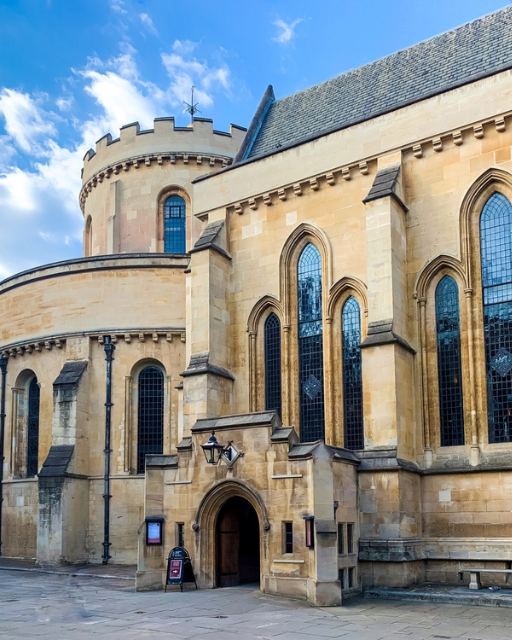
Most people walk past the entrance to Temple Church without realising what they’re approaching. Behind Fleet Street, along a narrow passage between two of London’s oldest legal institutions, stands a church that was once the English headquarters of the most powerful military order in medieval Europe. If you’re looking for the London church with the most surprising history, Temple Church is a strong candidate.
Love London history? Get it in your inbox.
Our free newsletter covers London’s hidden stories, local guides, and things worth seeing — delivered straight to you.
Subscribe Free →What Is Temple Church?
Temple Church sits within the boundaries of the Temple — a historic precinct on the north bank of the Thames, between Fleet Street and the Embankment. Today it’s flanked by the Inner Temple and Middle Temple, two of the four Inns of Court where barristers train and work. The church takes its name from the Knights Templar, who built it in the twelfth century.
The current structure dates from 1185, though the chancel was extended and completed in 1240. The church was consecrated by Heraclius, the Patriarch of Jerusalem — not a local bishop, but a senior churchman who made the journey from the Holy Land specifically for the occasion. That alone gives a sense of how significant this building was considered at the time.
The Knights Templar and Their London Base
The Knights Templar were founded around 1119 in Jerusalem, initially to protect Christian pilgrims travelling to the Holy Land. They grew rapidly into a powerful military and financial organisation with properties across Europe and the Middle East. At their peak, they operated a sophisticated banking system that allowed pilgrims to deposit money in Europe and withdraw it in the Holy Land — one of the earliest forms of international finance.
Their London base functioned as a centre for administration, finance, and recruitment. Kings and nobles deposited valuables here. The English Templars reported directly to the Pope, not to any English bishop, and were exempt from most taxes. By the time Temple Church was built, the order was at the height of its influence, and the church was designed to reflect that reach.
The Round Nave: A Jerusalem Connection
The most immediately striking thing about Temple Church is its shape. The nave — called the Round — is circular, not the rectangular form found in most English churches. This was deliberate. The Templars modelled their churches on the Church of the Holy Sepulchre in Jerusalem, built over the site traditionally identified as Christ’s tomb. A round church was a visual statement of their direct connection to the Holy Land.
There are only four surviving round-nave churches in England: Temple Church in London, the Church of the Holy Sepulchre in Cambridge, St John’s in Little Maplestead, and the Church of the Holy Sepulchre in Northampton. Of these, Temple Church is the best known and the most historically significant.
The interior of the Round is austere. Tall Purbeck marble columns support the circular gallery above. The stonework is clean and spare — in keeping with the Templars’ stated values of poverty and discipline, regardless of their actual financial standing.
Love London history? Get it in your inbox.
Our free newsletter covers London’s hidden stories, local guides, and things worth seeing — delivered straight to you.
Subscribe Free →The Stone Effigies on the Floor
Step into the Round and look down. Laid out across the floor are nine stone effigies of knights and noblemen, dating from the twelfth and thirteenth centuries. These are among the finest examples of medieval funerary sculpture remaining in England, and they are one of the most overlooked treasures in central London.
The most notable is thought to represent William Marshal, 1st Earl of Pembroke, who died in 1219. Marshal served five English kings — Henry II, Richard I, John, Henry III, and briefly acted as regent when Henry III was just nine years old. He played a key role in reissuing Magna Carta. When he died, he was brought to Temple Church, where he had taken vows as a Templar knight in his final days. His effigy lies with crossed legs, a convention sometimes associated with crusading knights.
The effigies were badly damaged when incendiary bombs struck the church on the night of 10 May 1941. They were carefully restored after the war, but traces of the damage are still visible if you look closely — a reminder that this building’s survival into the present was far from guaranteed.
The Fall of the Templars
The order’s power came to an abrupt end in the early fourteenth century. Philip IV of France, heavily in debt to the Templars, pressured Pope Clement V to act against them. In 1307, mass arrests began across France. Templars were tortured into confessions of heresy and other charges. In 1312, at the Council of Vienne, the Pope officially dissolved the order.
In England, the suppression was less brutal but equally decisive. The Temple’s properties were seized by the Crown. The church and surrounding buildings were eventually leased to lawyers — the Inner Temple and Middle Temple — who have occupied the precinct ever since. The church officially passed into their joint care in 1346 and has remained there, largely without interruption, for nearly seven hundred years. That arrangement is itself unusual: the church is neither a parish church nor a cathedral, but a private chapel administered by two legal societies.
The Blitz and the Restoration
When incendiary bombs hit the Temple on the night of 10 May 1941, the resulting fires destroyed much of the area. The church was gutted. The roof collapsed, wooden furnishings burned, and the medieval floor tiles cracked in the heat. The stone effigies suffered significant damage. For a period, it was not clear whether the building could be saved at all.
Restoration work began after the war and was completed in 1954. The work was guided by architect Walter Godfrey and aimed to return the building as closely as possible to its early thirteenth-century appearance. The resulting interior is clean and relatively uncluttered — arguably closer to what a medieval visitor would have recognised than many English churches, which have accumulated layers of alterations over the centuries.
Love London history? Get it in your inbox.
Our free newsletter covers London’s hidden stories, local guides, and things worth seeing — delivered straight to you.
Subscribe Free →Temple Church Today: What to Expect
Temple Church is still an active place of worship, with regular services throughout the week. It became widely known to a new generation when Dan Brown’s 2003 novel The Da Vinci Code featured it as a key location — a connection the church acknowledges in its visitor materials, with some ambivalence.
The church is open to visitors on most weekdays, though hours can vary and it sometimes closes for services or private events. It’s worth checking the church’s website before visiting. Entry is free, though donations are encouraged. A weekday morning visit tends to be quieter and gives you time to study the effigies and the architecture without crowds.
The title of Master of the Temple — the senior priest — dates back to the Templar era and is one of the more historically resonant clerical roles in England. Services here are held under the formal jurisdiction of both Inns of Court, an arrangement that exists nowhere else in the country.
How to Get There
Temple Church is located within the Temple precinct, accessible from Fleet Street via Middle Temple Lane, or from the Embankment via Temple Gardens. The nearest Underground station is Temple (District and Circle lines), a short walk to the south. Chancery Lane (Central line) is also within walking distance from the north.
The precinct is private but open to pedestrians during the day. The approach can be slightly confusing for first-time visitors, as signage is minimal. Look for the archway off Fleet Street, or follow Middle Temple Lane south from the Strand. Once inside the precinct, the church is clearly visible ahead of you.
Most visitors need about an hour to see the church properly — enough time to walk through the Round, examine the effigies, look at the chancel, and read the interpretation panels. It’s not a large building, but it repays close attention. There is a great deal packed into a relatively small space, and almost none of it is widely known.