
Deep in the City of London, tucked behind glass towers and busy streets, there stands a ruined church that most Londoners have never visited. Ivy drapes over stone arches. Trees grow where pews once stood. A fountain trickles in what used to be the nave. This is St Dunstan in the East — and it is one of the most extraordinary hidden places in the entire city.
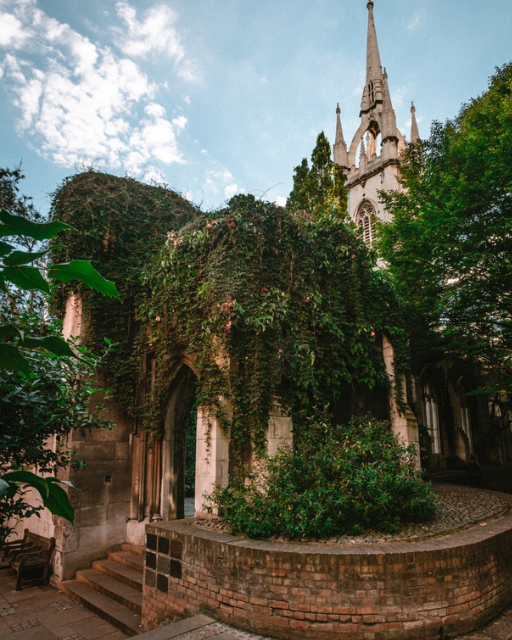
The church has stood on this site since at least 1100. It survived the Black Death, the English Civil War, and centuries of London’s endless reinvention. Then came the Great Fire of 1666, which gutted much of the building. Then came Christopher Wren, who rebuilt the tower and steeple in 1695. And then came the German bombers of the Blitz, which destroyed the body of the church in 1941 and left the walls standing as charred, hollow shells.
Rather than demolish what remained, the City of London made a remarkable decision. They would let nature reclaim it. Today, St Dunstan in the East is a public garden that sits inside those ruined stone walls — a place where the medieval and the modern coexist in extraordinary quiet.
A Church at the Heart of Medieval London
St Dunstan in the East takes its name from Saint Dunstan, the tenth-century Archbishop of Canterbury and patron saint of goldsmiths, blacksmiths, and jewellers. The “in the East” distinguishes it from St Dunstan in the West, another London church on Fleet Street — a reminder that medieval London had churches on nearly every street corner.
The church grew up in the heart of the medieval city, close to the Thames and the wharves where merchants loaded and unloaded their ships. The neighbourhood around it — now called St Dunstan’s Hill — was one of the busiest commercial zones in London throughout the Middle Ages. Sailors, cloth merchants, fishmongers, and spice traders all passed through the churchyard.
Records from the thirteenth century mention burials at St Dunstan in the East. Samuel Pepys, the famous diarist, attended services here in the 1660s. The church registers go back to the sixteenth century, making them a treasure trove for anyone researching London ancestry from that era. If your family name appears in City of London records from the 1500s to the 1800s, there is a good chance St Dunstan in the East features somewhere in your family tree.
The Great Fire of London and What Came Next
On the night of 2 September 1666, fire broke out at a bakery on Pudding Lane, less than half a mile from St Dunstan in the East. The wind drove it westwards through the city’s timber-framed streets, and within four days it consumed 13,200 houses, 87 parish churches, and most of the medieval city.
St Dunstan in the East burned. The congregation lost their church, their records, and the neighbourhood they had known for generations. The scale of the disaster was almost incomprehensible. More than 100,000 people lost their homes. The smoke visible from fifty miles away marked the end of medieval London as it had existed for centuries.
King Charles II appointed Christopher Wren to oversee the rebuilding. Wren designed 51 new churches across the city. St Dunstan in the East received something unusual in his portfolio — he rebuilt the tower and steeple rather than the whole church. The medieval body of the building was patched up and restored instead. The steeple Wren added in 1695 still stands today, a slender Gothic spire that reads as oddly medieval for a man best known for the baroque dome of St Paul’s Cathedral.
That Gothic steeple is one of the most distinctive details in the ruins today. Look up through the ivy-covered arches and you will see it rising above the garden walls — a reminder that this place has survived things that seemed unsurvivable.
🏙️ Enjoying this? 3,000 London lovers get stories like this every week. Subscribe free →
The Bombers Come to London
The Blitz began on 7 September 1940, when the Luftwaffe switched from bombing airfields to bombing British cities. London suffered 57 consecutive nights of raids. More than 43,000 civilians died across the United Kingdom during the campaign. The East End, close to the docks, took some of the heaviest punishment.
On the night of 29 December 1940 — a date Londoners remember as the Second Great Fire of London — German bombers dropped incendiary devices across the City in a coordinated attack designed to destroy its commercial heart. The fires burned with an intensity that reminded survivors of descriptions their ancestors had written about 1666. St Dunstan in the East caught fire again.
When the raids ended in May 1941, the body of the church was a roofless shell. The outer walls still stood. The tower and Wren’s steeple still stood. But the interior lay open to the sky, strewn with debris, unusable. The congregation dispersed. The church never reopened for worship.
After the war, the question of what to do with London’s bombed churches divided opinion sharply. Some argued for full restoration. Others argued for demolition and redevelopment. A few — and St Dunstan in the East was one of them — the authorities allowed to stand as ruins, transformed into something unexpected: public parks.
From Ruin to Garden
The City of London Corporation opened St Dunstan in the East as a public garden in 1971. Nature did most of the design work. Climbing plants covered the stone walls. Trees seeded themselves in the nave. Workers installed a stone fountain at the centre of what had once been the congregation’s floor.
The garden is small — you can walk around it in three minutes. But its atmosphere is unlike anything else in London. The City rises all around it: glass offices, steel and concrete, the perpetual noise of one of the world’s busiest financial districts. Step through the entrance gate and the noise drops. The air changes. The scale changes. You stand in a space that has held the dead of this city for nine hundred years, a space that has burned twice and been rebuilt twice, a space that now grows wild and quiet in the gap between towers.
Wren’s steeple rises above the garden walls. The pointed arches of the medieval windows frame views of sky and greenery. On a summer afternoon, workers from the nearby offices eat their lunch on the stone benches. Tourists stumble in and go quiet. The fountain runs.
What St Dunstan Tells Us About London
St Dunstan in the East is not a major tourist attraction. It has no entry fee, no gift shop, no audio guide. You will not find it featured prominently on most lists of things to do in London. That invisibility is part of what makes it extraordinary.
London is a city that has been destroyed and rebuilt so many times that the layers pile on top of each other in ways that make the past permanently present. The medieval, the seventeenth century, the Victorian, and the wartime all coexist here in a single stone garden. Every century left its mark.
The church registers that survived the fires are held at the London Metropolitan Archives on Northampton Road in Islington. They include baptism, marriage, and burial records going back to 1558. For anyone researching English or London ancestry, these are primary documents — the raw material of family history.
The parish of St Dunstan in the East covered an area that included some of the city’s most active commercial streets. If your ancestors worked in the cloth trade, the spice trade, or the financial sector in the City of London between the sixteenth and nineteenth centuries, there is a meaningful chance they appear in these records. The proximity to the Thames also means the records contain sailors, dock workers, and merchants from a remarkable range of origins — Dutch, Flemish, French, German — reflecting London’s long history as a port city that drew workers from across Europe.
How to Visit St Dunstan in the East
The garden sits on St Dunstan’s Hill, just off Lower Thames Street in the City of London. The nearest tube stations are Monument (Circle and District lines) and Tower Hill (Circle and District lines), both about a five-minute walk away. The garden opens at dawn and closes at dusk. Entry is free.
The walk from Monument station takes you past the column that gives the station its name — the Monument to the Great Fire of London, designed by Wren. It stands exactly 202 feet high and sits exactly 202 feet from the spot on Pudding Lane where the fire began in 1666. This is the kind of detail Wren embedded everywhere in the rebuilt city: history made geometric, the past turned into measurement.
From the Monument, walk down Monument Street and turn left on to Lower Thames Street. St Dunstan’s Hill is a short street on your right. The entrance to the garden is marked by stone gateposts that look deliberately understated — as if the place is not trying to attract you. Walk through anyway.
The best times to visit are early morning, before the City fills up, or lunchtime on a weekday, when office workers bring an unexpectedly companionable atmosphere to the ruins. Avoid weekend afternoons in summer, when it can get crowded. Most of the year, though, it is quiet enough to feel like a private discovery.
Nearby Heritage Worth Combining
The area around St Dunstan in the East contains some of the richest heritage in London. The Tower of London is a fifteen-minute walk east along Lower Thames Street. All Hallows by the Tower, one of London’s oldest churches with Roman origins, stands just around the corner. The church of St Mary at Hill, another Wren rebuild after the Great Fire, sits one street away.
If you are interested in the medieval city rather than the post-fire rebuild, a short walk north takes you to Leadenhall Market, which stands on the site of the Roman basilica that was once the largest building in Roman Britain. The market’s Victorian iron-and-glass canopy now covers what was once the public heart of Londinium.
For those tracing London ancestry, the walk between St Dunstan in the East and the Guildhall — about twelve minutes west through the city — passes through several blocks containing parishes most likely to hold records relevant to City of London families. The Guildhall Library holds an extensive collection of parish records, electoral rolls, and trade directories that complement what is available at the London Metropolitan Archives.
Frequently Asked Questions About St Dunstan in the East
When was St Dunstan in the East founded?
The church of St Dunstan in the East dates to at least the twelfth century, with the earliest documentary references appearing around 1100. It served as an active parish church for approximately eight centuries before the Second World War destroyed its interior. The site has been in continuous use as either a church or a public garden for nearly a thousand years.
Why did they leave St Dunstan in the East as a ruin rather than rebuild it?
German bombing destroyed the interior of the church in December 1940 during the Blitz. After the war, the City of London decided against full restoration. The outer walls and Christopher Wren’s 1695 tower and steeple remained structurally sound. In 1971, the authorities converted the ruins into a public garden rather than demolishing or rebuilding them. The decision preserved both Wren’s steeple and the medieval stonework of the outer walls for future generations.
Can I access church records from St Dunstan in the East for genealogy research?
Yes. The surviving parish registers for St Dunstan in the East, covering baptisms, marriages, and burials from 1558 onwards, are held at the London Metropolitan Archives (40 Northampton Road, London EC1R 0HB). Many of these records have been digitised and are accessible through genealogy platforms including FindMyPast and Ancestry. The records are particularly useful for tracing City of London families involved in trade, commerce, and the maritime industries between the sixteenth and nineteenth centuries.
Is St Dunstan in the East free to visit?
Yes. The garden is free to enter and open daily from dawn to dusk. There are no booking requirements and no guided tours. The nearest tube stations are Monument and Tower Hill, both on the Circle and District lines, approximately a five-minute walk from either station. The garden entrance is on St Dunstan’s Hill, off Lower Thames Street.
Join 3,000+ London Lovers
Every week, get London’s hidden history, heritage walks, and stories from the city’s remarkable past — straight to your inbox.
Subscribe free — enter your email:
Already subscribed? Download your free London guide (PDF)
Love more? Join 64,000 Ireland lovers → · Join 43,000 Scotland lovers → · Join 30,000 Italy lovers →
Free forever · One email per week · Unsubscribe anytime