
Just west of Paddington station, the streets change their character. The traffic thins. The noise drops a notch. And there, where the Grand Union Canal meets the Regent’s Canal, you find a place that doesn’t feel like London at all.
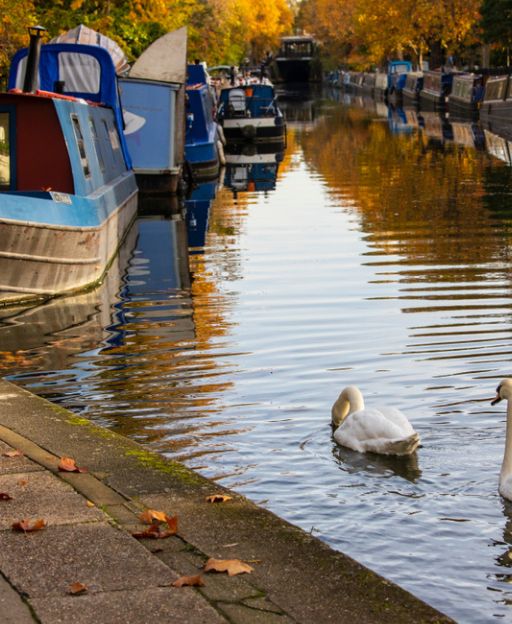
Colourful narrowboats line the water’s edge. Swans drift past without any particular hurry. Trees overhang the canal and, on a still morning, the whole scene reflects back like something from a painting.
Londoners call this place Little Venice. First-time visitors tend to stop, look around, and quietly wonder how they’d never heard of it.
How a Working Canal Became One of London’s Prettiest Corners
The Regent’s Canal was not built for beauty. When it opened in 1820, it was an 8.6-mile commercial waterway — a trade route linking the Grand Junction Canal at Paddington to the River Thames at Limehouse. Barges carried coal, timber, building materials, and goods through the heart of a rapidly expanding city.
🏙️ Love London?
3,000 London lovers get hidden history, street-level stories, and local secrets every week. Free, forever — no spam, unsubscribe any time.
Subscribe free — enter your email:
It was grimy, purposeful work. The towpaths were worn down by horses. The barges sat heavy in the water.
But industries change. The railways arrived in the mid-19th century and slowly took over much of the canal’s commercial role. By the 20th century, large parts of the Regent’s Canal had gone quiet. What remained was the water itself — calm and winding — and the towpaths worn smooth by two centuries of working boots.
Today, that same industrial channel is one of London’s most peaceful walks. The narrowboats are still here, but they carry people rather than cargo. The towpath is still there, but walkers and cyclists have replaced the working horses. The transformation took a hundred years and it is almost total.
The Poet Who Gave This Place Its Name
No one can say with complete certainty who first called this stretch of water Little Venice, though the name has stuck so firmly it is now entirely official.
The story most Londoners tell involves Robert Browning, the Victorian poet. Browning lived in Warwick Crescent — a short walk from the canal basin — for much of his adult life. He is said to have compared the junction of the two canals to the waterways of Venice, a city he knew and loved deeply.
Lord Byron’s name sometimes enters the story too. Both poets had spent time in Italy. Both would have understood what they were comparing it to.
What is certain is that someone, at some point in the 19th century, stood at this quiet junction of canals in West London and saw not an industrial waterway but something older, slower, and more romantic. They were right enough that the name has lasted nearly two hundred years.
Browning is remembered here still. There is a small garden in Browning’s name near the basin, and the memory of a poet who found beauty in an industrial canal says something true about what this place is — and what it does to the people who find it.
Life on the Water
Walk along the towpath from the basin and you will see narrowboats painted in deep greens, reds, yellows, and blues. Some are weekend boats, used for summer outings along the wider canal system. Others are permanent homes.
The people who live on narrowboats in Little Venice form a community unlike almost any other in London. They share water points and mooring spots. They tend small gardens in pots on their roof decks. They have wood-burning stoves for cold evenings and, in summer, prop their doors open to let the canal air through.
It is an unusual way to live in one of the world’s most expensive cities — and it carries its own particular appeal. There is something about having your home on the water, about the canal passing your window each morning, that changes the relationship between a person and the city around them.
Every May, the basin itself comes alive for the Canalway Cavalcade — a floating festival where decorated narrowboats gather at the junction. It is free to watch, entirely unlike anything else London puts on, and deeply local in a way the city’s larger events rarely are.
The Canal Walk to Camden
One of London’s finest free walks runs along the towpath from Little Venice to Camden Market — roughly two miles, completely flat, and worth doing at almost any time of year.
The route passes through the heart of Regent’s Park. The canal threads between the zoo on one side and the park’s open green spaces on the other. In summer, you can hear the animals over the sound of the water. In autumn, the trees along the towpath turn amber and gold, and the reflections in the canal make the whole walk feel slightly unreal.
At Camden, the canal arrives at a working lock. Narrowboats still pass through, rising and falling as the lock fills or empties — a piece of working canal history in the middle of a busy market. The market spreads out around the lock, and you can follow the towpath all the way into the basin, eat lunch by the water, and return through Regent’s Park on a different path.
If you’re planning a London trip that includes this walk, the London trip planning guide is the best place to start putting it together.
What Else Is Worth Knowing
Little Venice sits within the Borough of Westminster, though it feels a long way from Oxford Street and the bustle of central London.
The nearest Tube stations are Warwick Avenue on the Bakerloo line — a five-minute walk from the basin — and Paddington, around ten minutes on foot. There is no entrance gate, no signage, and no ticket required. You follow the road down to the water and you are there.
A handful of cafes and restaurants operate nearby. In summer, a floating café runs from a barge in the basin itself — one of those distinctly London details that you either happen across or miss entirely. The Puppet Theatre Barge has performed from this spot since the 1980s, staging shows year-round on the water.
The towpath is open to walkers and cyclists alike. It can get busy on summer weekends, but during the week — even in peak tourist season — you can walk long stretches of it in near silence.
If you enjoy finding green corners of the city that most visitors miss, you might also like the Japanese garden hidden in South London that makes you forget the city exists.
A Place That Moves at Its Own Pace
London is a city that does not stop. It moves fast, it is always building something new, and it rewards the people who keep up with it. But there are corners that operate on an entirely different schedule — and Little Venice is one of them.
It does not advertise itself. It does not appear at the top of most London lists. You have to look for it, or stumble upon it, or be brought there by someone who already knows.
People who live near the canal talk about it with the particular fondness of people who have found something good and would like to keep it. Not a secret exactly — more like a thing they are careful with.
🇬🇧 25 Hidden Gems of London Most Tourists Never Find
From secret riverside walks to hidden Victorian tunnels, centuries-old pubs to rooftop gardens with skyline views — our free guide reveals the London most visitors never discover. Join 3,000+ London lovers who get it free.
Get Your Free London Hidden Gems Guide →Love more? Join 65,000 Ireland lovers → · Join 43,000 Scotland lovers → · Join 30,000 Italy lovers →
Free forever · Unsubscribe anytime