
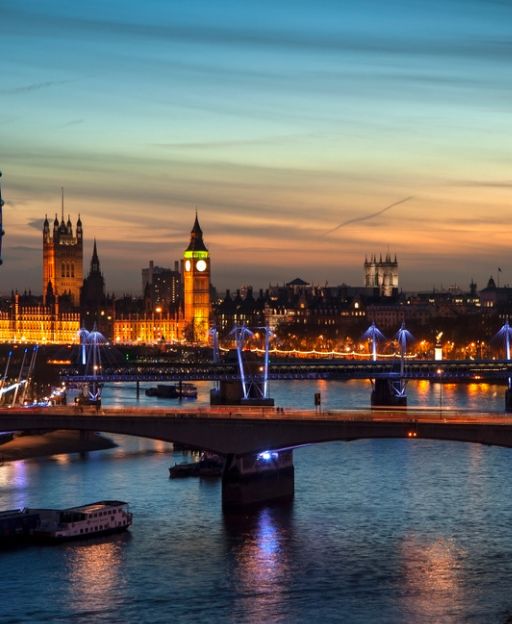
Stand on Westminster Bridge at dusk. Big Ben rises behind you. The Thames stretches ahead, dark and wide, carrying everything London has ever been. On the far bank, a two-mile stretch of riverside path waits — and it holds more history than most cities manage in their entirety.
The South Bank walk — from Westminster Bridge to Tower Bridge — is the one walk in London that most travel guides mention but few visitors actually complete. It is free. It runs alongside the river. It passes through layers of the city that span Roman trade, medieval theatre, Victorian industry, and modern art. And it changes completely depending on whether you walk it in the morning, the afternoon, or at night.
This is how London reveals itself: slowly, on foot, with the river beside you.
Westminster Bridge to Southwark: Where Roman London Ended
Cross Westminster Bridge from the north bank and you step onto ground that Romans knew well. The south bank of the Thames — what the Romans called Southwark — was where traders arrived from the Continent before crossing into Londinium. Grain, wine, olive oil, and pottery all came through here.
For centuries, Southwark was technically outside the City of London’s jurisdiction. That made it useful. Brothels, bear-baiting pits, theatres, and inns flourished on this bank because city authorities could not close them down. It was London’s escape valve — the place where the rules relaxed.
Walk east from the bridge along the Albert Embankment and the character of the water changes. The Thames here is tidal. At low tide, you can see stretches of muddy foreshore where mudlarkers still search for Roman coins, medieval clay pipes, and Victorian artefacts. The river gives up its secrets twice a day.
Borough Market and Southwark Cathedral: 1,000 Years of Food and Prayer
About twenty minutes into the walk, the smell hits you before you see it. Borough Market has been feeding Londoners since at least 1014 — possibly longer. It is one of the oldest food markets in Britain, and it still operates under the arches of the railway viaduct that Victorian engineers built straight through it.
The market sells everything from Scotch eggs and sourdough to Ethiopian spices and Spanish charcuterie. Go early in the morning for traders setting up, or Friday lunchtime when it reaches full noise. Either way, bring cash and come hungry.
Directly beside the market stands Southwark Cathedral. It is not as famous as Westminster Abbey, and that is precisely why it is worth visiting. There has been a church on this site since the 7th century. The cathedral’s nave contains a monument to Shakespeare — the Globe Theatre was a three-minute walk from here, and many actors were buried in this church. John Harvard, who founded Harvard University, was baptised in this building in 1607.
Enjoying this? 3,000+ London lovers get stories like this every week. Subscribe free →
Shakespeare’s Globe: Theatre Where It Has Always Been
A few hundred metres further east, the Globe Theatre appears. The original Globe — built by Shakespeare’s company in 1599, partly from the timbers of an older playhouse — stood 200 metres from the current building. It burned down in 1613 when a cannon fired during a performance of Henry VIII set the thatched roof alight. Nobody died. The audiences were too busy watching.
The rebuilt Globe, which opened in 1997, is the most faithful reconstruction of an Elizabethan theatre in the world. If you visit between April and October, you can watch a play in the open air, standing in the yard as groundlings did four centuries ago. Tickets for the yard cost about £5. You stand. You get wet if it rains. It is the best way to see Shakespeare in London.
Even if you do not see a performance, the exhibition inside traces the history of Bankside entertainment — bear-baiting, cockfighting, and theatre all operated within a quarter-mile of each other. The Tudors had complicated ideas about leisure.
Planning your trip and looking for help working out which areas suit you best? The 5-Day London Itinerary has the South Bank built into its second day, with practical advice on timing.
Tate Modern: A Power Station That Became a Cathedral of Art
Bankside Power Station loomed over the South Bank for decades as a functional, coal-burning eyesore. It closed in 1981. When Tate Modern opened inside it in 2000, the transformation was so complete that the building itself became the attraction.
The Turbine Hall — the main entry space — is eleven storeys tall and 152 metres long. Artists commissioned to fill it have included Louise Bourgeois, Olafur Eliasson, and Doris Salcedo. The permanent collection is free. You can walk in, spend twenty minutes or three hours, and walk out without spending a penny.
The building still looks like a power station from the outside, complete with its single chimney stack. Inside, the vast proportions make the art feel both monumental and human at the same time. Few museums in the world use their space as well as this one.
For an afternoon that costs nothing, combine Tate Modern with a walk along the riverfront. The view from the Millennium Bridge — a footbridge that connects Bankside to St Paul’s Cathedral — is one of the best in London. The bridge famously wobbled alarmingly on its opening day in 2000 due to resonance from pedestrian footfall. Engineers fixed it. It has been solid ever since.
The Final Stretch: Bermondsey and Tower Bridge
East of Tate Modern, the walk becomes quieter and more residential. Bermondsey has been reinvented in the past decade — Victorian warehouses that once stored hops and leather now house restaurants, independent breweries, and boutique galleries.
Maltby Street Market runs under the arches on Saturday and Sunday mornings, smaller and less crowded than Borough Market, with the same quality of food. It is where local chefs and food professionals do their weekend shopping.
The walk ends — or begins, depending on your direction — at Tower Bridge. The bridge itself is worth a stop. Built between 1886 and 1894, it was designed to lift its central roadway to allow tall ships through. The hydraulic system that powered the original lifts is still on display inside. The glass walkways high above the river are open to visitors and the views downstream and upstream on a clear day are extraordinary.
If you want to understand what London’s free museums and attractions can offer, this walk ties several of them together in a single afternoon.
How long does the South Bank walk take?
The walk from Westminster Bridge to Tower Bridge covers about two miles and takes roughly 90 minutes at a comfortable pace without stops. Allow three to four hours if you plan to visit Borough Market, the Globe, and Tate Modern along the way.
Is the South Bank walk suitable for all ages?
Yes. The path is paved and flat for almost its entire length, with benches, cafés, and public toilets throughout. It is pushchair and wheelchair accessible. Children enjoy the Tate Modern’s Turbine Hall and the Globe’s outdoor spaces particularly.
What is the best time of day to walk the South Bank?
Early mornings (before 9am) are quiet and atmospheric, with Borough Market traders setting up. Friday lunchtimes are the most vibrant — the market is at full capacity and the riverside is busy with workers on lunch breaks. At dusk, the view back across the Thames towards Westminster is one of the finest in Europe.
Can I do the South Bank walk for free?
Almost entirely yes. The walk itself, the riverfront views, the exterior of all the buildings, Tate Modern’s permanent collection, and Southwark Cathedral are all free to enter. Borough Market, the Globe exhibition, and Tower Bridge’s interior have admission charges.
The South Bank asks nothing of you except your time and your willingness to walk. Two miles of history, art, food, and water. London concentrated into a single afternoon.
🇬🇧 25 London Places Most Visitors Miss
From secret riverside walks to hidden Victorian tunnels, centuries-old pubs to rooftop gardens with skyline views — our free guide reveals the London most visitors never discover. Join 3,000+ London lovers who get it free.
Get Your Free 25-Places Guide →Love more? Join 65,000 Ireland lovers → · Join 43,000 Scotland lovers → · Join 29,000+ Italy lovers →
Free forever · Unsubscribe anytime
Subscribe Free