
Walk down almost any street in Mayfair, Bloomsbury, or Kensington and you will notice a gap in the rows of townhouses. A gate. A glimpse of green. Behind that gate is a garden square — a piece of quiet, private London that has existed, in many cases, for over 300 years.
There are more than 600 of them scattered across the capital. Most visitors never know they exist.
How London’s Garden Squares Were Born
The story begins with land speculation in the 17th century.
When wealthy landowners wanted to develop their estates in the West End, they had a problem. Rows of identical houses on bare streets would not attract the wealthy buyers they needed. The solution was simple but brilliant — put a garden in the centre.
The first great example was Bloomsbury Square, laid out in the 1660s. Then came Soho Square, Grosvenor Square, Berkeley Square. Each one followed the same formula: grand terraced houses arranged around a central private garden, exclusively for residents.
The garden square was a class signal. It told the world that the people who lived here were the kind who had exclusive access to green space in one of the most crowded cities on earth.
It worked. London’s great estates — Bedford, Grosvenor, Cadogan — grew rich building squares across the city. The pattern they established still shapes London today. Those same family names still own much of the land beneath these streets.
By the 19th century, the garden square had become a defining feature of London’s social geography. The closer you lived to a square, the better your address. Farther away and you were simply in a street.
The Squares Worth Seeking Out
Some garden squares are private — locked, accessible only to residents with keys. But many are open to the public, and they are among the finest small green spaces in Europe.
Russell Square in Bloomsbury is one of the largest and most welcoming. Set among the grand buildings of the British Museum quarter, it has a café and wide gravel paths that invite you to slow down on a busy day.
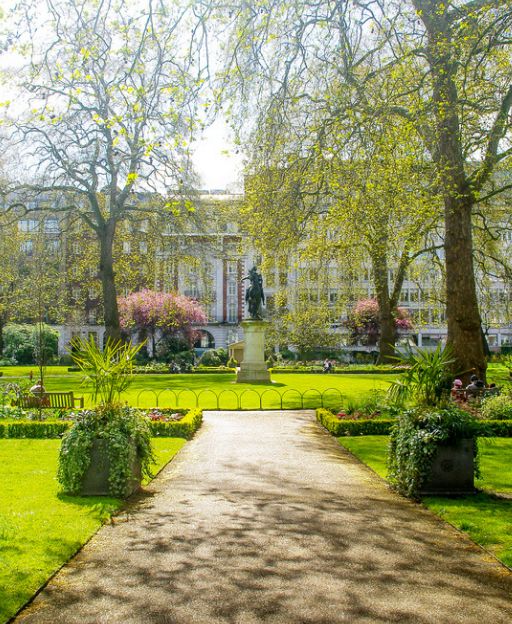
St James’s Square is quieter and more formal, ringed by some of the most expensive addresses in the city. On a spring morning the lawns are immaculate, the paths nearly empty. It feels entirely separate from the traffic on Pall Mall just beyond the railings.
Soho Square is perhaps the most democratic. This small patch of green near Oxford Street is where London’s office workers eat their lunches and tourists rest their feet. It has been a public garden since the 1680s, making it one of the oldest continually used green spaces in the city.
Belgrave Square is the grandest example — one of the largest in the city, designed by George Basevi in the 1820s. The garden itself is private, but standing on the pavement and looking through the Victorian iron railings at the plane trees and formal paths tells you everything about how 19th-century wealth imagined itself.
For a full guide to the best areas to explore in the city, see our guide to London’s best neighbourhoods for visitors.
Enjoying this? 3,000+ London lovers get stories like this every week. Subscribe free →
The History Inside the Gates
Some of London’s garden squares carry extraordinary histories. A few are better described as stages where famous events took place.
Gordon Square in Bloomsbury was the spiritual home of the Bloomsbury Group — the radical circle that included Virginia Woolf, John Maynard Keynes, and E.M. Forster. The philosopher Bertrand Russell lived here. So did art critic Clive Bell and his wife Vanessa, Virginia’s sister. The square was their communal ground, a place to walk and argue ideas that would shape 20th-century thought.
Cavendish Square, in Marylebone, was laid out in the 1720s as the centrepiece of one of the first grand West End developments. In the 18th century, it was the fashionable address in London. Today, it is a quiet haven between Oxford Street and Harley Street, used mainly by the medical professionals who work nearby.
Ladbroke Square in Notting Hill is one of the largest private garden squares in London, accessible only to local residents. Its circumference walk is something like half a mile. The garden is invisible from the street — completely hidden behind the terraces — which makes it one of the city’s most quietly kept secrets.
The existence of these private gardens has always said something about how London distributes its treasures. The best of them are invisible unless you know to look. Our earlier piece on the families who have quietly owned London’s best streets for 300 years explores the landowners who created many of these squares — and still own the land beneath them.
What to Expect When You Visit
The public garden squares — St James’s Square, Russell Square, Soho Square, Grosvenor Square — are generally open during daylight hours. Most have seating and benches. Some have cafés nearby.
The private squares are a different matter. In most cases, only residents have access and the gates are locked. But you can still appreciate them from the pavement, and in many cases the railings are low enough to give you a full view of what lies inside.
There is also an annual Open Garden Squares Weekend event in London, organised by the London Historic Parks and Gardens Trust. Over one weekend each June, dozens of private squares open their gates to the public. It is one of the quietest and most rewarding ways to spend a summer weekend in the city.
Garden squares are scattered across almost every central London neighbourhood, which means that wherever you are staying, there is almost certainly one within a short walk. They are most concentrated in Bloomsbury, Mayfair, Belgravia, Chelsea, and Kensington. If you are building a London itinerary that captures this quieter, greener side of the city, our 5-day London guide for first-time visitors is a good place to start.
Are London’s garden squares free to visit?
The public squares — including Russell Square, St James’s Square, Soho Square, and Grosvenor Square — are free to enter and open during daylight hours. Private squares are only accessible to residents with keys, but can be viewed and admired from the pavement outside.
When is the best time to visit London’s garden squares?
Spring is the finest season, particularly April and May when the plane trees are in new leaf and flower beds are coming into bloom. Early morning visits to the quieter squares are especially rewarding before the city gets busy. June brings Open Garden Squares Weekend, when many private squares open to the public.
Which is the most beautiful garden square in London?
St James’s Square is widely considered one of the finest — formal, quiet, and perfectly proportioned. Belgrave Square is the grandest in scale. For a more relaxed, village-like atmosphere, Canonbury Square in Islington is a lovely choice, and Gordon Square in Bloomsbury carries the most literary history.
How many garden squares are there in London?
London has over 600 garden squares, making it the city with the highest concentration of urban green squares in the world. They range from the great 17th-century squares of Bloomsbury to small Edwardian neighbourhood gardens in residential streets, many of which are still entirely unknown to visitors.
London’s garden squares are easy to miss, which is precisely why they remain so rewarding. The city saves its best green spaces not for its tourists — but for the people who think to look past the gate.
🇬🇧 25 Hidden Gems of London Most Tourists Never Find
From secret riverside walks to hidden Victorian tunnels, centuries-old pubs to rooftop gardens with skyline views — our free guide reveals the London most visitors never discover. Join 3,000+ London lovers who get it free.
Get Your Free London Hidden Gems Guide →Love more? Join 65,000 Ireland lovers → · Join 43,000 Scotland lovers → · Join 29,000+ Italy lovers →
Free forever · Unsubscribe anytime
Subscribe Free