
Every June, on a Saturday that the city has been quietly preparing for all year, something extraordinary takes over central London. By 7am, the pavements along the Mall are three people deep. Fold-up chairs have appeared overnight. Children sit on shoulders. The sound of distant drums begins to drift across St James’s Park.
What Trooping the Colour Actually Is
Trooping the Colour is the official celebration of the British monarch’s birthday. Not the actual birthday — King Charles was born in November — but the official one, held each June when the weather has a fighting chance of cooperating.
The ceremony dates formally to 1748 under George II, though the practice of trooping the colour — marching a regiment’s flag along its ranks so every soldier could recognise it in the chaos of battle — is far older. What began as military necessity became the most spectacular royal parade in the world.
Each year, one regiment of the Household Division is chosen to troop its colour. That regiment’s flag is carried slowly down the ranks, then marched back to the band’s beat. The whole thing sounds simple. In practice, it is breathtaking.
The Route and the Spectacle
The day unfolds across two miles of central London. The King travels from Buckingham Palace along the Mall to Horse Guards Parade in Whitehall — by carriage in recent decades, traditionally on horseback. Thousands of soldiers line the route, standing completely still while tens of thousands of spectators stream past them.
At Horse Guards Parade, around 7,000 invited guests fill tiered stands to watch the ceremony itself. The colour is trooped. A 41-gun salute fires in Hyde Park. Then the procession returns to Buckingham Palace, where the royal family gathers on the famous balcony.
The RAF fly-past follows. Up to twenty aircraft pass over the Palace in tight formation — often ending with the Red Arrows trailing red, white, and blue smoke overhead. From first drum to final aircraft, the whole event runs just over two hours.
The Guards Who March
The Household Division comprises five regiments of Foot Guards and two of Household Cavalry. At Trooping, all five Foot Guard regiments may march: the Grenadier Guards, Coldstream Guards, Scots Guards, Irish Guards, and Welsh Guards.
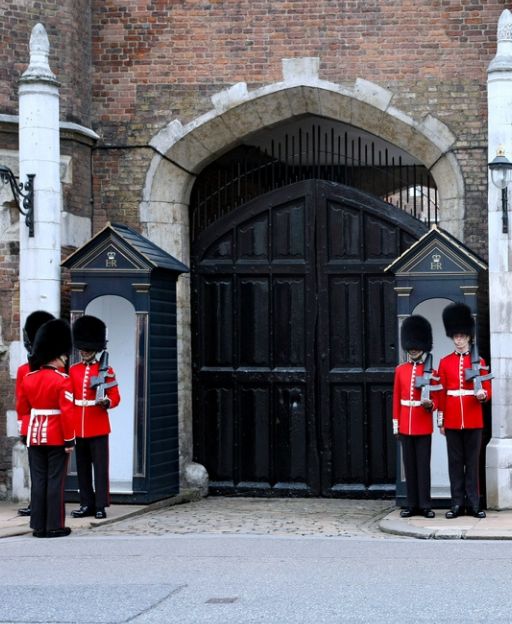
You can tell them apart by their button spacing — the Grenadiers have evenly spaced single buttons; the Coldstreams have pairs; the Scots have threes. Each soldier’s scarlet tunic is made to measure. Each bearskin cap is fashioned from Canadian black bear fur and weighs around 500 grams. They are not designed for comfort. They are designed to be unforgettable.
The same regiments you see at Trooping are on duty year-round. The daily Changing of the Guard at Buckingham Palace and St James’s Palace gives you a close-up view of the bearskin hats and scarlet tunics in a far more intimate setting. Trooping is the grand version. Changing the Guard is the everyday one. Both are worth seeing.
Enjoying this? 3,000+ London lovers get stories like this every week. Subscribe free →
How to Watch Without a Ticket
Here is what most visitors never realise: the majority of Trooping the Colour is entirely free to watch.
The Mall — the long ceremonial avenue from Trafalgar Square to Buckingham Palace — has open public viewing areas along its entire length. Arrive by 7.30am and you can find a good position near St James’s Park. The procession passes twice: on the way to Horse Guards Parade, and again on the return. That means two clear views of the full cavalcade for the price of an early morning.
The best free spots are along the Mall itself and around the Victoria Memorial in front of Buckingham Palace. For the balcony appearance, you’ll need to be near the Palace gates by mid-morning before the crowds thicken.
Tickets for the stands at Horse Guards Parade are allocated by public ballot, which opens in late autumn each year through the Household Division’s official website. The ballot is free to enter. If you’re visiting London in June and planning ahead, it’s absolutely worth trying — the enclosed view of the ceremony from the stands is extraordinary.
If you miss Trooping entirely, the Major General’s Review and the Colonel’s Review, held in the two weeks beforehand, are essentially dress rehearsals with free public access and far smaller crowds.
The Chelsea Pensioners — the scarlet-coated veterans of the Royal Hospital Chelsea — often attend Trooping as honoured guests, a reminder that these are working military traditions, not museum pieces staged for tourists.
Before you go, the London planning guide has everything you need on timing, transport, and what to do around the big day.
When does Trooping the Colour take place?
Trooping the Colour happens on a Saturday in June, usually the second or third Saturday of the month. The exact date is confirmed in late winter each year. In 2025, it took place on 14 June. Check the Household Division’s website in early spring for the current year’s date.
How do I get tickets to Trooping the Colour?
Tickets for the stands at Horse Guards Parade are allocated by public ballot each autumn through the Household Division Regimental Adjutants. The ballot is free to enter but competition is high. Most spectators watch from the Mall for free, which is a genuine pleasure and requires no ticket at all.
Where is the best free spot to watch Trooping the Colour?
Arrive early — by 7am if you can — and take a position along the Mall near St James’s Park or around the Victoria Memorial. The procession passes twice, giving two clear views of the full parade. Crowds build quickly from 8am onwards and the best positions go fast.
What is the difference between Trooping the Colour and the Changing of the Guard?
The Changing of the Guard is a daily ceremony at Buckingham Palace and St James’s Palace. Trooping the Colour is an annual event on Horse Guards Parade involving the full Household Division. They use the same regiments but are very different in scale — Trooping is London’s biggest annual military spectacle.
London saves its grandest gestures for one Saturday each June. The Mall fills, the drums echo, and thousands of people who couldn’t be more different from one another stand shoulder to shoulder, watching something that connects the present to 300 years of shared history. It is, quietly, one of the most moving things this city does.
🇬🇧 25 London Places Most Visitors Miss
From secret riverside walks to hidden Victorian tunnels, centuries-old pubs to rooftop gardens with skyline views — our free guide reveals the London most visitors never discover. Join 3,000+ London lovers who get it free.
Get Your Free 25-Places Guide →Free forever · Unsubscribe anytime
Subscribe Free