
In 1966, London’s city planners had a plan. They would knock down St Pancras station — that great red-brick Gothic pile on the Euston Road — and replace it with something modern. Practical. Efficient. Nobody important seemed to object. Nobody, that is, except one eccentric, bicycle-riding, church-obsessed poet named John Betjeman.
What happened next changed London forever.
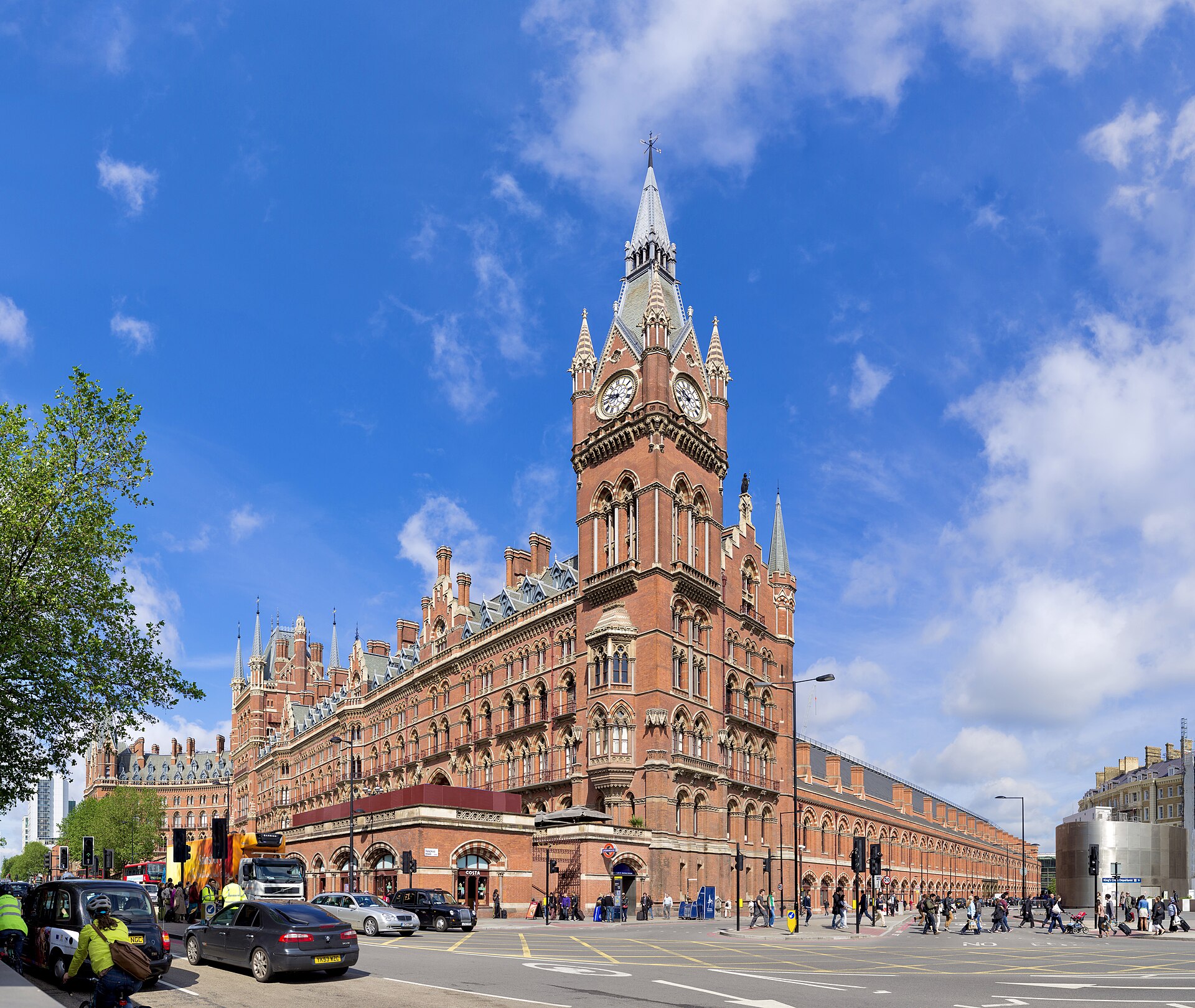
A Station Built to Impress
When the Midland Railway opened St Pancras in 1868, they weren’t just building a terminus. They were making a statement.
The railway companies of Victorian England competed fiercely — not just on speed and price, but on sheer architectural glory. The man they hired to design the hotel and station frontage was George Gilbert Scott, already famous for the Albert Memorial and the Foreign Office building. His brief was to build something that would make rival stations look shabby.
He did exactly that.
Scott’s Gothic Revival masterpiece rose 82 metres above the Euston Road, all pointed arches, terracotta spires, and a clock tower visible from half a mile away. The Midland Grand Hotel inside featured sweeping staircases, hand-painted ceilings, and rooms so elaborate that guests sometimes refused to leave. For a brief golden period, it was considered the finest hotel in England.
Then the railway age declined, the hotel closed, and St Pancras became a building Londoners walked past without looking up.
The Man Who Still Looked Up
John Betjeman was not a typical architectural campaigner. He was a poet — beloved, gently eccentric, and famous for writing about things everyone else overlooked. His poems celebrated Victorian churches, suburban tennis clubs, and seaside towns. He had a particular weakness for buildings that felt unfashionable.
St Pancras was precisely the sort of place he cared about.
When demolition plans emerged in the early 1960s, Betjeman was furious. He called the station “too beautiful and too romantic to survive.” He wrote letters. He gave interviews. He appeared on television making the case with the kind of passionate clarity that only comes from genuine conviction.
“What will people in a hundred years’ time think of us,” he asked, “if we pull this down?”
The plans had powerful backers. The land was valuable. The building was expensive to maintain. And Victorian architecture was deeply unfashionable — modernists had spent thirty years dismissing it as sentimental excess.
How Close It Came
The threat was entirely real. The nearby Euston station had already been demolished in 1962, losing its famous Greek Revival arch — the Euston Arch — in an act of destruction that left preservationists stunned. Betjeman described it as one of the worst acts of architectural vandalism in British history. He was determined St Pancras would not follow.
Enjoying this? 3,000+ London lovers get stories like this every week. Subscribe free →
The campaign gathered momentum slowly. Betjeman was joined by historians, architects, and a growing body of public opinion that had watched the Euston Arch fall and begun to wonder what might go next. The Victorian Society — founded partly in response to precisely that kind of loss — threw its weight behind the cause.
Letters poured into newspapers. Questions were raised in Parliament. And in 1967, St Pancras was formally listed as a Grade I protected building — the highest level of protection available in England. It could not be demolished without a full public inquiry. The battle was not won, but it could no longer be lost quietly in a planning office.
The Long Years of Waiting
Listing the building saved it from demolition. Saving it from decay took another four decades.
For much of the 1970s and 1980s, St Pancras existed in a state of magnificent uncertainty. The train station itself continued to operate, but the hotel above it fell into disrepair. Its grand staircases were used as film sets. Pigeons nested in rooms where Victorian industrialists had once slept. Developers circled. Various proposals came and went without result.
The rescue began in earnest in the 1990s, when the decision was made to bring Eurostar — the new cross-Channel rail service — into St Pancras rather than Waterloo. This required a major expansion of the platforms and a full-scale restoration of the building. For the first time in a century, serious money was committed to bringing St Pancras back to life.
The station reopened as St Pancras International in 2007. The hotel followed as the St Pancras Renaissance in 2011, its grand public rooms finally accessible to anyone who wanted to step inside and see what Victorian ambition actually looked like. The old iron train shed — a vast single arch of glass and metal considered an engineering marvel when it was built — was cleaned, repainted, and is now one of the finest interior spaces in London.
If you’re planning your trip to the city, our complete London planning guide has everything you need to make the most of your visit. And if you’d like to explore more of London’s Victorian heritage, the story of London’s Victorian terraces reveals how the city’s residential streets were built with the same ambition as its grandest public buildings.
The Statue That Looks Up
John Betjeman died in 1984, before the full restoration was complete. He never saw his campaign fully vindicated in brick and steel.
But he is still there, in a sense. A bronze statue stands inside St Pancras International — the poet caught mid-stride, bags at his feet, head tilted back, eyes fixed on the vast curving roof above. It is exactly the gesture of someone seeing something extraordinary for the first time.
He saved it by paying attention. By looking up when everyone else had stopped noticing. The building he fought for is now one of London’s most admired landmarks, regularly cited as the city’s finest Victorian structure. What was once scheduled for demolition attracts millions of visitors a year.
Next time you pass through St Pancras, find the statue. Stand where he stands. Look up. And consider what this city would have lost if he had stayed quiet.
Frequently Asked Questions
When is the best time to visit St Pancras station in London?
St Pancras is busiest on weekday mornings and weekend afternoons. Visit between 10am and noon on a weekday for a quieter experience — you’ll have more space to look up at the architecture without fighting through commuter crowds.
What is inside St Pancras station besides the trains?
Beyond the Eurostar and East Midlands Railway platforms, St Pancras houses the St Pancras Renaissance Hotel, a champagne bar built into the Victorian train shed, independent shops, and some of the finest restored Victorian ironwork in London. Entry to the station itself is entirely free.
How do I get to St Pancras International from central London?
St Pancras is served by the London Underground at King’s Cross St. Pancras station, which connects six tube lines including the Piccadilly, Northern, Victoria, Metropolitan, Circle, and Hammersmith & City lines. It sits on the Euston Road in Camden, roughly 10 to 15 minutes by tube from most central London areas.
Is the St Pancras hotel open to non-guests?
Yes. The St Pancras Renaissance Hotel welcomes visitors for afternoon tea, drinks, and meals in its restored Victorian public rooms. The grand staircase — one of the most photographed interiors in London — is accessible during hotel opening hours without a reservation.
🇬🇧 25 Hidden Gems of London Most Tourists Never Find
From secret riverside walks to hidden Victorian tunnels, centuries-old pubs to rooftop gardens with skyline views — our free guide reveals the London most visitors never discover. Join 3,000+ London lovers who get it free.
📲 Know someone who’d love this? Share on WhatsApp →
Free forever · Unsubscribe anytime
Subscribe Free