
You’ve walked past them a hundred times. Red brick, white stone trim, a row of sash windows, and that distinctive wrought iron railing. And you probably thought: nice houses.
But those details aren’t decoration. They’re a language. Once you learn to read it, every Victorian terrace in London becomes a history book you can walk right through.
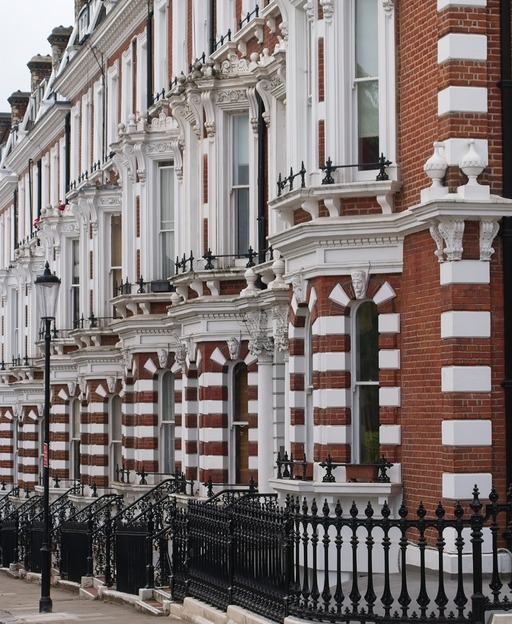
The Bricks Tell You When It Was Built
Not all red brick is the same. And not all Victorian terraces are red.
The earliest Victorian homes — built in the 1840s and 1850s — used London Stock Brick. It’s a yellowish, slightly muddy-looking material made from clay dug right out of London’s own ground. It gives Bloomsbury and Brixton their distinctive colour: a warm amber-grey that looks almost ancient in winter light.
By the 1870s, that changed. The railways had made red brick from the Midlands cheap to ship, and it arrived in Kensington and Chelsea carrying a clear message: this building is modern, prosperous, and confident.
If you see very ornate brickwork — alternating red and white bands, terracotta panels, decorative string courses — you’re almost certainly looking at the 1880s or 1890s. Victorian builders in those decades were showing off everything the new manufacturing age could produce.
The Front Door Is a Statement
A Victorian front door wasn’t just a door. It was a calling card.
The fanlight — the arched or rectangular window above the door — was standard on Georgian houses and carried over into early Victorian building. But as the century progressed, fanlights became more elaborate: coloured glass, decorative ironwork, ornate tiled porches that announced exactly how much money was being spent on appearances.
And beside the steps, almost invisible to most people? A boot scraper — a simple iron frame fixed into the stone. In the 1860s and 1870s, London’s streets were unpaved mud tracks. Arriving at someone’s front door without scraping your boots was a serious social offence. Those scrapers are still there on thousands of London doorsteps. Most visitors step over them without a second glance.
Look at the number tiles on the path too. In the grandest streets, the tiled entrance path was a status symbol — geometric patterns in deep blue, terracotta, and cream, pressed into the ground to greet every visitor before they reached the door.
Below Street Level: A Whole Other World
Drop your gaze below the front steps and you’ll find a separate world entirely.
Most London terraces have an area — a sunken courtyard between the pavement and the house. This was the domain of servants. The grand front door at the top of the steps was for family and guests. The door at area level led directly to the kitchen and the scullery below stairs.
At pavement level, look for the round iron discs set into the flagstones. These are coal hole covers. Every Victorian household ran on coal — for heating, cooking, and hot water — and the coal merchant would pour it straight through the hole in the footway, down a chute into the basement. The family inside never had to see or think about where the fuel came from.
These details are archaeology at street level. They’re in plain sight, everywhere. For more on the families who shaped these streets over centuries, this piece on the estates that have quietly owned London’s best streets for 300 years makes a fascinating companion read.
Enjoying this? 3,000+ London lovers get stories like this every week. Subscribe free →
How Victorian Streets Were Designed to Separate Classes
Victorian developers thought carefully about who would live on each street. Social separation wasn’t incidental — it was the plan.
The grandest terraces faced the street with wide frontages. Behind them, accessed through a narrow side alley, sat rows of mews cottages — small, practical buildings originally designed for horses, carriages, and the grooms who tended them. Servants lived above the stables in cramped rooms overlooking the cobbled yard.
Today, those same mews cottages sell for millions. But when they were built, they were emphatically the back-of-house accommodation, carefully concealed from the main street.
Developers also used a deliberate visual trick. Street-facing houses were given white stucco facades — a render that looked convincingly like expensive stone. The sides and backs were plain brick or cheaper construction entirely. The impression of grandeur was precisely that: a constructed impression. If you look at the returns and side walls of stucco terraces in Belgravia or Pimlico, you can often see the plain stock brick hiding just behind the façade.
London has always been a city of carefully maintained appearances. The Victorian terrace just made that visible in architectural form. For a longer view of how the city’s layers sit on top of each other, the hidden medieval layers that most tourists walk past puts the Victorian era into deeper perspective.
The Best Streets to Read in London
Not all Victorian terraces were created equal. Some streets are a complete masterclass in what Victorian ambition could achieve.
Ladbroke Grove in Notting Hill is one of the finest. The plots are wide, the communal gardens lavish, the front doors enormous. It was a developer’s vision of a new neighbourhood for London’s expanding professional classes — ambitious, well-executed, and still largely intact.
Canonbury Square in Islington is quieter but just as revealing. Its original Georgian character was completed and modified by Victorian additions, and the tension between the two eras is visible in every roofline and door surround.
Walk along Elgin Crescent or Colville Terrace in Notting Hill, or along Gloucester Terrace in Paddington. You’ll find the full vocabulary in use: ornate brickwork, tiled entrance paths, elaborate porches, and those boot scrapers still standing guard beside the steps.
These streets have barely changed in 140 years. They were built with extraordinary care, from quality materials, by developers who fully expected them to last. And they have. That’s the extraordinary thing about London’s Victorian terraces. They were built so well that they’ve simply outlasted almost everything around them.
Frequently Asked Questions
What makes a house “Victorian” in London?
A Victorian house was built between 1837 and 1901, during Queen Victoria’s reign. In London, this typically means terraced housing with sash windows, a fanlight above the front door, and either yellow London stock brick or red Midlands brick, depending on which decade it was built.
Where can I see the best Victorian terraces in London?
The finest examples are in Notting Hill (Ladbroke Grove and Elgin Crescent), Kensington, Islington (Canonbury Square), and Paddington (Gloucester Terrace). South Kensington has exceptional late Victorian red brick architecture, and Belgravia is the best place to see grand white stucco facades.
What is a boot scraper on a Victorian house?
A boot scraper is a small iron frame fixed to the stonework beside a front door step. Victorian visitors were expected to scrape mud from their shoes before entering — essential etiquette when London’s streets were largely unpaved. Thousands of scrapers still survive on London doorsteps today.
What are the round iron discs in London’s pavements?
Those cast iron discs are Victorian coal hole covers. Coal merchants would pour fuel through the opening in the footway, down a chute, directly into the house’s cellar below. They kept deliveries entirely separate from household life — and they’re a small piece of social history embedded in the street itself.
The next time you walk down a Victorian terrace, stop for a moment. Look at the brick colour, the fanlight, the boot scraper beside the steps, the coal hole cover in the pavement.
There’s a whole household there — its ambitions, its daily rhythms, its exact place in the social order — written in brick and iron and stone, still perfectly legible nearly 150 years later. London keeps its history in plain sight. You just have to know how to look.
🇬🇧 25 Hidden Gems of London Most Tourists Never Find
From secret riverside walks to hidden Victorian tunnels, centuries-old pubs to rooftop gardens with skyline views — our free guide reveals the London most visitors never discover. Join 3,000+ London lovers who get it free.
Get Your Free London Hidden Gems Guide →📲 Know someone who’d love this? Share on WhatsApp →
Love more? Join 65,000 Ireland lovers → · Join 43,000 Scotland lovers → · Join 29,000+ Italy lovers →
Free forever · Unsubscribe anytime
Subscribe Free