
She stands at the north end of Westminster Bridge, reins raised high, daughters at her side, charging into history. Most visitors glance up for a moment and keep walking.
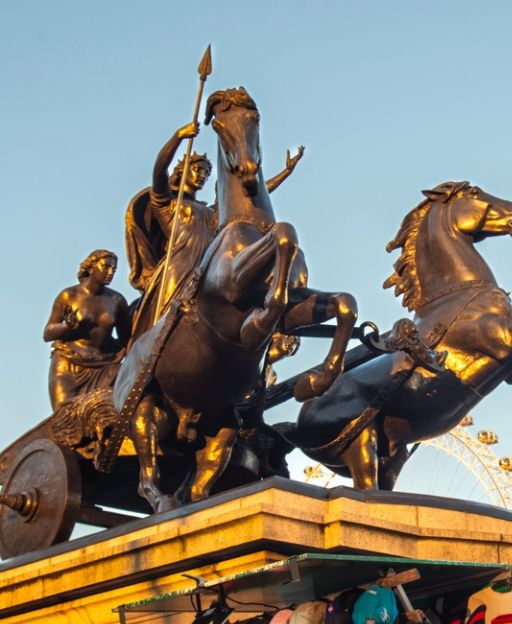
Few realise they are looking at the woman who, 2,000 years ago, razed the very city at their feet to the ground. Boudicca — sometimes spelled Boadicea — was a queen of the Iceni tribe in what is now Norfolk. She led one of the most devastating revolts in Roman history. The city she burned is the same one you are walking through today.
Who Was Boudicca?
When her husband, King Prasutagus, died around 60 AD, he left his kingdom to be shared between his two daughters and Emperor Nero. It was a diplomatic gesture — an attempt to protect his family under Roman occupation.
The Romans ignored it entirely.
Roman officials seized the Iceni lands. Boudicca herself was publicly flogged in the street. Her daughters were assaulted. It was a deliberate humiliation of a ruling family, and Rome expected submission.
They did not get it.
Boudicca united the Iceni with the neighbouring Trinovantes tribe and raised an army tens of thousands strong. The Roman governor, Gaius Suetonius Paulinus, was hundreds of miles away in Wales, suppressing resistance on the island of Anglesey. London — then known as Londinium — was left to defend itself.
The Day London Burned
Londinium in 60 AD was not yet a walled city. It was a thriving commercial settlement of roughly 30,000 people, built along the north bank of the Thames. When the governor sent word that he could not return in time, most residents fled.
Boudicca arrived anyway.
She burned it to the ground.
Archaeologists excavating across the City of London — beneath offices, car parks, and underground stations — have found the evidence: a thin layer of red and black ash, roughly five centimetres deep, running beneath the streets. Wherever Roman Londinium once stood, that destruction layer is still there.
This was not just London. Boudicca’s forces burned Camulodunum (modern Colchester) first, then marched south-west to Londinium, then north to Verulamium (St Albans). Across those three cities, an estimated 70,000 to 80,000 Romans and their supporters were killed. Rome had not faced anything like it.
If you visit the Monument to London’s Great Fire in the City, you are standing close to the area where Boudicca’s fires burned hottest. Londinium lay in ruins for years before the Romans rebuilt it — this time with walls.
The Final Battle
Governor Paulinus turned back from Wales and chose his ground carefully. He selected a narrow valley that gave his legions a tactical advantage. The exact location is still debated, but the Midlands is the most widely accepted theory — possibly near Mancetter in Warwickshire.
His forces were heavily outnumbered. But Boudicca’s warriors had brought their families in wagons to watch the expected victory. When the Romans held the line and counter-charged, those wagons blocked any retreat.
The battle became a rout. Roman discipline and terrain proved decisive. An estimated 80,000 Britons were killed. Boudicca is believed to have died either in the fighting or shortly afterwards. Ancient sources disagree on whether she fell in battle or took poison to avoid capture.
Rome rebuilt Londinium. This time, it built walls around it.
Enjoying this? 3,000+ London lovers get stories like this every week. Subscribe free →
What London Still Hides Beneath Its Streets
The Boudiccan destruction layer is one of the most quietly remarkable things about London. You cannot see it from the street, but it runs beneath the city in an almost unbroken line through the oldest parts of the City of London.
Excavations along Fenchurch Street, at King William Street, and around Aldgate have all revealed the same picture: scorched red earth, melted metal fragments, and charred timber. The Museum of London holds artefacts recovered from this layer, and the story they tell is stark.
London burned in 60 AD. It was rebuilt. It burned again in 1666. It was rebuilt again. There is a reason Londoners have a particular relationship with resilience.
If you want to explore this history in depth, our complete London planning guide covers how to build an itinerary that takes you through the city’s ancient layers — from Roman walls to Victorian warehouses to the living city of today.
The Legend Under King’s Cross Station
Here is where recorded history gives way to something London loves even more: a good story.
A legend that has circulated for well over a century holds that Boudicca is buried somewhere beneath King’s Cross Station — near Platforms 8, 9, or 10, depending on who is telling it. The thinking, loose as it is, runs that King’s Cross once sat near the edge of ancient territory where a final battle might plausibly have been fought.
Historians are almost universally sceptical. The area was largely marshland in the first century — unsuitable for a high-status burial. The Romans, who controlled the territory after the revolt, had little reason to honour Boudicca’s grave. And no archaeological evidence has ever surfaced to support the story.
But London holds onto its legends. This one has appeared in guidebooks, pub conversations, and local histories for generations. The platform numbers change depending on the telling. The story does not.
Why She Stands at Westminster Bridge
The bronze statue was created by sculptor Thomas Thornycroft, who began work on it in the 1850s. Prince Albert — Queen Victoria’s consort — suggested the project, struck by the parallel between Boudicca and Victoria: two queens, ruling at the heights of their respective powers, separated by nearly two thousand years.
Thornycroft worked on the piece for decades but died before it was complete. The statue sat in his studio, then in storage, for twenty more years. His heirs finally had it cast in bronze and it was unveiled at the north end of Westminster Bridge in 1902.
The positioning is deliberate. Boudicca faces directly towards the Palace of Westminster — the seat of British law, the symbol of how this nation is governed. The woman who refused to submit to an empire stands, permanently, opposite the building where that empire’s successors now make their laws.
She is one of the most photographed statues in London. Most people use her as a backdrop without knowing her name.
Where is the Boudicca statue in London?
The Boudicca statue stands at the north end of Westminster Bridge, directly beside the Houses of Parliament. It is free to visit and open at any time. The nearest Tube stations are Westminster (District, Circle, and Jubilee lines) and Embankment (District and Circle lines).
Is Boudicca really buried under King’s Cross Station?
Almost certainly not. The legend is long-standing but historians consider it very unlikely. The area was marshland in the first century AD, and the Romans had no motivation to mark her burial site. The story is enjoyable, but there is no archaeological evidence to support it.
What was Roman London like before Boudicca destroyed it?
Londinium in 60 AD was a thriving commercial town of roughly 30,000 people, not yet fortified with walls. It had grown rapidly as a trading hub on the Thames. After the revolt, the Romans rebuilt on a larger and better-defended scale — which is why most surviving Roman structures in London date from after Boudicca’s fire.
Can I see evidence of Boudicca’s revolt in London today?
Yes. The Museum of London holds artefacts from the Boudiccan destruction layer, including pottery and metalwork scorched in the fires of 60 AD. Occasionally, excavations in the City of London during construction work expose the destruction layer. It sits just a few metres below modern street level across much of the old Roman city.
🇬🇧 25 Hidden Gems of London Most Tourists Never Find
From secret riverside walks to hidden Victorian tunnels, centuries-old pubs to rooftop gardens with skyline views — our free guide reveals the London most visitors never discover. Join 3,000+ London lovers who get it free.
Get Your Free London Hidden Gems Guide →📲 Know someone who’d love this? Share on WhatsApp →
Love more? Join 65,000 Ireland lovers → · Join 43,000 Scotland lovers → · Join 29,000+ Italy lovers →
Free forever · · Unsubscribe anytime
Subscribe Free