
Stand on a quiet Kensington street on a still morning, and something catches your eye. The brick. The stripes. The arched windows framed in white, the iron railings, the ornate cornicing running the length of the terrace. You stop without meaning to — and you cannot quite explain why.
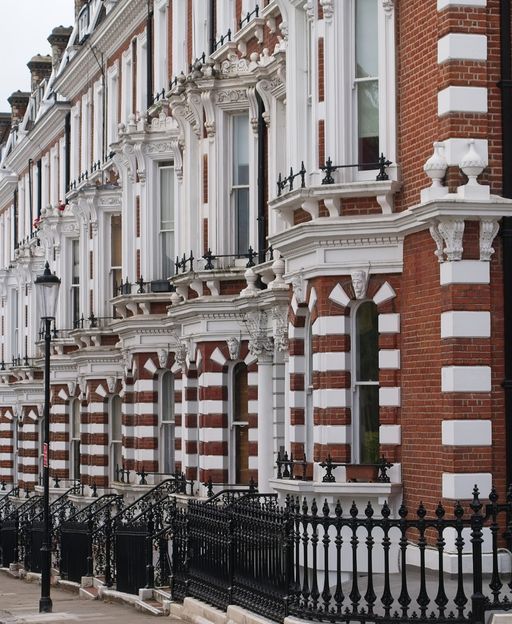
That instinct is not accidental. The people who built these streets intended exactly that reaction. Victorian architecture was not decoration. It was a statement, a strategy, and occasionally a piece of bravado carried out in brick.
They Were Built to Say Something
Victorian London was a city in a hurry. Between 1840 and 1900, the population of the capital nearly doubled. Land was expensive. Space was scarce. But status mattered enormously.
The solution was the Victorian terrace — a row of houses, each designed to look like more than it was. From the street, a terrace could suggest wealth, permanence, and taste, even if the family inside was stretched to the limit. The architecture did the talking so the residents did not have to.
Builders were deliberate about this. The grander the street, the more ornate the facade. Red brick, cream stucco, pilasters, keystones. Nothing was an accident. Every detail was chosen to impress the person walking past on the pavement below.
Where the Stripes Came From
The distinctive striped look — red brick alternating with white render or cream stone — came from two things: the influence of Italian architecture and the Victorian genius for showing off.
Italianate design, made fashionable by Prince Albert and the triumph of the Great Exhibition of 1851, swept through middle-class housing during the second half of the century. Builders added everything they could afford: moulded cornices, decorative brackets, terracotta panels, shallow pilasters. The more detail, the more prestige.
The white elements were often made from stucco — a plaster compound that could be shaped into curves, columns, and keystones. It was cheaper than stone, but looked just as impressive from the pavement. That, in a single sentence, is the secret of Victorian architecture: maximum effect at manageable cost.
The Great Estates That Shaped London’s Finest Streets
Much of what we call “Victorian London” was not built by individual developers, but by great landed estates that held enormous stretches of the city under long lease. The Grosvenor Estate built the terraces of Belgravia and Mayfair. The Cadogan Estate shaped the elegant streets of Chelsea. The Howard de Walden Estate determined the character of Marylebone.
Each estate leased land to speculative builders who had to follow strict design rules. Every house on a street conformed to the same height, the same materials, the same proportions. The result was the uniformity that we now find beautiful — row after row of near-identical houses, each one subtly different only when you look closely.
It is why London’s finest residential streets look as if they were drawn by a single hand. In a sense, they were — carried out by dozens of different craftsmen over decades, guided by the same pattern books and the same estate surveyors who tolerated no deviation from the agreed design.
Where to Find London’s Best Victorian Streets Today
Kensington and South Kensington have the grandest concentration. The streets around Onslow Square, Redcliffe Gardens, and Collingham Road are lined with substantial terraces that have barely changed since the 1870s. Walk them on a weekday morning when they are quiet and you will feel the scale of Victorian ambition most clearly.
Holland Park and Notting Hill share the same confident red-and-white vocabulary, though they attract very different crowds. Bayswater — still underrated by most visitors — has long stretches of Victorian architecture that tourists almost never reach. Queensway runs through the middle, but it is the side streets that reward the curious.
If you want something less polished, try Islington. The streets around Barnsbury and Canonbury carry a quieter, slightly lived-in Victorian dignity. The houses are smaller, the gardens tighter, but the craftsmanship is still unmistakably there. If you are planning your trip to London, building a morning walk through one of these neighbourhoods costs nothing and lingers longest.
Enjoying this? 3,000+ London lovers get stories like this every week. Subscribe free →
The Two Lives Hidden in Every Terrace
A Victorian terrace tells two stories: the one upstairs and the one below. The family lived on the ground and upper floors — parlour, dining room, drawing room, bedrooms above. Below, in the semi-basement, the household’s servants lived and worked.
You can still see these spaces in almost every Victorian street: the iron railings with a gap, and stone steps leading down to the kitchen area below street level. It was called the area, and it formed a separate world — its own entrance, its own rhythms, its own smells of coal smoke and cooking.
Look down at the pavement as you walk and you will notice small round iron covers set into the stone or tarmac. These are the coal hole covers — original Victorian ironwork through which coal was delivered directly to the basement stores. Many are more than 150 years old. Most Londoners walk over them twice a day without a second glance.
Why London Nearly Lost All of Them
The mid-20th century was not kind to Victorian London. Post-war planners looked at old terraces and saw slums to be swept away and replaced. Hundreds of streets were torn down across the East End, south London, and the inner boroughs. Entire communities were moved to tower blocks on the city’s edges.
What saved what remained was a growing preservation movement and the passionate advocacy of writers, architects, and campaigners who argued that Victorian buildings were worth keeping. The poet John Betjeman’s fight to save St Pancras became legendary, but it was part of a much larger effort that gradually changed how London understood its own inheritance.
Today, most of London’s finest Victorian streets sit inside conservation areas. Altering even a window frame requires planning permission. The polychrome brick and the stucco cornicing are protected — not as museum pieces, but because enough people fought hard enough to keep them alive.
Neighbourhoods like Hackney Wick show what happens when Victorian industrial buildings survive long enough to be reimagined rather than demolished. The bones of the old city turn out to be worth far more than anyone thought at the time.
Frequently Asked Questions
Where are the best Victorian streets to visit in London?
The finest concentration is in Kensington, South Kensington, and Chelsea. Streets like Onslow Square, Redcliffe Gardens, and the roads around Holland Park are outstanding examples. Bayswater and Islington’s Barnsbury area are excellent alternatives if you prefer somewhere quieter and less visited.
When is the best time to walk London’s Victorian neighbourhoods?
Weekday mornings are ideal — the streets are quiet, the light is good for photography, and you can walk at your own pace without crowds. The Victorian terraces look particularly striking in autumn and early winter light, when the red brick picks up the warmth of low sun.
What makes London’s Victorian architecture different from other cities?
The combination of red brick with white stucco detailing, polychrome brickwork, and elaborate ironwork is distinctively London. The estate system — where single landowners controlled whole neighbourhoods and enforced consistent design standards — produced a uniformity and confidence that has no real equivalent elsewhere in Britain.
How do I find Victorian walking routes in London?
Pick a Victorian neighbourhood — South Kensington, Bayswater, Barnsbury, or Canonbury — and walk the residential side streets rather than the main roads. The Victorian Society publishes free walking guides, and any Ordnance Survey map clearly shows which streets predate the 20th century. No tour guide required.
🇬🇧 25 London Places Most Visitors Miss
From secret riverside walks to hidden Victorian tunnels, centuries-old pubs to rooftop gardens with skyline views — our free guide reveals the London most visitors never discover. Join 3,000+ London lovers who get it free.
Get Your Free 25-Places Guide →📲 Know someone who’d love this? Share on WhatsApp →
Free forever · · Unsubscribe anytime
Subscribe Free