
The first time you cross the canal into Hackney Wick, it doesn’t look like much. Corrugated steel shutters, an old railway arch, a few painted figures watching you from a brick wall. Then you notice the smell of fresh coffee drifting from somewhere you can’t see, hear something like jazz from an open door, and realise you’ve stumbled into one of the most quietly extraordinary corners of London.
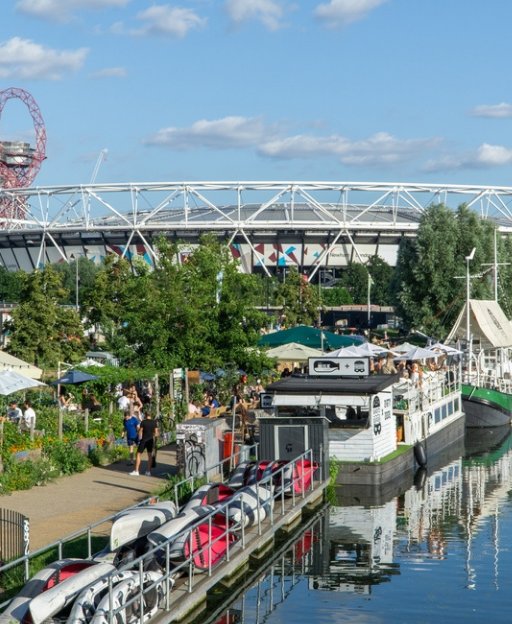
It didn’t happen overnight. Hackney Wick’s transformation from forgotten industrial backwater to thriving creative neighbourhood is one of east London’s great stories — one that involves ink factories, artists priced out of Shoreditch, the Olympics, and a canal that turned out to be the whole point.
An Industrial Past Worth Knowing
For most of its history, Hackney Wick was where London made things. In the 19th century, the flat land around the River Lea was packed with factories — ink works, rubber manufacturers, paint suppliers, chemical plants, and food processors. The canals weren’t there to be admired. They were working waterways carrying raw materials in and finished goods out.
It was unglamorous, loud, and entirely practical. Cheap rents kept workers close by. Warehouses stretched back from the water in long, functional rows with no thought for aesthetics. The pubs were basic. The streets were designed for lorries, not pedestrians.
Nobody came to Hackney Wick unless they had to. That began to change in the early 2000s, when a new generation of creatives found themselves priced out of nearby Shoreditch and started looking east. Those vast, cheap warehouse spaces — once used for manufacturing rubber and printing ink — turned out to be perfect for making other things entirely.
When the Artists Moved In
By 2005, Hackney Wick had more artists per square mile than anywhere else in Europe. That statistic was widely reported at the time, and it wasn’t an exaggeration. Open studios, DIY galleries, and artist collectives had quietly occupied the old industrial buildings in a way nobody had planned or predicted.
The neighbourhood grew without a masterplan. There were no planning committees deciding this should be a creative district. People simply came because they could afford to, and because the unglamorous spaces suited the work — ceramics, film-making, sculpture, printmaking, and everything in between. If you needed a large, messy space where you could make noise and leave paint on the floor, Hackney Wick was your answer.
Small galleries opened. Pop-up markets appeared in car parks. Canal-side bars started serving craft beer to people who worked in the studios above. A community took shape, raw and independent, in the shadow of the chimney stacks.
How 2012 Changed the Neighbourhood Forever
When London won the Olympic bid, Hackney Wick sat directly on the edge of the proposed Olympic Park site. For residents and artists already established there, the announcement prompted genuine anxiety. Regeneration of the kind London had seen before — clearing old communities to build new ones — was a real possibility.
What followed was more complicated. Some artists were relocated. Some industrial buildings were demolished. But the transformation also brought cleaner waterways, new walking and cycling routes, and direct transport links that made Hackney Wick accessible to the rest of the city for the first time.
The Queen Elizabeth Olympic Park opened on the doorstep of a creative community that had already put down roots. Rather than erasing what was there, the development created an unusual tension — elite architecture alongside grassroots studios — that gives the area a character unlike anywhere else in London.
Enjoying this? 3,000+ London lovers get stories like this every week. Subscribe free →
The Canal — Hackney Wick’s Real Centre
The River Lea Navigation and the Hertford Union Canal frame Hackney Wick on two sides. Walk the towpaths on a warm afternoon and you’ll understand immediately why people talk about this place differently to other parts of east London.
Converted barges sit alongside outdoor terraces. Canal boats pass at walking pace. There are painted walls at every turn — not graffiti in any pejorative sense, but commissioned murals and spontaneous works that have been accumulating here for twenty years.
The towpath connects Hackney Wick to Victoria Park in one direction and the Olympic Park in the other. It also connects to the quieter stretches of London’s canal network that most visitors never reach. The best thing you can do here is walk slowly and stop often. Bring cash — several of the best canal-side spots are still card-reluctant.
Street Art at Every Corner
Hackney Wick has one of the most concentrated collections of outdoor art in Europe. Unlike areas where murals are installed self-consciously as part of a regeneration scheme, Hackney Wick’s art feels genuinely earned — created by people who live and work in the neighbourhood, often for other people who live and work here.
White Post Lane is a good starting point. Walls several storeys high carry photorealistic portraits and abstract compositions in equal measure. Railway arches bear geometric patterns that change with each new commission. Back alleys reveal small pieces you’d only find if you were actively looking — and some that you’d find simply by taking a wrong turn.
Several studios offer guided art trail tours at weekends, and local information points carry printed maps. But the honest advice is to walk without a destination. The best things in Hackney Wick tend to appear when you’re not looking for them.
Where to Eat, Drink and Spend a Saturday
The food and drink scene has caught up with the neighbourhood’s creative reputation. Along the canalside and around the Olympic Park boundary, a cluster of venues has emerged that reflects the area’s independent spirit.
Crate Brewery and Pizzeria sits in a converted canalside building and brews its own beer on site. The pizzas are good, the seating spills onto pontoons over the water, and on summer weekends the queue moves faster than you’d expect. Grow is a partially outdoor venue with live music, food trucks, and direct canal access — it closes in winter but runs events through spring and early autumn. Number 90 Bar and Kitchen occupies a converted warehouse and has a rooftop terrace that fills quickly when the weather allows.
There are also a growing number of independent coffee shops, small bakeries, and street food operators. These tend to arrive early in areas like this and, increasingly, to stay even as the neighbourhood changes around them.
Getting to Hackney Wick and When to Visit
Hackney Wick has its own London Overground station. Trains from Liverpool Street take under 20 minutes and run frequently throughout the day. The station drops you almost directly onto the canal towpath — there’s very little between the exit and the water.
For a weekend visit, aim to arrive mid-morning. Venues open from around 11am, the canal is quieter before noon, and a full circuit from the station through the Olympic Park and back takes around two to three hours at a gentle pace — longer if you stop, which you will.
Weekday evenings in warmer months bring a different crowd — local artists, people who actually live here rather than visit, and the kind of low-key atmosphere that weekend visitors rarely see. Both versions are worth experiencing if you have time.
If you’re planning a broader east London trip or your first visit to the city, the London planning guide covers transport, accommodation and neighbourhoods in detail.
What is Hackney Wick known for?
Hackney Wick is best known for its street art, working artist studios, canal-side bars, and its location adjacent to the Queen Elizabeth Olympic Park. It developed as a creative neighbourhood organically from the early 2000s, when artists moved into affordable former industrial spaces.
How do I get to Hackney Wick from central London?
Take the London Overground to Hackney Wick station, which is under 20 minutes from Liverpool Street. The station is steps from the canal towpath and the main cluster of bars and studios.
What is the best time to visit Hackney Wick?
Summer weekends offer the full outdoor experience — canal-side venues, art markets and outdoor terraces. Autumn weekdays are quieter and equally atmospheric, with most venues still open. Avoid winter weekends when several outdoor spaces close entirely.
Is Hackney Wick good for street art?
Yes — it has one of the largest concentrations of outdoor murals in Europe, with pieces ranging from photorealistic portraits on multi-storey walls to small works hidden in back alleys. White Post Lane and the railway arches are the most concentrated areas, but art appears throughout the neighbourhood.
Hackney Wick doesn’t ask to be loved. It arrived here — ink factories, rubber works and all — before anyone was paying attention, and it’s been making things ever since. If you cross the canal on a warm afternoon when the light catches the water and the smell of coffee meets you on the bridge, you’ll understand exactly why people who move here rarely leave.
🇬🇧 25 Hidden Gems of London Most Tourists Never Find
From secret riverside walks to hidden Victorian tunnels, centuries-old pubs to rooftop gardens with skyline views — our free guide reveals the London most visitors never discover. Join 3,000+ London lovers who get it free.
Get Your Free London Hidden Gems Guide →📲 Know someone who’d love this? Share on WhatsApp →
Love more? Join 65,000 Ireland lovers → · Join 43,000 Scotland lovers → · Join 29,000+ Italy lovers →
Free forever · Unsubscribe anytime
Subscribe Free