
Beneath the streets of Westminster, there is a place where history stopped. Not metaphorically — literally. When the Second World War ended in 1945, the doors to Churchill’s underground command centre were locked, the lights switched off, and everything left exactly as it was. Typewriters mid-sentence. Pins in maps. Ashtrays on desks. For nearly four decades, the rooms sat untouched, as if the world above had simply moved on and forgotten.
Today, those rooms are open to visitors. And walking into them feels like stepping through a crack in time.
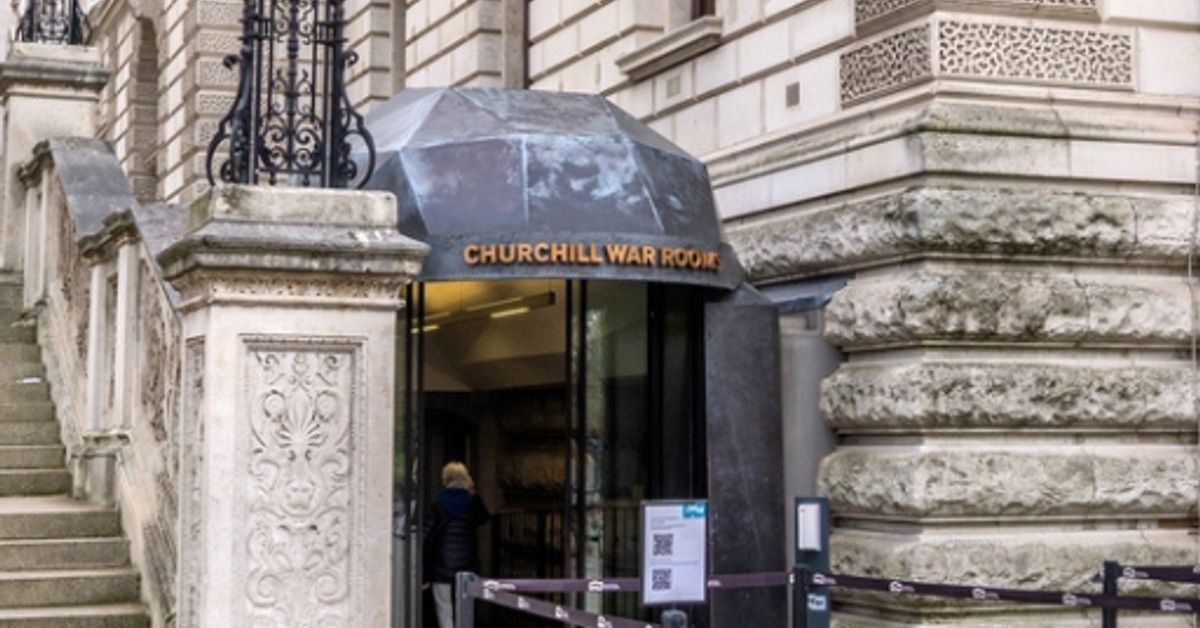
The Churchill War Rooms — located beneath the Treasury building on King Charles Street in Westminster — served as Britain’s nerve centre during the Second World War. From here, Winston Churchill and his War Cabinet directed operations across the globe. The Map Room tracked the movement of ships, troops, and aircraft around the clock. Planners worked through the night, fuelled by tea and the particular tension of people who knew that every decision they made could determine whether a nation survived.
What makes the site remarkable — both historically and as a visitor experience — is how intact it all is.
How Britain Ended Up Fighting a War Underground
When the threat of air raids became clear in the late 1930s, the British government faced a practical problem: its offices in central London were vulnerable. A direct hit during a Cabinet meeting could collapse the entire chain of command. The solution was to move critical operations underground — specifically into the sub-basement of a building that had been reinforced with thick concrete.
The rooms were operational by August 1939, just days before Germany invaded Poland and Britain entered the war. The location was not secret in the conventional sense — the address was known to those who needed it. What was protected was what happened inside.
Churchill himself called it simply “the Annexe.” Maps lined the walls. A transatlantic telephone line connected the Cabinet Room directly to the White House, where Churchill spoke with President Roosevelt. He slept here on the worst nights of the Blitz — his bedroom is small and plain, a single bed, a microphone for broadcasting to the nation, and not much else.
The bed is still there.
What You’ll See Inside the War Rooms
The Churchill War Rooms today form part of the Imperial War Museum network and are divided into two sections: the Cabinet War Rooms and the Churchill Museum.
The Cabinet War Rooms are the preserved historical spaces — the offices, bedrooms, and working areas used during the war itself. The Map Room is the centrepiece. Coloured pins mark the positions of Allied and Axis forces. The telephones are still on the desks. The duty roster from the final day of operation — 16 August 1945 — is still pinned to the wall.
The Churchill Museum, which opened in 2005, tells the story of the man himself: his childhood, his early career, his relationship with painting and writing, his extraordinary skill as a communicator. The museum is anchored by a large interactive table containing thousands of documents from Churchill’s life, browsable by visitors.
Together, the two sections take most visitors two to three hours to explore properly.
🏙️ Enjoying this? 3,000 London lovers get stories like this every week. Subscribe free →
The Details That Stop You Cold
It is one thing to know, intellectually, that people worked in these rooms during one of history’s most dangerous periods. It is another to stand in them.
A typist’s chair pushed back from a desk at an angle, as if the person just stepped out for tea. The in-tray with papers still in it. The clock on the wall of the Map Room that ran without stopping, 24 hours a day, for the entire duration of the war.
The level of preservation is exceptional. After the lights went off in 1945, the rooms were essentially forgotten — too useful to demolish, too sensitive to open to the public. When the site was prepared for visitors in the early 1980s, historians found the rooms almost exactly as they had been left. The preservation was minimal because the rooms had preserved themselves.
This is what separates the Churchill War Rooms from most museums: there is very little reconstruction here. The chairs, the maps, the papers are, by and large, the real things.
A Place of Particular Meaning for American Visitors
For visitors from the United States, the Churchill War Rooms carry a specific kind of weight. The transatlantic alliance — forged in part through those secure telephone calls between Churchill and Roosevelt — shaped the postwar world that both nations inherited.
The telephone in Churchill’s private room was, at the time, the most secure line in existence. The conversations it carried — about strategy, about resources, about where the war should go next — are part of the shared history of Britain and America.
Many American visitors also come with family connections. If your grandfather served in the European Theatre, the decisions made in these rooms directly affected the operations he was part of. The history here is not abstract. It is personal.
The Blitz Above While They Worked Below
Between September 1940 and May 1941, German aircraft bombed London on 57 consecutive nights. The sound of the raids reached down into the War Rooms — a dull, persistent rumble that those working below learned to identify and, eventually, mostly ignore.
The area around Westminster was hit repeatedly. Whitehall, Parliament Square, the streets immediately above the bunker — all took damage. The reinforced slab above the War Rooms held. The work continued.
Further east, St Paul’s Cathedral survived the Blitz surrounded by destruction. The photograph of its dome rising above smoke and flames became the defining image of London’s determination not to be broken. From the War Rooms, it is a short walk. Standing outside St Paul’s after you have been underground in Churchill’s bunker gives the whole story a physical reality that no book or film quite manages.
Planning Your Visit
The Churchill War Rooms are located at Clive Steps, King Charles Street, Westminster, London SW1A 2AQ. The nearest Underground station is Westminster, served by the District, Circle, and Jubilee lines — it is a five-minute walk.
The site is open daily. Tickets should be booked in advance through the Imperial War Museum website, particularly from spring through to early autumn when visitor numbers are highest. Allow at least two hours for a full visit, and longer if you want to spend time in the Churchill Museum section.
There is a café on site and a gift shop with a good selection of books on Churchill and the war. If the history grips you — and it usually does — the books available here are a worthwhile addition to the visit.
Nearby WWII Heritage Worth Your Time
The War Rooms sit at the heart of a cluster of WWII-related sites, all within easy walking distance.
Westminster Bridge offers views toward the Houses of Parliament, which Churchill passed through by car each day, sometimes driving streets still smouldering from the previous night’s bombing. St James’s Park, just to the north, had its ornamental lake drained during the war to prevent it from acting as a navigation landmark for enemy aircraft at night.
The Imperial War Museum itself, further south in Lambeth, holds the deepest collection of Second World War material in London — if the War Rooms ignite your interest, the IWM is the logical next step. Entry is free.
Frequently Asked Questions
Where exactly are the Churchill War Rooms?
The Churchill War Rooms are located at Clive Steps, King Charles Street, Westminster, London SW1A 2AQ. They are a five-minute walk from Westminster Underground station.
How long does a visit take?
Most visitors spend two to three hours. The site includes both the preserved Cabinet War Rooms and the Churchill Museum. Taking your time in the Map Room and Cabinet Room is worthwhile — the detail rewards a slow visit.
Do I need to book tickets in advance?
Yes — particularly between spring and autumn. Tickets can be booked through the Imperial War Museum website. Walk-up tickets are sometimes available, but booking ahead guarantees entry and saves you queuing.
Is the Churchill War Rooms suitable for children?
Yes. Children who are interested in history tend to find the preserved rooms genuinely compelling — the real-life spy drama quality of the setting holds attention well. The Imperial War Museum produces educational materials for younger visitors. The site is step-free accessible throughout.
🇬🇧 25 Hidden Gems of London Most Tourists Never Find
From secret riverside walks to hidden Victorian tunnels, centuries-old pubs to rooftop gardens with skyline views — our free guide reveals the London most visitors never discover. Join 3,000+ London lovers who get it free.
Get Your Free London Hidden Gems Guide →Already subscribed? Download your free London guide (PDF)
Love more? Join 65,000 Ireland lovers → · Join 43,000 Scotland lovers → · Join 30,000 Italy lovers →
Free forever · Unsubscribe anytime
Subscribe Free