
Turn off Gracechurch Street in the City of London and duck through an archway between two glass office towers. In an instant, the noise drops, the light shifts, and you find yourself somewhere that feels like another century entirely.
The Victorian wrought-iron roof stretches above you. Garlands of flowers hang from ornate pillars in deep maroon and cream and gold. People spill out of a pub that has stood here since the 18th century. This is Leadenhall Market — one of London’s most beautiful spaces, sitting right at the heart of one of the world’s most modern financial districts.
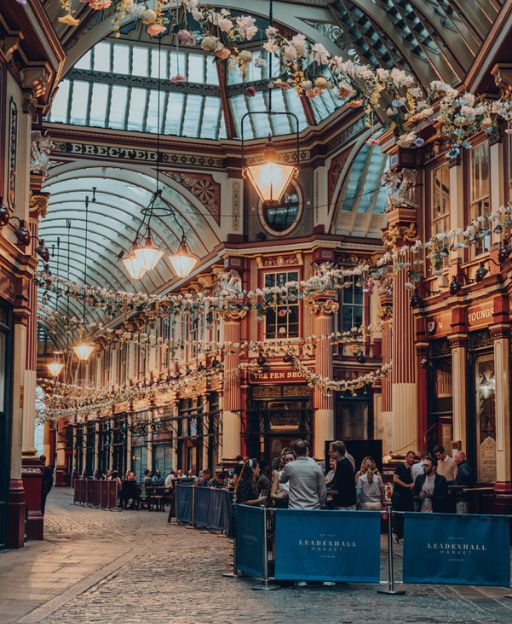
Most visitors to London never find it. Those who do rarely forget it.
The Ground Beneath Your Feet Is Roman
Before it was a Victorian market, and long before it was a medieval poultry hall, this patch of the City of London was the heart of Roman Londinium.
Archaeologists have confirmed that Leadenhall Market stands on the site of the Roman basilica — the largest Roman building north of the Alps when it was constructed around AD 100. The basilica served as the city’s law courts, meeting hall, and commercial centre. The forum beside it was where Romans traded grain, cloth, and livestock in the open air.
Walk the cobblestones today and you are walking on ground where Roman merchants haggled and lawyers argued nearly 2,000 years ago. That is not a metaphor. The foundations are still down there.
How the Market Got Its Unusual Name
In the 14th century, a great manor house stood on this site. It belonged to the Neville family, and its most distinctive feature was a roof made of lead. The building became known as the Leaden Hall, and the market that grew around it took the same name.
By the late 1300s, Leadenhall was one of the most important markets in medieval London. It sold poultry, cheese, wool, and grain. Traders came from across the city and beyond. Unusually for the time, the market had a formal set of rules that gave foreign merchants and non-guild traders the right to buy and sell directly — a level of openness that was radical in medieval commerce.
The market thrived for nearly three centuries. Then came 1666.
The Fire That Burned It to the Ground
The Great Fire of London started on Pudding Lane on 2 September 1666 and burned for three days. It destroyed more than 13,000 houses, 87 churches, and most of the medieval City of London. Leadenhall burned with everything else.
What rose in its place was rebuilt several times over the following two centuries as London expanded and changed. But it was the Victorian construction of 1881 that gave Leadenhall the form it holds today.
The architect was Horace Jones — the same man responsible for Smithfield and Billingsgate markets. Jones created a covered arcade in Victorian Baroque Revival style: arching glass and wrought ironwork overhead, coloured tile columns, decorative crests and finials at every corner. The result was both functional and beautiful.
You can stand at the edge of the fire’s history today. The Monument to the Great Fire of London — Wren’s column marking the exact point where the blaze began — stands less than five minutes’ walk from Leadenhall’s front entrance.
Enjoying this? 3,000+ London lovers get stories like this every week. Subscribe free →
Inside the Market Today
The market is divided into four historic sections: the Cheese Row, the Green Market, the Grand Avenue, and the Meat Market. The names echo the medieval trades that once took place here, even though the stalls today sell coffee, wine, and upmarket food.
The centrepiece is the central octagonal hall, where the glass dome floods the space with natural light. Look up and you see Victorian ironwork and painted crests in green, cream, and maroon. Look around and you are surrounded by independent restaurants, wine bars, and delis serving City workers on their lunch breaks.
The contrast outside is extraordinary. The Lloyd’s of London building — Richard Rogers’ famous inside-out structure with its exposed steel ducts and external lifts — stands immediately beside the market. The Leadenhall Building (known locally as the Cheesegrater) rises overhead. Nobody demolished Leadenhall when the glass towers went up. It simply became more remarkable by contrast.
The Lamb Tavern
The pub inside the market has been on this site since around 1780. The current Victorian interior — dark wood, etched glass, brass fittings — dates from the 1881 rebuild and has barely changed since. It is one of the most authentic Victorian pub interiors surviving in London.
On a weekday lunchtime it fills with City workers in suits. On weekend mornings it is almost quiet — you can take your pint to the courtyard and have the market largely to yourself. That Saturday morning visit, with the light coming through the glass roof and few other people around, is genuinely special.
The Market That Became a Film Set
Leadenhall’s Victorian grandeur has made it a favourite for film and television crews. Harry Potter fans will recognise the market’s exterior as part of the Diagon Alley filming location — the entrance to The Leaky Cauldron was shot at the Bull’s Head passage on the Lime Street side of the market.
It also appeared in Bridget Jones’s Diary and has served as a backdrop in dozens of TV productions and commercials over the years. The beauty of Leadenhall is that it looks like a film set even when no cameras are rolling.
If you are exploring London’s real Harry Potter filming locations, Leadenhall is one of the most atmospheric stops on the list — and one of the few where you can also stop for a pint in the same visit.
Frequently Asked Questions
What is the best time to visit Leadenhall Market?
Saturday mornings between 9am and 11am offer the best experience. The market is quiet, the light through the glass roof is beautiful, and you can explore without the weekday crowds of City workers. Weekday lunchtimes are the busiest.
Is Leadenhall Market free to visit?
Yes, completely free. The covered arcade is open to the public at all times. The restaurants, wine bars, and pubs inside are private businesses, but there is no charge to walk through, explore, and take photographs.
Where is Leadenhall Market and how do I get there?
Leadenhall Market is on Gracechurch Street in the City of London, EC3V 1LT. The nearest tube stations are Monument (District and Circle lines, 3-minute walk) and Bank (Central and Northern lines, 5-minute walk). It fits naturally into a walk between the Monument to the Great Fire and the Tower of London.
Was Leadenhall Market really used in Harry Potter?
Yes. The Bull’s Head passage entrance on Lime Street was used as the exterior of The Leaky Cauldron pub in Harry Potter and the Philosopher’s Stone (2001). The ornate Victorian arcade made it ideal as a backdrop for Diagon Alley.
How to Include Leadenhall in Your London Trip
The market pairs well with a broader walk through the City of London. Start at the Monument to the Great Fire, walk north through the financial district, pass the Lloyd’s building, and step through into the market’s covered arcade. From there it is an easy walk to Barbican, Guildhall, or down to the Thames at London Bridge.
For help planning the rest of your trip — neighbourhoods, transport, what to see first — our London trip planning guide covers everything you need.
Leadenhall has outlasted every empire and every office tower built around it. Empires end. A market this good simply endures. Push through that archway off Gracechurch Street and find out for yourself.
🇬🇧 25 Hidden Gems of London Most Tourists Never Find
From secret riverside walks to hidden Victorian tunnels, centuries-old pubs to rooftop gardens with skyline views — our free guide reveals the London most visitors never discover. Join 3,000+ London lovers who get it free.
Get Your Free London Hidden Gems Guide →📲 Know someone who’d love this? Share on WhatsApp →
Love more? Join 65,000 Ireland lovers → · Join 43,000 Scotland lovers → · Join 29,000+ Italy lovers →
Free forever · Unsubscribe anytime

Subscribe Free