
Most people who visit Hampton Court Palace walk through the grand gates, gaze at the Tudor brick facade, and head straight inside. What they leave behind — in the 60 acres of formal gardens that fan out behind the palace — is extraordinary.
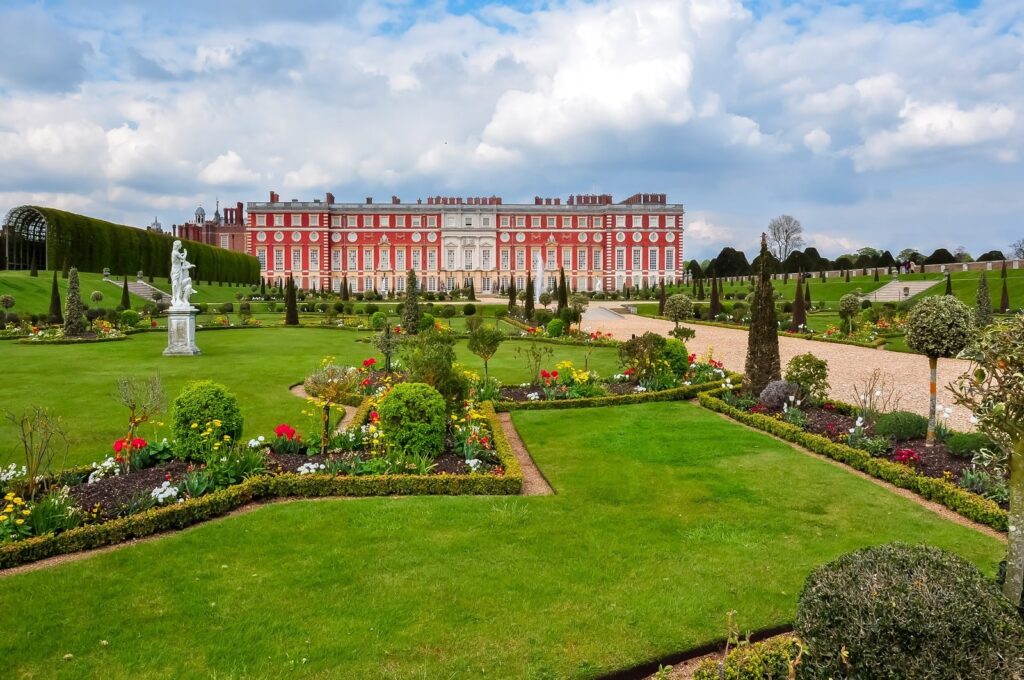
These gardens are not an afterthought. They are the result of nearly 500 years of royal gardening — from Henry VIII’s fishponds to William III’s formal parterres to a grapevine that has been growing since 1768. Hampton Court’s grounds are among the finest historic gardens in Europe, and most visitors spend less than an hour in them.
Hampton Court Palace and the Vine That Has Been Growing Since 1768
In the glasshouse on the palace’s north side, there is a grapevine that was planted in 1768 by Lancelot “Capability” Brown — the most celebrated garden designer in British history — on the instruction of King George III.
It is a Black Hamburg variety. Sweet, dark-skinned grapes that once appeared on Victorian dinner tables across Britain. Nearly 260 years later, the original plant is still producing fruit.
The trunk is now over a metre in circumference. The main shoot stretches more than 36 metres across the glasshouse ceiling. Each summer, the vine produces between 500 and 700 bunches of grapes, bagged individually to protect them as they ripen. From August onwards, they are sold to visitors.
There is no other cultivated grapevine in the world known to be older. You can stand next to it, look up at the canopy of leaves overhead, and understand — in a way that no exhibition quite manages — what 250 years actually feels like.
Gardens Built for a King — Then Largely Forgotten by Tourists
Henry VIII did not merely inherit Hampton Court. He transformed it. The Pond Gardens — three sunken rectangular beds that run along the palace’s south front — were originally Henry’s fishponds, stocked with freshwater fish for the royal kitchen.
Today they are planted with seasonal flowers. In April and May, tulips in deep red, purple and orange fill the beds in waves of colour. The scale is modest. The effect is not.
A little further along is the Privy Garden, a formal walled garden restored in 1995 to its exact 1702 layout. The design was recreated from historical surveys made during the reign of William III. Twelve intricate topiary shapes stand in geometric rows. Gravel paths divide the beds with military precision.
It looks exactly as it would have looked the last time William walked it. That kind of precision — a garden frozen at a specific moment in history — is rare anywhere in the world.
Enjoying this? 3,000+ London lovers get stories like this every week. Subscribe free →
The Maze That Has Been Confusing People for 330 Years
The Hampton Court maze was planted around 1690 during the reign of William III. It covers roughly a third of an acre. The paths run for approximately half a mile.
In a straight line, the exit sits about 65 metres from the entrance. Most visitors take between 20 and 45 minutes to find their way out. Some take considerably longer.
The maze was originally planted in hornbeam. Over the centuries, yew has gradually replaced sections of it. The hedges now stand nearly two and a half metres high — tall enough to block every sightline, short enough to remind you that other people are laughing somewhere nearby and you cannot find them.
Inside, there is no landmark to navigate by. No shortcut. The classic advice — keep your right hand on the hedge and never let go — will eventually get you out. Not quickly. But out.
Tulip Season: Why Right Now Is the Best Time to Visit
April and May are the finest months in the Hampton Court calendar. The Tulip Festival transforms the East Front Garden and the Pond Gardens with thousands of spring bulbs planted the previous autumn.
The planting is timed deliberately — early and late varieties are mixed so the display extends across several weeks. Deep purple Negrita tulips bloom alongside pale Menton and tall white Maureen. At ground level, grape hyacinths and forget-me-nots fill the spaces between.
The light in late April is soft and clean. The crowds are still manageable — this is the window before the school holiday season arrives and numbers double. If you are planning a trip to London and want a day that feels genuinely different, this is the moment.
How to Get There and Make the Most of a Full Day
Hampton Court Palace is in East Molesey, Surrey, roughly 20 miles south-west of central London. Direct trains from London Waterloo reach Hampton Court station in around 35 minutes. The palace gates are a five-minute walk from the platform.
The gardens are included in the standard admission ticket. The Great Vine glasshouse is included too — no separate charge. The maze has its own modest entry fee.
Set aside a full day. Gardens, palace interiors, the café and the inevitable time in the maze will fill it comfortably. It also works beautifully as one of the best day trips from London if you prefer to keep a city base and travel out in the morning.
Wear comfortable shoes — the grounds are gravel and grass. In April, mornings can still be cool, so bring a layer. The café inside the palace courtyard serves decent food, and the courtyard itself is sheltered from the wind.
The gardens close at dusk. The palace closes earlier. If you want to end the day with a walk along the river — the Thames path runs directly past the palace gates — allow yourself the last hour of light to do that. It is worth it.
Frequently Asked Questions
What is the best time to visit Hampton Court Palace gardens?
April and May are the finest months, when the Tulip Festival is in full bloom and visitor numbers are lower than in summer. The gardens open daily from 10am. Late April offers the best combination of flowers, light and manageable crowds.
Is the Great Vine really the oldest grapevine in the world?
It is widely recognised as the oldest known cultivated grapevine. Planted in 1768, the Black Hamburg vine is still producing grapes each summer. Bunches are sold to visitors from August onwards inside the palace grounds — and the vine itself is free to visit with standard admission.
How long does it take to get through the Hampton Court maze?
Most visitors take between 20 and 45 minutes, though it varies. The maze covers approximately half a mile of paths and the hedges are high enough to remove all landmarks. Visiting on a weekday morning gives you a quieter experience.
Can you visit Hampton Court Palace as a day trip from London?
Yes — it is one of the most rewarding. Direct trains from London Waterloo take around 35 minutes and run frequently throughout the day. Allow a full day to do justice to both the palace interiors and the extensive formal gardens.
🇬🇧 25 London Places Most Visitors Miss
From secret riverside walks to hidden Victorian tunnels, centuries-old pubs to rooftop gardens with skyline views — our free guide reveals the London most visitors never discover. Join 3,000+ London lovers who get it free.
Get Your Free 25-Places Guide →📲 Know someone who’d love this? Share on WhatsApp →
Free forever · Unsubscribe anytime
Subscribe Free