
Everyone photographs Tower Bridge. Millions of tourists walk across it every year, cameras raised, without knowing what lies inside the two towers looming above them.
Hidden behind the Gothic stonework are two Victorian engine rooms, a set of high-level walkways that Londoners once refused to use, and a glass floor that suspends you 42 metres directly above the Thames.
The bridge you see is not quite what it appears to be. And that, it turns out, was always the idea.
A Bridge Built to Fool the Eye
By the 1870s, East London had a serious problem. Thousands of workers, carts, and horse-drawn vehicles needed to cross the Thames daily, but London Bridge — the only crossing nearby — was overwhelmed.
The answer was a new bridge. But there was a complication.
The Tower of London stood right beside the proposed site. A modern iron bridge would have looked wrong beside a medieval fortress dating back to William the Conqueror. So the designers made a bold decision.
City Architect Horace Jones drew up towers in the Gothic-revival style, clad in Cornish granite and Portland stone. Beneath all that stone is a skeleton of steel — the actual structure doing all the work — but the intention was that nobody would notice the deception.
Completed in 1894 after eight years of construction, Tower Bridge was deliberately built to look older and more ancient than it was. It worked so well that most visitors today still assume it is a medieval structure.
The Steam Engines That Powered the Bascules
When Tower Bridge was first built, the two lifting sections — called bascules — were powered entirely by steam. Coal-fired boilers heated water that fed into hydraulic accumulators: enormous cylinders packed with water under pressure.
When a ship needed to pass, that stored pressure drove pistons that tipped each bascule skyward. The whole operation took under two minutes — fast enough to keep river traffic and road traffic both moving without long delays.
The original steam-powered machinery is still there today. Housed in the Engine Rooms at the south end of the bridge, the equipment is in extraordinary condition — painted a deep red, polished to a near-mirror finish, every component labelled exactly as it was in 1894.
In 1976, the steam system was replaced with electric motors. But nobody removed the old engines, and now they form the centrepiece of the Tower Bridge Exhibition.
The Walkways That Respectable Londoners Refused to Use
When Tower Bridge opened in 1894, it included enclosed high-level walkways connecting the two towers, 42 metres above the river. The logic was practical: pedestrians could cross while the bascules were raised for river traffic, rather than waiting at street level.
The public had other ideas.
The walkways quickly gained a poor reputation. They became associated with pickpockets and unsavoury characters — or simply with anyone who had no good reason to be 42 metres above the Thames. Respectable Londoners preferred to wait below. By 1910, with almost no footfall, the walkways were closed.
They reopened in 1982 as part of the Tower Bridge Exhibition. Glass floor panels were added in 2014. Today, the walkways are the most photographed feature of the entire bridge — the very thing Victorian Londoners refused to use became one of the most visited spots in the city.
Enjoying this? 3,000+ London lovers get stories like this every week. Subscribe free →
The Glass Floor and What It Actually Feels Like
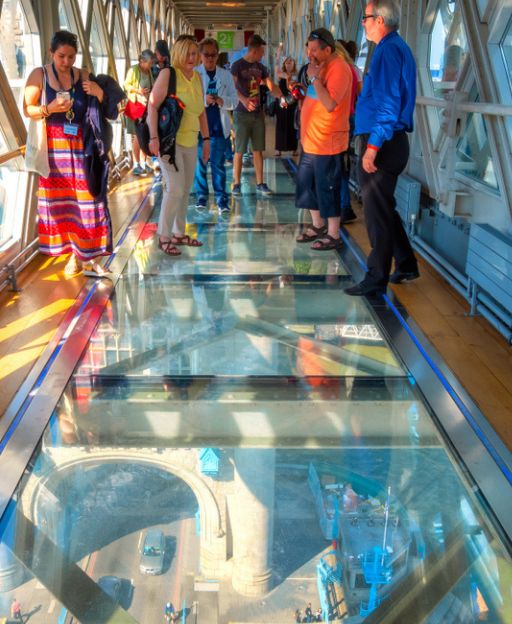
Two glass floor panels now span sections of the high-level walkways. Each one is roughly two metres wide and several metres long, and each offers an unobstructed view directly down to the road traffic 42 metres below.
The panels have been load-tested to hold 400 kilograms per square metre. That figure is more than adequate. But standing on invisible glass above a busy road does not feel adequate — it feels extraordinary in a way that defies the engineering data.
On a busy afternoon, you can watch double-decker buses pass beneath your feet. On clearer days, you can see the Thames in both directions, the City of London to the north, and the domes of Southwark to the south. Most visitors approach the glass cautiously, test it with one foot, then step fully onto it — and then refuse to leave.
If you are planning a day in this part of London, the London planning guide covers how to build a sensible itinerary that combines Tower Bridge with the South Bank and the City.
The Day a Bus Driver Saved His Passengers
On 30 April 1952, a number 78 double-decker bus was crossing Tower Bridge when the bascules began to open beneath it. The bridge operator had not noticed the bus still on the span.
Driver Albert Gunter had seconds to decide. He accelerated.
The bus launched from the rising south bascule, cleared the gap, landed on the north bascule with a heavy jolt, and continued across the bridge. Ten passengers were injured. None were killed. Gunter walked away unhurt and was later awarded a ten-pound reward — roughly £300 in today’s money.
A more reliable bridge alert system was put in place shortly afterwards. Gunter’s decision is still considered one of the most remarkable split-second choices made on a London road.
How to Visit the Tower Bridge Exhibition
The Tower Bridge Exhibition gives access to both towers, the high-level walkways with glass floor panels, and the Engine Rooms in the south tower. Everything is included in a single ticket.
Book online before you go. The bridge is one of London’s most popular paid attractions and walk-up queues can be substantial. Opening time is 9:30am, and the first hour is notably quieter than midday.
The Engine Rooms are often rushed through by visitors keen to reach the walkways. This is a mistake. The scale of the Victorian machinery only becomes clear when you are standing next to it — the accumulators alone are taller than most rooms.
From Tower Bridge, a short walk west through the City brings you to Leadenhall Market, one of London’s most beautiful Victorian covered markets, largely hidden from street view. London has a long tradition of burying its finest engineering in plain sight — as the Monument to the Great Fire also demonstrates.
Frequently Asked Questions About Tower Bridge
What is inside Tower Bridge that visitors can see?
The Tower Bridge Exhibition includes the high-level walkways with glass floor panels, both towers, and the Victorian Engine Rooms in the south tower. The engine rooms contain the original 1894 steam-powered hydraulic machinery, still intact and in excellent condition. All areas are included in a single ticket.
When is the best time to visit Tower Bridge?
First thing in the morning is the quietest time — the Exhibition opens at 9:30am and the first hour sees far fewer visitors than midday. Weekdays are generally quieter than weekends. To see the bascules open for river traffic, check the Tower Bridge website, which publishes lifting times in advance.
Is Tower Bridge the same as London Bridge?
No — this is one of the most common confusions in London. Tower Bridge is the Gothic-revival bridge with two towers and lifting bascules, located next to the Tower of London. London Bridge is the plain, modern concrete bridge a short walk upstream. Many visitors photograph Tower Bridge while calling it London Bridge.
How high up is the Tower Bridge glass floor?
The glass floor panels in the high-level walkways sit 42 metres above the road surface below. From there, you can look straight down through the glass at vehicles and pedestrians passing beneath. The panels are rated to hold 400 kilograms per square metre and are inspected regularly.
Most of what makes Tower Bridge extraordinary is invisible from the pavement. The Gothic stonework is a disguise. The engine rooms are sealed from street view. The walkways are forty metres up.
Coming to London and only seeing the outside of Tower Bridge is like visiting a library and only reading the spines.
Go in. The Victorian engineers built something remarkable in there.
🇬🇧 25 Hidden Gems of London Most Tourists Never Find
From secret riverside walks to hidden Victorian tunnels, centuries-old pubs to rooftop gardens with skyline views — our free guide reveals the London most visitors never discover. Join 3,000+ London lovers who get it free.
Get Your Free London Hidden Gems Guide →📲 Know someone who’d love this? Share on WhatsApp →
Love more? Join 65,000 Ireland lovers → · Join 43,000 Scotland lovers → · Join 29,000+ Italy lovers →
Free forever · Unsubscribe anytime
Subscribe Free