
There’s a part of central London where the roads give way to towering willows, narrowboats drift past Georgian terraces, and swans hold court on the water. It’s five minutes from Paddington Station. Almost nobody outside London has heard of it.
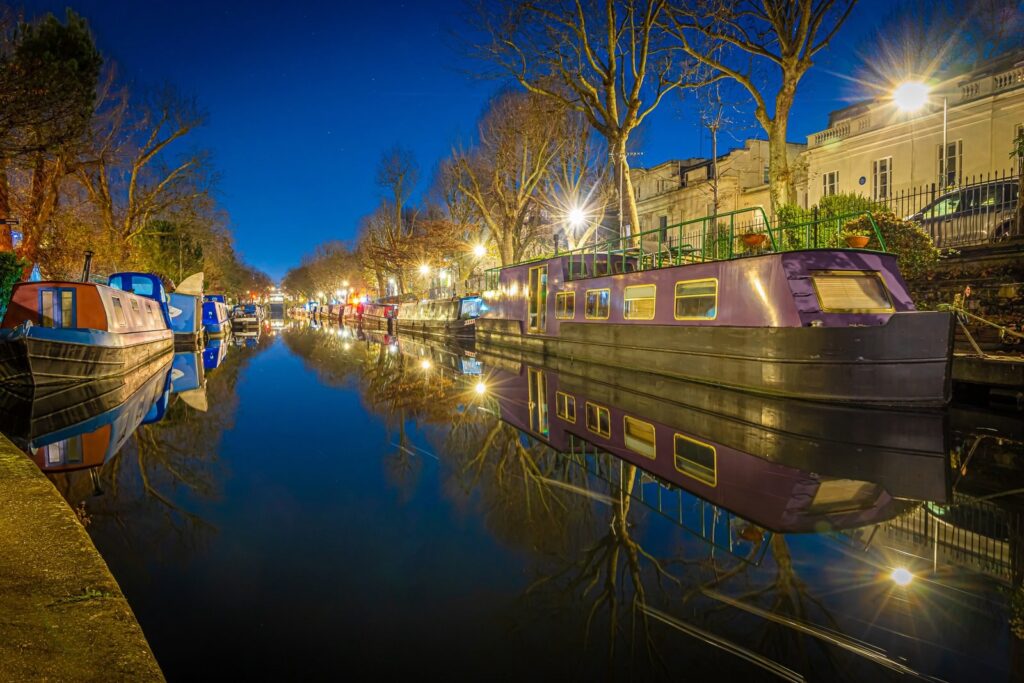
Little Venice is one of those places that makes first-time visitors stop and stare. The name sounds like an estate agent’s stretch, or a joke at London’s expense. Step onto the towpath, though, and it starts to earn its reputation.
Where Two Canals Meet
Little Venice sits at the junction of the Paddington Arm of the Grand Union Canal and the Regent’s Canal. In practical terms, this means the waterway widens into a broad, shallow pool — almost a basin — before splitting off in two directions.
Canal boats cluster here year-round. Some are weekend vessels, painted in the traditional English style: deep greens, reds, and golds, with roses and castles picked out on the wooden panels. Others are permanent homes, with window boxes, solar panels on the roof, and the general look of somewhere someone has lived comfortably for years.
The effect is one of surprising calm. You’re a short walk from one of the busiest railway stations in Britain, surrounded by some of the most expensive property in London, yet the world at water level feels entirely different. Quieter. Slower. Almost wilfully unhurried.
How the Name Came About
The neighbourhood is sometimes credited to the poet Robert Browning, who lived near the water in the 1860s and reportedly described the scene from his window as reminiscent of Venice. Whether the exact words are his is debated, but the name stuck.
Browning arrived at Warwick Crescent — a handsome street overlooking the water — after the death of his wife, Elizabeth Barrett Browning. He stayed for nearly twenty years. That part of London attracted writers and artists precisely because of its unhurried pace, its proximity to Regent’s Park, and the odd beauty of the waterway threading through the heart of the city.
The grand stucco terraces of Blomfield Road and the surrounding streets date from the early Victorian era. They were designed to attract wealthy residents who wanted the advantages of central London without the noise and grime of the centre. The canal wasn’t a drawback — it was the selling point.
What to See and Do
Most people come to walk. The towpath along the Regent’s Canal runs east from Little Venice all the way to Camden Market — a route of roughly three miles that passes under Victorian bridges, along the rear of London Zoo, and through Regent’s Park. For the full route and what to expect, the Regent’s Canal walk guide covers it well.
At the junction itself, a handful of moored boats operate as cafés and performance spaces.
The Puppet Theatre Barge
One of London’s more unusual cultural venues, this floating theatre has been producing shows for children and adults since 1982. In summer it moves to Henley-on-Thames and Richmond; in winter and spring, it returns to Little Venice. The performances are genuinely impressive — this is not novelty entertainment. Book in advance.
Café Laville
This canal-side café sits above the water on the Edgware Road side, with a terrace looking directly down the length of the canal. It’s the kind of spot that’s impossible to find on purpose and impossible to forget once you’ve stumbled across it. Arrive early — the terrace tables go quickly on any decent morning.
Jason’s Canal Boat Trips
If walking three miles to Camden sounds like more than you signed up for, Jason’s runs traditional narrowboat trips along the canal between Little Venice and Camden Market. The journey takes about an hour each way and gives you a view of the city from the water that you can’t get any other way. Booking ahead is recommended in summer.
Enjoying this? 3,000+ London lovers get stories like this every week. Subscribe free →
The Streets Above the Water
The residential streets around Little Venice reward a slow wander on foot. Blomfield Road runs directly alongside the canal, with a series of handsome Victorian houses that have private moorings at the bottom of their gardens. Clifton Villas and Randolph Avenue have some of the finest period stucco terraces in west London.
Warwick Avenue — the nearest Underground station — gives its name to a pleasant local high street with independent cafés, a good bookshop, and the general feel of a neighbourhood that hasn’t quite been discovered yet. The pace here is noticeably different from the busier parts of the city.
Head east along the towpath for twenty minutes and you’ll reach Regent’s Park. The rose garden inside the park is one of the most beautiful free spaces in London — over 12,000 roses in a setting that feels genuinely extraordinary, particularly in June.
When to Visit and How to Get There
Little Venice is served by Warwick Avenue station on the Bakerloo Line — one stop south of Paddington and about a five-minute walk to the canal junction. You can also walk along the towpath from Paddington Basin, which takes roughly ten minutes and is pleasant in its own right.
There’s no entrance fee, no ticket, and no queue. You arrive at the towpath and you walk.
The best time to visit is a weekday morning in spring or autumn. The light on the water in October is genuinely striking — golden and low, catching the reflections of the canal boats and the trees. Summer weekends bring more visitors, though the area remains calm by London standards. For a complete guide on when to visit London and what to expect each month, the month-by-month breakdown covers all the details.
Frequently Asked Questions
What is Little Venice in London?
Little Venice is a residential area in west London, near Paddington, where the Regent’s Canal meets the Paddington Arm of the Grand Union Canal. The waterway widens into a broad pool, surrounded by Victorian terraces, moored canal boats, and willow trees. It’s one of the most peaceful and photogenic spots in central London, and it costs nothing to visit.
Is Little Venice in London worth visiting?
Yes — particularly if you’re looking for a calm, genuinely beautiful part of London that most tourists miss. The canal boats, swans, waterside cafés and handsome Victorian streets make for an easy half-morning away from the usual circuit. There’s no entrance fee and it’s straightforward to reach by Tube.
How do you get to Little Venice in London?
Take the Bakerloo Line to Warwick Avenue station. It’s one stop from Paddington and about five minutes’ walk to the canal junction. From central London, the journey is around fifteen minutes. You can also walk along the towpath from Paddington Basin in roughly ten minutes.
What is the best time to visit Little Venice London?
Spring and autumn weekday mornings give the best experience — good light, fewer visitors, and the canal looking its most beautiful. Summer is pleasant but slightly busier. Winter visits have a quiet charm of their own, though the outdoor café terraces are less inviting. Avoid arriving after dark if you want to see the water at its best.
London rewards people who wander past the obvious. Little Venice is the proof of that.
The swans don’t hurry. Neither should you.
🇬🇧 25 London Places Most Visitors Miss
From secret riverside walks to hidden Victorian tunnels, centuries-old pubs to rooftop gardens with skyline views — our free guide reveals the London most visitors never discover. Join 3,000+ London lovers who get it free.
Get Your Free 25-Places Guide →📲 Know someone who’d love this? Share on WhatsApp →
Free forever · Unsubscribe anytime
Subscribe Free