
Every morning, people come to stand quietly in a London garden that feels unlike the others. It is not the biggest. It is not the most famous. But something about the white flowers, the still water, and the way the light falls makes visitors stop and linger longer than they expected.
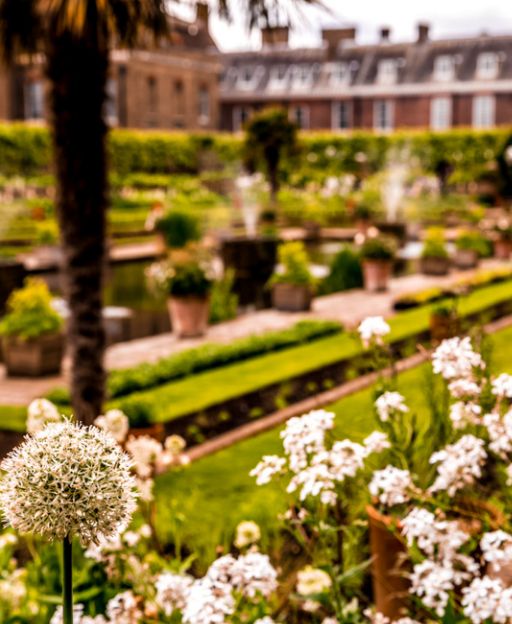
This is the Sunken Garden at Kensington Palace — and it has quietly become one of the most emotionally resonant places in the whole of London. Many visitors walk straight past it. Those who slow down rarely regret it.
A Garden That Has Stood for Over a Century
The Sunken Garden was first planted in 1909, designed in the style of Hampton Court Palace’s formal Elizabethan gardens. It sits just a few steps from the main entrance to Kensington Palace, tucked between lime trees that form a green canopy overhead in summer.
The design is formal and deliberate — a sunken rectangular pool at the centre, surrounded by neat box hedges, terracotta urns, and carefully arranged flower beds. Water lilies float on the surface of the pool. In the early morning, before the crowds arrive, the whole space has a chapel-like stillness.
For most of the 20th century, it was admired mainly by garden enthusiasts and those who happened to wander through Kensington Gardens. That changed completely in 2017.
How Princess Diana Changed This Garden Forever
To mark the 20th anniversary of Princess Diana’s death, the team at Kensington Palace made a quiet but deliberate decision. They replanted the Sunken Garden almost entirely with white flowers — the colours Diana loved most throughout her life.
White forget-me-nots. White roses. White stocks. White alliums, their globe-shaped heads rising on tall stems and catching the light. The planting scheme was not announced with fanfare. There was no press release or official ceremony. The gardeners simply changed what grew there.
The result is a garden that feels intentionally peaceful. It does not announce itself or demand your attention. But those who spend a few minutes by the pool tend to feel something settle in them — a sense of calm that is surprisingly rare in a city this busy.
The Diana Memorial Statue
In July 2021, on what would have been Princess Diana’s 60th birthday, a bronze statue was unveiled at the centre of the Sunken Garden. Her sons, Prince William and Prince Harry, attended the ceremony together — their first joint public appearance in years.
The statue was created by sculptor Ian Rank-Broadley, best known for the portrait of Queen Elizabeth II that appeared on British coins for decades. Here, he chose a very different kind of image.
Diana stands with three children pressed close around her — representing the many generations of people she connected with through her charity work and public life. Her arms are open wide. It is an unusually warm and human piece of public sculpture for a royal setting, and deliberately so.
Visitors often leave flowers at the base of the statue. Some take photographs. Many simply stand quietly for a moment before moving on. The garden absorbs all of this without feeling overwhelming or mournful.
Enjoying this? 3,000+ London lovers get stories like this every week. Subscribe free →
What to Know Before You Visit
The Sunken Garden is free to enter. You do not need a ticket to Kensington Palace to see it — it sits within the public grounds of Kensington Gardens, which are open during daylight hours every day of the year.
Kensington Palace itself charges for admission to its interior, which includes a permanent exhibition exploring Diana’s life and wardrobe, as well as rooms connected to Queen Victoria’s childhood and the early lives of William and Catherine. It is worth a visit in its own right, but the garden is the heart of the experience for many people.
Spring and early summer are the most striking times to visit, when the white flowers are in full bloom and the garden looks exactly as the gardeners intended. But the reflecting pool and the bronze statue are moving in any season. Winter visits, when the garden is bare and still, have their own particular quality.
If you are building your visit around London’s royal spaces, a well-planned 3-day London itinerary can take in Kensington Palace, Hyde Park, and several other highlights without feeling rushed. The Sunken Garden fits naturally into an afternoon walk that covers this entire part of the city.
The Orangery — Tea in a Royal Setting
Just steps from the Sunken Garden sits one of the most beautiful rooms in London for afternoon tea. The Orangery at Kensington Palace was built in 1704 for Queen Anne, designed by Nicholas Hawksmoor. It is a long, light-filled room with soaring windows, pale stone columns, and an airy calm that feels very different from the rest of the city.
The menu follows British tradition — finger sandwiches, warm scones with clotted cream and jam, miniature pastries, and a pot of tea that arrives properly brewed. Afternoon tea here is not the cheapest option in London, but the setting earns its price. Few places in the world let you take tea in a room that has served royalty for more than three centuries.
Booking ahead is strongly recommended, especially in summer and at weekends. If you visit in the afternoon after spending time in the Sunken Garden, the contrast between the outdoor stillness and the warm interior of The Orangery is worth planning for.
If formal gardens are what draws you to London, the Regent’s Park Rose Garden is another remarkable place — 12,000 roses in bloom from late May, and completely free to enter. The two gardens make a natural pair for a day of London’s finest green spaces.
The Diana Memorial Fountain — Ten Minutes Away
Many visitors combine a trip to the Sunken Garden with the Princess Diana Memorial Fountain in Hyde Park, which is a short walk south through Kensington Gardens. The fountain was designed by landscape architect Kathryn Gustafson and opened in 2004.
It is a very different kind of tribute. A wide oval ring of flowing water in polished Cornish granite, it is designed to be touched — children paddle in it during summer, families sit on its banks, people trail their hands through the water. Where the Sunken Garden is hushed and intimate, the fountain is open and welcoming. Together, they capture two sides of what Diana represented: the quiet compassion and the joyful engagement with ordinary people.
The walk between them takes you past the Albert Memorial on the south edge of Kensington Gardens — an extraordinary piece of Victorian excess dedicated to Prince Albert, Queen Victoria’s husband. Standing 54 metres tall and covered in gold leaf, it is one of the most lavish monuments in London, and entirely free to view.
St James’s Park, a short walk east, is another royal green space worth lingering in. It is home to London’s resident pelicans — a royal tradition that began in 1664 when a Russian ambassador gave the first birds as a gift to King Charles II. They are still there today.
Frequently Asked Questions
Is the Kensington Palace Sunken Garden free to visit?
Yes. The Sunken Garden sits within the free public grounds of Kensington Gardens and is open during daylight hours every day. You only need a ticket if you want to go inside Kensington Palace itself, which houses permanent royal exhibitions.
When is the best time to visit the Sunken Garden at Kensington Palace?
April through June is the most beautiful time, when the white flowers planted in Diana’s memory are in full bloom. Weekday mornings are the quietest, giving you the reflective atmosphere the garden was designed for. That said, the garden is worth visiting year-round.
How do I get to Kensington Palace from central London?
Take the Underground to High Street Kensington station on the Circle or District line, then walk north through Kensington Gardens for about ten minutes. Alternatively, Queensway station on the Central line drops you at the northern edge of the park.
Do I need a ticket to see the Princess Diana statue?
No. The Diana statue stands inside the Sunken Garden in the free public grounds of Kensington Palace. You can walk in and see it without paying admission. The statue is accessible during daylight hours throughout the year.
London’s royal gardens hold a particular kind of history — not just the grand public history of kings and queens, but the quieter stories of ordinary feeling in extraordinary places. The Sunken Garden is exactly that. Go in the morning, if you can. Stay longer than you planned.
🇬🇧 25 Hidden Gems of London Most Tourists Never Find
From secret riverside walks to hidden Victorian tunnels, centuries-old pubs to rooftop gardens with skyline views — our free guide reveals the London most visitors never discover. Join 3,000+ London lovers who get it free.
Get Your Free London Hidden Gems Guide →📲 Know someone who’d love this? Share on WhatsApp →
Love more? Join 65,000 Ireland lovers → · Join 43,000 Scotland lovers → · Join 29,000+ Italy lovers →
Free forever · Unsubscribe anytime
Subscribe Free