
Walk into Camden Market on any Saturday morning and something shifts. The air smells of street food from a dozen countries. Music thumps from a doorway. A vintage leather jacket catches your eye.
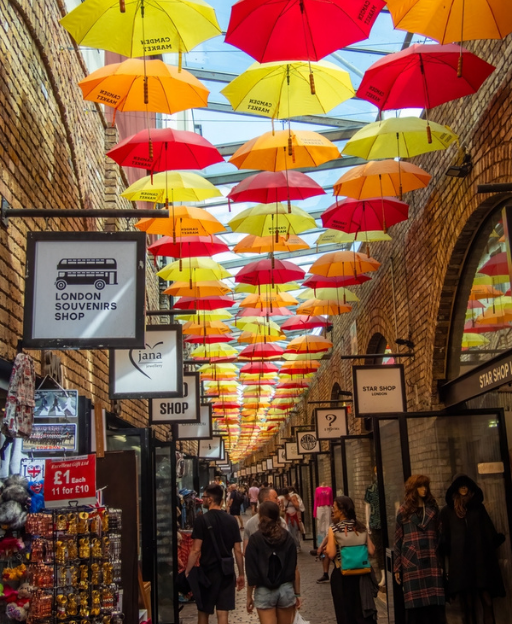
And somewhere above you, hundreds of colourful umbrellas hang suspended over a cobblestone alley, swaying slightly in the breeze. This is not the London of Buckingham Palace or Mayfair. This is the London that has always refused to behave.
The Unlikely Origins of Camden Market
Camden Market didn’t start as a market at all. In the 1850s, the site along Regent’s Canal was home to a working horse hospital — a place where London’s working animals were treated and shod between long days hauling coal and goods along the waterway.
The Victorian brick buildings that still define the Stables Market today were built to house horses, not people. Stable stalls, hay lofts and blacksmiths’ forges occupied these spaces for decades.
When the canal trade declined and the railways took over, the buildings fell into disuse. By the early 20th century, the site was a patchwork of warehouses, lock-up garages and forgotten yards. For a long time, nobody quite knew what to do with it.
That changed in 1974, when a group of small traders set up stalls around the lock on a single Sunday. It was modest — a few dozen people selling crafts and bric-a-brac. But Londoners came. And they kept coming back.
How the Punks Arrived — and Never Left
By the late 1970s, something remarkable was happening in Camden. As punk exploded out of Soho and onto the streets of Britain, Camden Lock became one of its unofficial headquarters.
The market’s combination of cheap rents, independent stalls and canal-side freedom made it the natural home for the alternative scene. Record stalls selling UK Subs and The Damned appeared next to vintage clothing traders. Doc Marten boots were piled high in shop doorways.
The Electric Ballroom on the High Street — still operating today — hosted bands that would go on to define British music. The punks gave Camden its attitude. That defiant, creative, slightly chaotic energy never really left.
Even as Camden has grown more famous and more international, it has held onto something the rest of London often loses. It still feels like a place where the rules are optional.
The Markets Within the Market
Camden today is not one market but several, each with its own character and its own crowd.
The Stables Market occupies the original Victorian horse hospital. Wander its cobblestone courts and you’ll find three floors of vintage clothing, handmade jewellery, global antiques and independent design studios. The old stable stalls are still visible if you know where to look.
Camden Lock Market sits directly on the canal and is the historic heart. This is where the original 1974 market began. Browse independent crafts, street art and food stalls, or just sit by the water and watch the narrowboats pass.
The Hawley Wharf development opened in 2019, after a catastrophic fire destroyed part of the market in 2008. Modern but still independently spirited, it added dozens of new food vendors and studio spaces to the mix.
Enjoying this? 3,000+ London lovers get stories like this every week. Subscribe free →
What to Eat at Camden Market
Camden has one of London’s most diverse street food scenes. The lock area concentrates an extraordinary variety — Japanese, Ethiopian, American, Mexican, Persian and dozens more cuisines — into a compact cobblestoned space.
On weekend mornings, independent coffee roasters set up between the vintage stalls and the smell of fresh espresso drifts through the alleys. Get there early and the crowd is manageable. By noon on a Saturday, Camden is a different place entirely.
For something uniquely Camden, look for the pie and mash stalls tucked near the canal — a nod to the East End traditions that fed working Londoners for generations. Then follow the aromas wherever they lead. You won’t go hungry.
Getting to Camden and When to Visit
Camden is on the Northern line — alight at Camden Town station and you’ll step directly onto the High Street. The market is five minutes on foot.
Weekdays before noon are quieter and easier for browsing. Weekend afternoons are busy, loud and electric — worth experiencing once, but bring patience and arrive early for the food stalls.
The Regent’s Canal Walk runs directly past the market, making it a perfect half-day combining canal-side walking with market browsing. Follow the canal west and you’ll eventually reach Little Venice, one of London’s most unexpected and peaceful neighbourhoods — a world away from the bustle you left behind.
Frequently Asked Questions About Camden Market
What is Camden Market famous for?
Camden Market is famous for its alternative culture, eclectic street food scene and mix of vintage clothing, independent traders and live music venues. It became one of London’s most distinctive areas through its strong association with punk and counterculture from the late 1970s onwards.
How long do you need to explore Camden Market?
Allow at least two to three hours to explore the main markets properly. If you plan to eat there and walk along the Regent’s Canal, a half-day is ideal. The market stays open late on weekends, particularly the Hawley Wharf section.
When is the best time to visit Camden Market in London?
Weekday mornings before midday offer a calmer experience and easier browsing. Saturday and Sunday afternoons are the most vibrant but also the most crowded. If visiting in summer, the canal-side seating fills up quickly — arrive before 11am to secure a good spot.
Is Camden Market free to enter?
Yes — entry to all sections of Camden Market is completely free. Bring cash for smaller traders, though most vendors now accept card payments.
🇬🇧 25 Hidden Gems of London Most Tourists Never Find
From secret riverside walks to hidden Victorian tunnels, centuries-old pubs to rooftop gardens with skyline views — our free guide reveals the London most visitors never discover. Join 3,000+ London lovers who get it free.
📲 Know someone who’d love this? Share on WhatsApp →
Love more? Join 65,000 Ireland lovers → · Join 43,000 Scotland lovers → · Join 29,000+ Italy lovers →
Free forever · Unsubscribe anytime

Subscribe Free