
Somewhere beneath the glass towers of the Square Mile, Roman soldiers once patrolled a wall. They built it around 200 AD to encircle their bustling port city, and much of it is still standing. The next time you visit the City of London, you are walking a street plan drawn up nearly two thousand years ago.
How the Romans Chose This Spot
The Romans did not build London by accident. When they invaded Britain in 43 AD, they needed a crossing point on the Thames — wide enough for sea trade, narrow enough to bridge. They found their spot where the river bends near what is now London Bridge.
They called it Londinium. Within a generation, it had become one of the most important cities in the western Roman Empire. By 100 AD, it had a basilica bigger than any building in Roman Britain, a bustling forum, bathhouses, an amphitheatre, and a governor’s palace. All of it built on marshland and river gravel beside the Thames.
Londinium was never simply a garrison town. It was a working capital — a port city where merchants from Gaul, Spain, and the Mediterranean traded alongside British tribespeople. The commercial energy that defines the City of London today started in those same streets, nearly two thousand years ago. The names have changed. The spirit has not.
What the Wall Was Built For
Around 190 to 225 AD, the Romans enclosed Londinium with a defensive wall. It was serious engineering — nearly three miles around, up to twenty feet high, and six feet thick at its base. The stone was ragstone, quarried in Kent and transported up the Medway and Thames by barge.
The wall was not built because London was under immediate threat. It was a statement of permanence. Rome was declaring: this city matters, this city stays. That confidence would prove misplaced — the Romans withdrew from Britain in 410 AD — but the wall they left behind outlasted almost everything else.
In many places it stood for over a thousand years after the Romans departed. Medieval builders did not tear it down; they added to it, using the Roman foundations as their base. You can still see these layers of history in the surviving sections — Roman ragstone at the bottom, then medieval flint and brick above, then later repairs on top of that. Each layer is a different era of London, compressed into a single wall. It is, in miniature, the story of the whole city.
Where to Find It Today
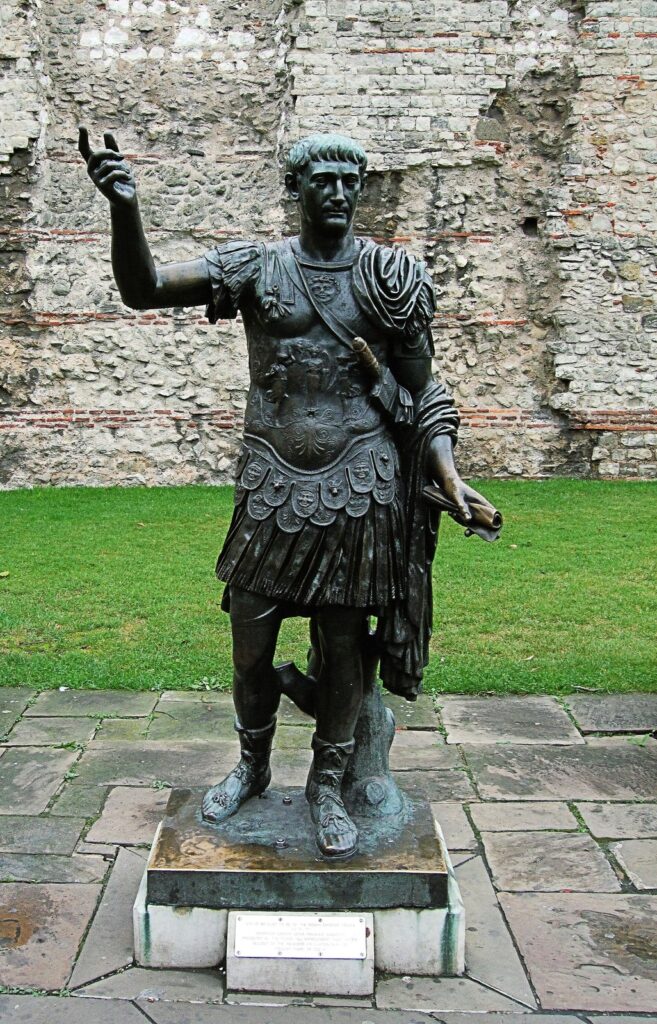
The best place to start is Tower Hill, just outside the Tower of London. A substantial section of the Roman wall stands here alongside a replica of the Trajan statue — the same emperor who presided over the empire at its greatest extent. It is one of the most evocative spots in the whole city, and it is almost always quiet.
Walk north to Cooper’s Row, where another preserved section is integrated into the basement of a modern office block. Glass and steel above; Roman foundations below. This is, in miniature, the story of the entire City of London.
Leadenhall Market sits directly above the site of the Roman basilica and forum — the administrative and commercial heart of Londinium. Walk through its Victorian iron arches today and you are standing over the spot where Roman merchants conducted their business two thousand years ago. The address has changed. The activity has not.
Enjoying this? 3,000+ London lovers get stories like this every week. Subscribe free →
The Barbican’s Hidden Ruins
The Barbican offers some of the most dramatic surviving sections. After the Second World War, when vast areas of this part of the City were cleared of bomb damage, archaeologists uncovered substantial portions of the wall that had been buried under medieval streets for centuries.
The postwar Barbican development was designed partly to preserve what they found. Today you can walk alongside exposed Roman masonry on the raised walkways and garden terraces. It sits beside the residential towers and concert halls as though it belongs there — which, of course, it does. It has been there considerably longer than anything else in the neighbourhood.
At Noble Street, near the old Museum of London, another section stands open to the elements in a small public garden. It is free, always accessible, and walked past daily by thousands of office workers who barely give it a glance. This is London’s great trick — the extraordinary rendered invisible by familiarity.
The Square Mile That Never Changed Its Shape
Here is the detail that takes a moment to absorb. The boundaries of the City of London — the famous Square Mile that forms the financial heart of the modern capital — follow almost exactly the line of the Roman and medieval wall.
The Lord Mayor of London’s authority still extends over the same ground the Romans enclosed. The streets inside that boundary still follow Roman alignments in several places. Cheapside was once the principal east-west Roman road. Cornhill sits on the highest natural point the Romans chose for their forum.
Walk from Tower Bridge towards the Barbican and you are tracing the eastern arc of the old Roman wall, whether you know it or not. London is a city that erases its own history and then leaves pieces of it lying in plain sight. The Roman wall is the finest example: still standing after two thousand years, walked past by millions, noticed by very few.
Where can I see the Roman Wall in London?
The best preserved sections are at Tower Hill beside the Tower of London, Cooper’s Row, Noble Street near the Barbican, and along the Barbican’s elevated walkways. All are free to visit and within easy walking distance of each other in the City of London.
How old is the London Wall?
The original Roman wall was built between approximately 190 and 225 AD, making it around 1,800 years old. You can clearly see the medieval additions layered on top of the Roman stonework in surviving sections at Tower Hill and the Barbican.
Is there an admission charge to see the Roman Wall?
No — all the surviving sections of the Roman Wall are free to visit and open to the public at all times. The Tower Hill section is the easiest to find, with signage and the Trajan statue marking the spot. The Barbican sections are accessible via the public walkways.
How do I plan a Roman London walking tour?
Start at Tower Hill, walk north to Cooper’s Row, then continue to the Barbican and Noble Street. Allow around two hours at a relaxed pace. Our 3-day London itinerary can help you fit this into a broader visit to the capital.
🇬🇧 25 London Places Most Visitors Miss
From secret riverside walks to hidden Victorian tunnels, centuries-old pubs to rooftop gardens with skyline views — our free guide reveals the London most visitors never discover. Join 3,000+ London lovers who get it free.
Get Your Free 25-Places Guide →📲 Know someone who’d love this? Share on WhatsApp →
Free forever · Unsubscribe anytime
Subscribe Free