
Most visitors to London spend their time looking up — at Big Ben, at the Shard, at the ornate facades of Piccadilly. But one of the city’s most remarkable journeys happens below street level, along a towpath that threads through eight miles of London that tourists rarely see.
Regent’s Canal was built in 1820 to link Paddington to the Thames at Limehouse. For decades it was a working waterway — coal, timber, and building materials hauled by horse-drawn barges through the heart of the city. Today it is one of London’s most beloved walking routes and, somehow, one of its best-kept secrets.
The Route at a Glance
The canal stretches 8.6 miles from Little Venice in the west to Limehouse Basin in the east. Most walkers tackle a section rather than the whole thing, and every section has its own personality.
The most popular stretch runs about three miles from Little Venice through Regent’s Park and down to Camden. This is easy to follow, beautiful in any season, and connects two of London’s most distinctive neighbourhoods. Beyond Camden, the towpath continues east through Islington, Hackney, and the old docklands — quieter territory that rewards those who push on.
You don’t need to plan a round trip. The canal is well-served by Tube stations at both ends and along the way, so you can walk as much or as little as you choose. Start at Warwick Avenue station for Little Venice, or finish at Camden Town, Angel, or Hackney Wick.
Little Venice: Where the Journey Begins
The starting point at Little Venice is worth a moment on its own. The canal widens here into a broad pool where three waterways meet, and the banks are lined with narrowboats in every colour — some pristine and freshly painted, others worn and lived-in and clearly someone’s home.
The Puppet Theatre Barge is moored here — a tiny floating theatre that has been staging professional puppetry performances since 1982. It seats just 55 people. There are café boats too, serving coffee and breakfast to regulars who have been coming for years.
Sit for a while and watch the boats navigate in and out of the pool. Even at this point, before you have walked a single step, it already feels like a different city.
Through Regent’s Park and Alongside the Zoo
East of Little Venice, the towpath enters a tunnel for a stretch — too low for the old horses, which had to be led over the hill while the barges were punted through by men lying on their backs, walking along the tunnel ceiling. On the other side, the canal opens out into Regent’s Park.
This is the most beautiful section of the walk. The towpath runs beneath a canopy of ancient trees, the water perfectly still on calm mornings. On one side is the park; on the other, a high wall behind which London Zoo operates. Walk quietly and you may hear the calls of exotic birds above the traffic that the trees have blocked out entirely.
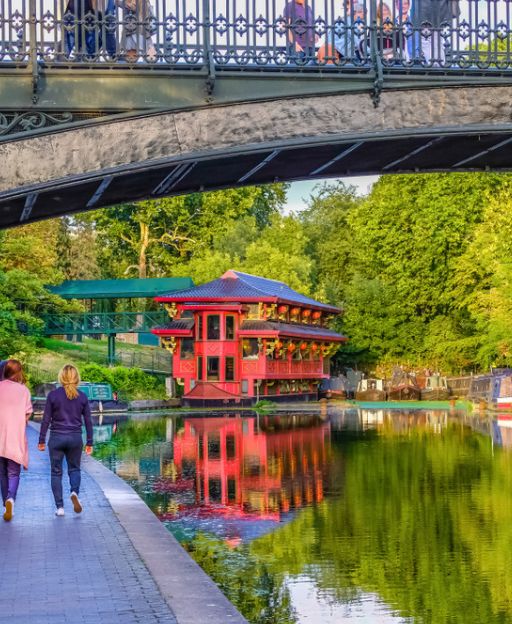
Around a bend in the canal, the Feng Shang Princess appears — a magnificent red floating Chinese restaurant moored beside an ornate iron bridge, its reflection shimmering in the water below. It has been here since 1986 and looks as if it belongs to another era entirely. It is one of those London sights you cannot quite believe is real.
Enjoying this? 3,000+ London lovers get stories like this every week. Subscribe free →
Camden: Where the Canal Built a Market
As the canal approaches Camden, the atmosphere shifts. The locks begin — Camden Lock is the most famous, a double lock where narrowboats rise and fall as tourists gather to watch from the bridges above. The market grew up around this point because the canal made it easy to bring goods directly into the city.
The market stalls press right to the water’s edge. The smell of street food drifts down to the towpath. This is where the walk becomes lively rather than peaceful — useful to know in advance if you are after solitude.
Camden is a natural turning point for many walkers. But those who press on east find something the visitors rarely see: the canal’s quieter, more personal side.
East of Camden: Islington, Hackney, and the Real Canal
Beyond Camden, the canal curves east through Islington. The Islington Tunnel — 886 metres long, built in 1820 — requires walkers to leave the towpath temporarily and rejoin it on the far side via street-level streets that have barely changed since Victorian times.
After the tunnel, the towpath continues through Haggerston and into Hackney. The narrowboats here are more bohemian — artists and musicians who have chosen to live on the water. The Broadway Market is a short walk from the towpath and one of the finest Saturday markets in London — independent traders, excellent coffee, bread that makes every supermarket loaf feel like an apology.
The canal ends at Limehouse Basin, where it meets the Thames. Standing here, watching the river traffic pass, the distance from Little Venice feels considerable — not just in miles, but in character and mood. If you’re planning to weave this walk into a broader London visit, our 3-day London itinerary shows how it fits alongside the city’s other highlights.
Frequently Asked Questions
How long does the Regent’s Canal walk take from Little Venice to Camden?
The section from Little Venice to Camden Lock is roughly three miles and takes between 45 minutes and one hour at a comfortable pace. Allow longer if you plan to stop at canal-side cafés or watch the locks at Camden.
Can you cycle along Regent’s Canal towpath in London?
Yes, the towpath is shared between walkers and cyclists for most of its length. The Hackney section is particularly popular with cyclists, and Santander Cycles docking stations are located near the canal at several points along the route.
What is the best time of year to walk Regent’s Canal?
The canal is worth walking in any season. Spring and early summer bring the trees into full leaf and the light on the water in the early morning is exceptional. Autumn adds golden colour along the Regent’s Park section. Even in winter, the narrowboats and still water create a genuinely atmospheric walk with far fewer people around.
Is it free to walk along Regent’s Canal?
Yes, the towpath is entirely free and open to the public throughout the year. There are no gates, fees, or restricted sections. The most you are likely to spend is the price of a coffee from one of the canal-side café boats, which is money well spent.
The canal does something London rarely manages: it forces you to slow down. The city is still there, just a few metres above you — but the moment you step onto the towpath, it recedes. The boats move at walking pace. The ducks ignore you completely. Whatever felt urgent before you arrived seems, just for a while, considerably less so.
🇬🇧 25 Hidden Gems of London Most Tourists Never Find
From secret riverside walks to hidden Victorian tunnels, centuries-old pubs to rooftop gardens with skyline views — our free guide reveals the London most visitors never discover. Join 3,000+ London lovers who get it free.
Get Your Free London Hidden Gems Guide →📲 Know someone who’d love this? Share on WhatsApp →
Love more? Join 65,000 Ireland lovers → · Join 43,000 Scotland lovers → · Join 29,000+ Italy lovers →
Free forever · Unsubscribe anytime
Subscribe Free