
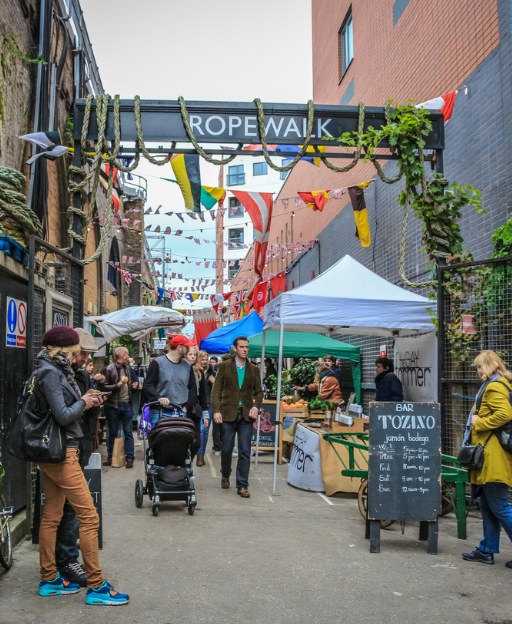
Borough Market doesn’t announce itself. There’s no grand entrance, no sweeping plaza. You turn off a side street near London Bridge, duck under the Victorian railway viaduct, and suddenly the smell hits you — roasting coffee, warm bread, something spiced and foreign and wonderful.
And just like that, you’re in one of the oldest markets on earth.
A Market Older Than the Norman Conquest
Borough Market has been trading on the south bank of the Thames since at least 1014 — and some historians trace its origins back even further, to Roman Londinium.
When William the Conqueror arrived in 1066, this market was already here. When the Black Death swept through medieval London, trading continued. When the Great Fire destroyed the city north of the river in 1666, Borough Market kept going. When the Blitz turned much of London to rubble, traders came back the next morning.
That kind of stubborn continuity means something. This place is not a convenience — it’s a necessity.
The market sits in Southwark, on the south bank just below London Bridge. For most of London’s history, Southwark was the city’s other half — rougher, freer, less governed. It’s where you came for theatre (Shakespeare’s Globe was just down the road), for the taverns, and for the food.
Borough Market has always been where London fed itself. And for a thousand years, it has never stopped.
What You’ll Actually Find Here
Today’s Borough Market runs across a compact warren of lanes and railway arches in SE1.
The covered section, built under the Victorian railway arches in the 1850s, is where the serious produce merchants set up. Whole cheeses stacked in wheels. Cured meats hanging from hooks. Bread that smells like it just came out of the oven — because it did.
Outside, the weekend market spills onto Stoney Street, Park Street, and the alleys connecting them. This is where the hot food stalls operate — the ones responsible for the smells that pull you in before you’ve even turned the corner.
The traders are not random. Many have been selling here for decades. Some are third-generation stallholders. Borough Market’s management has always been selective, which is why the quality stays consistently extraordinary.
Most people come for the produce. They stay for the atmosphere. The covered market hall, all iron pillars and arched ceilings, is beautiful even when empty. When it’s full of colour and noise and the smell of fresh food, it is one of the best places in London to simply stand and breathe.
The Producers Worth Seeking Out
The best way to understand Borough Market is not as a place to buy food — it’s a place to meet the people who make it.
Neal’s Yard Dairy
Neal’s Yard Dairy has been at Borough since the 1990s, championing British and Irish farmhouse cheese at a time when most people thought British cheese meant cheddar in plastic wrap. They age their stock in their own cellars and their staff can discuss affinage with the same depth a wine merchant talks about vintages. Ask what’s good today — you’ll leave with something you’ve never tried before.
Monmouth Coffee
Monmouth Coffee operates a small wooden cabin in the market that has become a pilgrimage site for London’s coffee obsessives. The queue is almost always long. It is almost always worth it. They roast their own beans and the standard has barely wavered in thirty years of trading.
The Anchor Bankside
A five-minute walk from the market entrance, The Anchor Bankside is a pub that’s been on this stretch of the Thames since the seventeenth century. Samuel Johnson drank here. So did Samuel Pepys. If you want to end a Borough Market visit properly, this is where to do it — a pint in the riverside garden with the Thames rolling past is one of London’s quiet pleasures.
Enjoying this? 3,000+ London lovers get stories like this every week. Subscribe free →
How to Visit Without the Crowds
Borough Market has become extremely popular. On a Saturday morning in summer, the lanes can be genuinely difficult to navigate. That doesn’t mean you shouldn’t go — it means you should go with a plan.
Wednesday and Thursday mornings are the open secret. The full market runs Wednesday through Saturday, but midweek mornings feel entirely different. The same stalls, the same quality, but with a fraction of the weekend crowds and enough space to actually talk to the producers.
Go hungry. This is not a market you walk through quickly. Allow at least two hours, eat as you go, and resist buying everything in the first five minutes. The best stalls often reveal themselves at the far end of a lane you almost didn’t bother with.
Borough Market is free to enter. No admission charge, no suggested donation, no wristband queue. You walk in and look around.
What’s Around Borough Market
The market sits in one of London’s richest corners for history.
Southwark Cathedral is immediately adjacent — so close you can smell the coffee from the nave. It’s one of the oldest churches in London and worth fifteen minutes before or after your visit. Shakespeare is commemorated inside; the building predates him by centuries.
A short walk east takes you to Shad Thames, the extraordinary stretch of Victorian riverside warehouses behind Tower Bridge. The overhead iron walkways that once connected the buildings are still there — a time capsule of nineteenth-century London that most visitors walk straight past.
For a longer South Bank day, our 3-day London itinerary shows you how to build the full experience around Borough Market, the cathedral, and the Thames riverside path.
Frequently Asked Questions
What time does Borough Market open?
Borough Market opens Wednesday and Thursday 10am–5pm, Friday 10am–6pm, and Saturday 8am–5pm. It’s closed on Sunday and Monday. Thursday and Friday lunchtimes tend to see the highest weekday footfall, so arriving at opening time is always the better move.
Where is Borough Market and how do I get there?
Borough Market is on Stoney Street, SE1, immediately south of London Bridge station. The nearest Tube stop is London Bridge on the Jubilee and Northern lines. From the station exit, the market is a two-minute walk and impossible to miss once you follow the smell of fresh bread and coffee.
What’s the best food to eat at Borough Market?
The raclette stall, fresh oysters, Gujarati vegetable curry, and anything from the cheese and bread producers are consistently excellent. The key is to arrive without a fixed plan and let the stalls guide you — the best thing you’ll eat is often something you’ve never tried before.
Is Borough Market worth visiting in the rain?
Yes — much of the market is covered by the Victorian railway arches and canopies. A rainy weekday can actually be more pleasant than a sunny Saturday, with smaller crowds and far more time to talk to the stallholders without queues forming behind you.
Borough Market has survived the Great Fire, the Blitz, property developers, and a thousand years of change. It’s still here, still feeding London, still exactly what it was always supposed to be.
If that doesn’t make it worth a detour, nothing will.
🇬🇧 25 Hidden Gems of London Most Tourists Never Find
From secret riverside walks to hidden Victorian tunnels, centuries-old pubs to rooftop gardens with skyline views — our free guide reveals the London most visitors never discover. Join 3,000+ London lovers who get it free.
Get Your Free London Hidden Gems Guide →📲 Know someone who’d love this? Share on WhatsApp →
Love more? Join 65,000 Ireland lovers → · Join 43,000 Scotland lovers → · Join 29,000+ Italy lovers →
Free forever · Unsubscribe anytime
Subscribe Free